Boutique accommodation is defined as an intimate, character-driven property of fewer than 100 rooms that prioritizes personalized service and local cultural identity over standardized convenience. That definition explains why boutique beats resort stays for travelers who want more than a pool and a buffet. 80% of travelers are willing to spend more on well-being and experiential offerings in 2026. That number tells you something important: the era of choosing a hotel purely for square footage and loyalty points is giving way to something richer. Boutique properties deliver that richness through design precision, local integration, and the kind of attentive service that a 500-room resort simply cannot replicate at scale.
Why boutique beats resort stays: design and guest experience
Boutique hotels build memory through concentrated spatial identity. Boutique hotel design relies on compression, placing guests in immediate contact with the property's character from the moment they step through the door. There is no long corridor walk past conference rooms and gift shops. You arrive, and the place already tells you a story.

Resorts work the opposite way. They unfold over large landscapes, using sequence and scale to create a sense of grandeur. That approach works beautifully for a family wanting a self-contained week of sun and activities. For a traveler who wants to feel somewhere, it often falls flat.
The advantages of boutique hotels show up most clearly in service. With fewer rooms to manage, staff know your name, your coffee preference, and which local beach is worth the drive. That level of attention is structural, not accidental. It comes directly from operating at a smaller scale.
Boutique properties also function as social and cultural hubs integrated with their neighborhoods. The restaurant sources from the farm two miles away. The art on the walls was made by a local artist. The front desk staff grew up nearby and can tell you which sunset spots the tourists miss. Resorts, by contrast, prioritize self-contained environments where guests rarely need to leave the property.
The unique boutique hotel features that matter most are not always the obvious ones. Strong interior aesthetics catch the eye, but boutique hotel quality ultimately hinges on handling basics like soundproofing and lighting effectively. A beautiful room that lets in street noise at 2 a.m. is still a bad room.
- Fewer than 100 rooms creates natural intimacy and staff accountability
- Thematic, locally curated design makes the property a part of the destination, not separate from it
- Neighborhood integration gives guests access to authentic local experiences that no resort concierge can fully replicate
- Compressed spatial design means every corner of the property is intentional and memorable
Pro Tip: Book directly with the boutique property rather than through an online travel agency. Direct bookings are often cheaper and come with better service, since the hotel keeps the full rate and has more room to take care of you.
How resorts prioritize scale, predictability, and convenience
Resorts are engineered for low-effort travel. Every amenity you might need, from the spa to the kids' club to the swim-up bar, lives on the same property. That bundling removes decision fatigue, which is genuinely valuable for certain trips. A family with young children does not want to research local restaurants every night. A couple celebrating an anniversary may want everything handled for them.
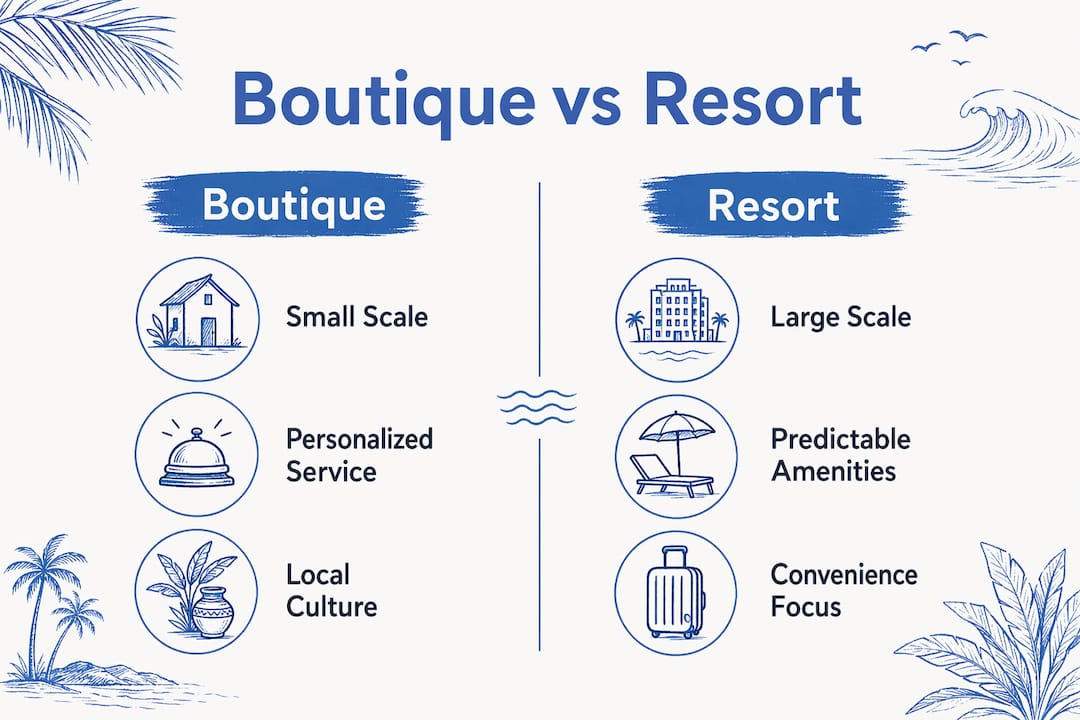
Scale also enables resources that boutique properties cannot match. A 400-room resort can staff a full-service medical clinic, multiple pools, a water sports center, and a dedicated concierge team for each floor. That operational depth is a real advantage, not just a marketing point.
The financial case for resorts is also real. Hotel loyalty programs grew 14.5% year over year by 2024, reaching 675 million members. That growth reflects genuine value. Frequent travelers accumulate points that translate into free nights, upgrades, and status benefits that compound over years of travel.
The trade-offs are worth naming clearly:
- Less local character: Resort design prioritizes consistency across properties, which means the experience in Cancun can feel similar to the experience in Bali
- Larger crowds: More guests means more noise, longer waits at the pool bar, and less personal attention from staff
- Self-contained bubble: Guests often spend an entire trip without meaningfully engaging with the local culture or community
- Standardized service: Staff manage high volumes, which limits the personalized attention that defines the boutique vs resort experience
Resorts serve travelers seeking convenience over cultural immersion. That is not a criticism. It is simply a different travel philosophy, and knowing which one fits your trip is the whole game.
Cost, loyalty programs, and booking considerations
Pricing between boutique and resort stays is more nuanced than a simple rate comparison. The channel you book through matters as much as the nightly rate itself.
63.4% of independent hotel bookings were made through online travel agencies in 2025. That statistic has a direct cost implication. Boutique hotels pay OTA commission rates of 15–25%, compared to 10–15% for large chains. Those costs often get passed to the guest through higher OTA prices. Booking directly at a boutique property cuts that markup entirely.
The loyalty program question deserves honest math. Loyalty points at major chains can yield a $7–$10 rebate per night in effective value. Over ten nights a year, that is $70–$100 in real savings or free nights. For frequent travelers, that opportunity cost is worth factoring in when choosing boutique accommodation.
Pro Tip: Weigh the loyalty math against the experience you actually want. If you travel four or more times a year and stay at the same chain, the points add up to something real. If you travel once or twice a year for a meaningful trip, the experience premium at a boutique property almost always wins.
The benefits of staying at boutique hotels show up in value beyond the rate. Personalized service, local knowledge, and a property that feels like a genuine part of its destination are not line items on a receipt, but they are real returns on your travel investment.
How to choose between boutique and resort stays
The right choice depends on what you actually want from a trip, not on which type of property sounds more appealing in theory.
| Travel scenario | Better fit |
|---|---|
| Solo or couple trip focused on local culture | Boutique stay |
| Family vacation with young children | Resort |
| Wellness-focused retreat with personalized care | Boutique stay |
| Large group trip needing consistent amenities | Resort |
| City break or cultural destination | Boutique stay |
| Beach holiday with minimal planning | Resort |
| Anniversary or milestone trip | Boutique stay |
| Business travel with loyalty program benefits | Resort or chain |
Boutique stays consciously integrate local culture, making the accommodation a narrative piece of the travel experience rather than just a place to sleep. That integration works best when you want to engage with a destination, walk its streets, eat where locals eat, and come home with stories rather than just photos.
Resorts work best when the destination itself is secondary to the experience on the property. A beach resort in Hawaii is selling you the beach, the pool, the food, and the service. The surrounding island is a backdrop, not the point. That is a perfectly valid way to vacation.
Privacy and group size also shape the decision. Boutique properties often have shared common spaces that create natural social interaction. Luxury resorts bundle convenience and amenities to minimize decision fatigue, which suits larger groups who need a single property to satisfy multiple preferences at once.
Travelers seeking authentic and immersive local experiences consistently choose boutique hotels, even when the booking process requires a bit more research. The extra effort pays off in the quality of the experience.
Key takeaways
Boutique stays deliver a more personal, culturally connected experience than resorts by combining smaller scale, local design, and direct service with the destination itself.
| Point | Details |
|---|---|
| Size drives service quality | Fewer than 100 rooms allows staff to deliver genuinely personalized attention. |
| Design tells a story | Boutique properties use compressed spatial design to create immediate, memorable character. |
| Book direct to save money | Avoid OTA commissions of 15–25% by booking directly with the boutique property. |
| Loyalty points have real value | Major chain points yield $7–$10 per night, a real cost to weigh when skipping a resort. |
| Match property type to trip purpose | Boutique stays suit cultural and experiential trips; resorts suit convenience-first vacations. |
Why I think boutique stays are worth the extra thought
I've stayed in properties across both categories, and the difference that sticks with me is not the thread count or the pool size. It's whether the place had a point of view. The best boutique stays I've experienced felt like they were made by someone who genuinely cared about the destination. The art, the food, the staff recommendations, all of it pointed outward toward the place you were actually in.
The most common misconception about boutique accommodation is that it means expensive or inconvenient. Neither is reliably true. Booking directly often brings the rate in line with or below a comparable chain property, and the service you get in return is rarely matched at scale. The friction people fear, like researching a smaller property or navigating a less polished booking system, is usually a one-time, 20-minute task.
What I tell anyone planning a meaningful trip is this: if the destination matters to you, let the place you sleep reflect that. A boutique property that is woven into its neighborhood will give you a richer experience than a self-contained resort ever can. Check the wellness amenities before you book, read the host's notes, and ask a question or two. The answers will tell you everything about whether a property is the real thing.
— Nicole
A boutique stay on the Big Island: Luanainn
If you've been thinking about why choose boutique accommodation for your next Hawaii trip, Luanainn's Luana Inn Bed & Breakfast on the Big Island is worth a long look.

Perched in the foothills of Mauna Loa and overlooking Kealakekua Bay, Luana Inn offers the kind of stay that resorts simply cannot replicate. Sunsets change every evening over the bay. Pastel sunrises come up over the mountain. The location on Napo'opo'o Road puts you close to some of the most beautiful water on the island. You can browse the rooms and amenities to see exactly what's included, or check out the vacation packages to plan your stay from start to finish. This is boutique accommodation done right, personal, peaceful, and rooted in the place itself.
FAQ
What is a boutique hotel?
A boutique hotel is a small, independently styled property with fewer than 100 rooms that emphasizes personalized service, local character, and distinctive design over standardized amenities.
Are boutique hotels more expensive than resorts?
Not necessarily. Boutique hotels often appear pricier on OTA platforms due to commission markups of 15–25%, but booking directly with the property frequently brings the rate down to or below comparable resort pricing.
Do boutique hotels have loyalty programs?
Most boutique hotels do not offer integrated loyalty programs, which means you forgo the $7–$10 per night in effective value that major chain programs provide. That trade-off is worth weighing against the quality of the experience.
When does a resort make more sense than a boutique stay?
Resorts are the better fit for families with young children, large groups, or travelers who want a fully bundled, low-planning vacation where all amenities are on one property.
What makes boutique hotel design different from resort design?
Boutique hotels use compressed spatial design, placing guests in immediate contact with the property's character from arrival. Resorts unfold over larger landscapes, using scale and sequence to create a sense of grandeur.