
Reach for breathwork when you need your body to calm down fast; reach for meditation when you're training your mind to stay steady over time. Research on both practices is genuinely promising but still mixed, with meta-analyses showing real but modest effects and plenty of study-quality caveats. The good news is you rarely have to pick just one. If either practice brings up anything concerning, the safety guidance further down covers exactly what to watch for.
TL;DR:
- Breathwork techniques like cyclic sighing and slow paced breathing can produce immediate improvements in mood and physiological arousal within minutes, especially when practiced regularly.
- Meditation primarily develops sustained attention and emotional regulation over weeks or months, with natural breath observation used as an anchor without manipulation.
- For acute stress or pre-sleep relaxation, breathwork offers faster results, while meditation is better suited for building long-term mental resilience.
- Intense breathwork protocols carry higher safety risks, including dizziness and fainting, especially if overused or performed improperly; beginners should start gently and seek professional guidance if needed.
- Combining breathwork and meditation in sequence—regulating the body first, then observing the mind—can maximize benefits while minimizing risks.
Table of Contents
- Breathwork vs Meditation: What Breathwork Actually Is
- What Meditation Trains That Breathwork Doesn't
- Breathwork vs Meditation: How Do You Choose?
- Is Breathwork Safe? What to Watch For
- A Combined Breathwork and Meditation Routine You Can Try Today
- Why Perfect Practice Matters Less Than Showing Up
- Ready for Guided Breathwork and Restorative Sessions?
- Sources
- FAQ
Breathwork vs Meditation: What Breathwork Actually Is
Breathwork means deliberately changing the rate, depth, timing, or pattern of your breathing to shift your physical and mental state. Unlike meditation, which mostly asks you to observe the breath as it naturally happens, breathwork asks you to change it on purpose.
A few technique families show up again and again in research and practice:
- Cyclic sighing — a long inhale through the nose followed by a slow, extended exhale through the mouth repeated for a few minutes.
- Box breathing — equal counts for inhale, hold, exhale, and hold, often used for pre-performance nerves.
- Coherent or slow breathing — pacing breaths around five to six per minute to encourage heart rate variability.
- Diaphragmatic (belly) breathing — deep, slow breaths that expand the abdomen rather than the chest.
- Fast or breath-retention practices — rapid breathing followed by extended holds, used in more intense breathwork traditions but carrying the highest risk profile.
The evidence here is more encouraging than most people expect for something so simple. A remote randomized controlled trial found that daily five-minute breathwork sessions, particularly exhale-focused cyclic sighing, improved mood and lowered respiratory rate more than an equivalent mindfulness meditation condition over the course of a month.
Cyclic sighing outperformed mindfulness on both mood and respiratory rate in that trial, with the difference reaching statistical significance.
That said, don't assume every breathwork protocol works, or works equally well. A 2023 meta-analysis of 12 randomized trials covering 785 adults found a small-to-medium reduction in subjective stress from breathing interventions compared with control groups, with an effect size of g = −0.35. The heterogeneity across those trials was notable, meaning some studies used very different protocols, populations, and comparison groups, which makes it hard to say breathwork "works" as a single, uniform intervention.
A well-controlled trial comparing coherent breathing against a matched placebo found no measurable benefit beyond placebo for some mental health outcomes. That single study is a useful reality check: breathwork isn't magic, and some techniques studied under rigorous conditions simply don't beat a convincing sham comparison.
In practice, most trial protocols run sessions of short duration, typically a few minutes daily, which lines up with how breathwork tends to get used in real life: as a short, targeted reset rather than a long sit.
What Meditation Trains That Breathwork Doesn't
Meditation trains attention and awareness, most often by having you observe the breath, body sensations, or thoughts without trying to change them, as explained in this clinical perspective on mindfulness in therapy. That's the core distinction from breathwork: meditation doesn't manipulate the breath so much as use it as an anchor for attention.
Several styles dominate both research and everyday practice:
- Focused attention meditation — repeatedly returning attention to a single anchor, usually the breath.
- Open monitoring meditation — observing whatever arises in awareness without fixing on one object.
- Loving-kindness meditation — directing warm, compassionate intention toward yourself and others.
- Breathing-focused meditation — a hybrid that uses natural breath sensation as the primary object of attention, distinct from breathwork because nothing about the breath itself is altered.
NHS guidance on meditation for beginners frames the whole practice around attention training rather than relaxation. There's no required session length, though the guidance offers 20 minutes as a useful reference point once you're past the beginner stage. What matters more than duration is what happens when your mind wanders, which it will, repeatedly, every single session.
That wandering-and-returning cycle is the practice, not a failure of it. Every time you notice your mind drifted and gently bring attention back, you're doing the actual training. This is worth sitting with, because most beginners assume meditation isn't "working" until their mind goes quiet, when the entire mechanism runs on the opposite premise: notice, return, repeat.

Pro Tip: Track sessions completed, not minutes of stillness achieved. Consistency, not depth of calm, is what builds the skill over time.
For beginners, start with five minutes of focused attention on the breath, seated somewhere supported and comfortable. Expect distraction. Return attention without judging yourself for wandering. Build toward longer or more frequent sessions only once the short ones feel manageable.
Breathwork vs Meditation: How Do You Choose?
The decision boils down to one question: do you need your nervous system to change state right now, or are you building a long-term skill? Breathwork is the tool for state change. Meditation is the tool for skill development. Neither is "better" in the abstract; each solves a different problem.
Here's how that maps onto common goals:
- Acute stress or a racing mind before a stressful event → breathwork, especially cyclic sighing or slow-paced breathing.
- Panic or activation spikes → breathwork first to lower physiological arousal, meditation once you're calmer if you want to build longer-term regulation.
- Winding down before sleep → slow diaphragmatic breathing, which requires no attention training and works within minutes.
- Building sustained focus or attention control → meditation, practiced regularly over weeks and months.
- Long-term resilience to stress → a combination, with meditation as the backbone and breathwork as a situational tool.
The comparison of breathwork and meditation gets clearer when you line up what each one changes and how fast:
| Factor | Breathwork | Meditation |
|---|---|---|
| Immediate effect | Rapid shift in mood and physiological arousal within minutes | Minimal immediate state change; effects build over sessions |
| Skill developed | Limited, mostly technique familiarity | Attention control and emotional regulation, built over time |
| Typical session length | 5 to 10 minutes | 5 to 20 minutes, no strict requirement |
| Best suited for | Acute stress reset, pre-sleep wind-down, activation spikes | Long-term attention training, sustained resilience |
| Safety profile | Higher variability; intense protocols carry real risk | Generally low risk for standard seated practice |
The research backs this split. The cyclic sighing trial showed breathwork outperforming mindfulness specifically on mood and respiratory rate within a single month, exactly the kind of fast, measurable state change breathwork is designed for. Meanwhile, the broader meta-analysis of breathing interventions found effects that were real but modest, and inconsistent enough across studies that no one should expect breathwork to replace sustained attention training.
The trade-offs worth weighing before you commit to one:
- Breathwork delivers faster results but has a steeper risk profile with intense variants.
- Meditation has a gentler learning curve but takes longer to show measurable benefit.
- Breathwork needs less frequent practice to feel useful; meditation rewards daily consistency.
- Combining both covers more situations than either practice alone.
Is Breathwork Safe? What to Watch For
Most gentle breathwork is safe for healthy adults, but a few practices and situations call for real caution. Certain protocols push your body harder than people expect from something as ordinary as breathing.
- Avoid forceful hyperventilation and prolonged breath-holding, especially in water, while driving, or standing without support. These are the exact practices behind viral "breathing challenges."
- Watch for red-flag symptoms: chest pain, fainting, severe dizziness, or unexplained breathlessness during or after a session mean stop immediately.
- Check with a clinician first if you have COPD, asthma, a seizure disorder, are pregnant, or have a history of panic attacks.
- Practice seated or supported, and only attempt a technique when your breathing is already comfortable, never during an episode of breathlessness.
The American Lung Association specifically warns against social-media breathing challenges involving hyperventilation or extended breath-holds, since these can cause fainting and other harm. Their broader guidance recommends learning belly or pursed-lip breathing only when breathing feels comfortable, starting with five to ten minutes, and never using intense new techniques as a first response to feeling breathless.
A Combined Breathwork and Meditation Routine You Can Try Today
The most practical approach borrows from both practices in sequence: regulate your body first, then observe your mind.
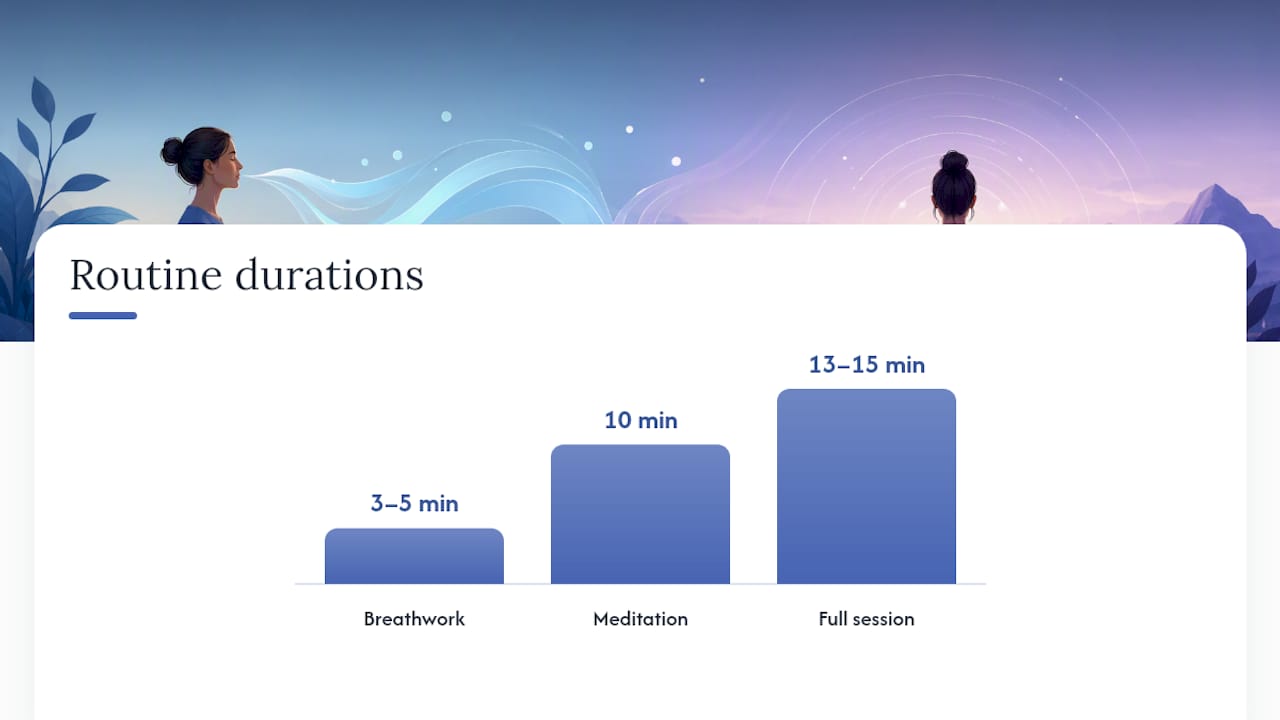
- Spend 3 to 5 minutes on gentle extended-exhale breathing — inhale through your nose, exhale slowly and longer through your mouth, seated and supported.
- Let your breathing return to normal without forcing anything.
- Shift into 10 minutes of focused-attention meditation, using the natural breath as your anchor.
- Stop immediately if you feel dizzy, and skip straight to meditation alone if breathwork doesn't feel right that day.
Regulating first makes stillness far more approachable, since a body still running hot from stress rarely settles into meditation easily. This lines up with the American Lung Association's own sequencing advice around practicing breathing techniques only when comfortable and building up gradually.
Pro Tip: Try the sequence three times in one week before judging whether it works for you. One session tells you almost nothing; a short pattern tells you a lot.
Start with three sessions a week rather than daily, and track how you feel afterward in a single word or two. Small, honest notes over two weeks reveal more than trying to remember how session one felt.
Why Perfect Practice Matters Less Than Showing Up
Most people quit breathwork or meditation not because it doesn't work, but because they expect too much from session one. Start with micro-sessions, two minutes of breathwork or five of meditation, and stack them onto something you already do, like right after brushing your teeth. A simple checkmark on a calendar beats any app for tracking honesty.
If symptoms persist, or you're curious about structured breathwork training beyond the basics, working with a guided practitioner is worth it. Retreat settings like guided meditation sessions offer that structure without the guesswork of going it alone.
— Nicole
Ready for Guided Breathwork and Restorative Sessions?
If you've read this far wondering whether you're doing any of this right, that's exactly what guided instruction solves. Wellness retreats can include Reichian Breathwork alongside a variety of restorative services, such as massage, craniosacral therapy, and naturopathic consultations, offered at eco-friendly properties near Kealakekua Bay in Captain Cook, Hawaii.

Rather than piecing together a routine from articles alone, you can work directly with a practitioner who adjusts pacing and technique to how your body actually responds that day. The spa menu for some wellness retreats includes Reichian Breathwork and complementary options like a Naturopathic Doctor's Consultation for those seeking a broader wellness check before starting intensive practices. For a longer reset, the wellness packages pair breathwork and rest across several days rather than a single session. Check availability and book a session directly through the spa page whenever you're ready to try guided breathwork in person.
This article is general information, not a substitute for advice from a qualified doctor. Consult a qualified healthcare professional about your own circumstances before acting on anything here.
Sources
- Brief structured respiration practices enhance mood and reduce physiological arousal
- Effect of breathwork on stress and mental health: A meta-analysis of randomised-controlled trials
- How to meditate for beginners - Mental wellbeing tips - Every Mind Matters
- Randomized controlled trial of coherent breathing vs matched placebo
FAQ
Why Do People Scream During Breathwork?
Some intense breathwork styles, particularly rapid or retention-based protocols, can trigger strong emotional release as physiological arousal builds quickly. This isn't universal or expected in gentler forms like cyclic sighing or diaphragmatic breathing, which is part of why choosing the right technique for your goal matters.
What Are the Potential Downsides of Breathwork?
Intense protocols carry real risk, including dizziness, fainting, and in rare cases loss of consciousness from hyperventilation or prolonged breath-holding, as the American Lung Association warns. Even gentler techniques show mixed results in controlled trials, so expectations should stay realistic.
What Happens When You Do Breathwork Every Day?
Daily practice, even just five minutes, has been linked to improved mood and lower respiratory rate in a month-long trial of cyclic sighing. Results vary by technique and individual, and consistency matters more than intensity.
Who Should Not Do Breathwork?
People with COPD, asthma, seizure disorders, a history of panic attacks, or who are pregnant should check with a clinician before trying breathwork, especially anything beyond gentle, slow-paced techniques. Anyone experiencing chest pain, severe dizziness, or unexplained breathlessness should stop immediately and seek medical guidance.