
Neither guided nor self-directed meditation wins outright. Pick guided when you need support tonight, whether that's easing into sleep, calming pre-flight nerves, or simply learning the basics; pick silent practice when your goal is long-term independence and deeper attention training. Most people who stick with meditation eventually use both formats, leaning on guided sessions as scaffolding while silent sits do the heavier lifting over time.
TL;DR:
- Guided meditation is ideal for beginners, stress relief, and sleep support, but can lead to dependency and recurring costs over time.
- Silent meditation builds long-term focus and independence, requiring patience with initial discomfort and regular practice to develop self-monitoring skills.
- Transitioning from guided to silent practice can be done gradually over four weeks, starting with short guided sessions and increasing silent periods progressively.
- For immediate needs like anxiety or travel, guided sessions provide reliable support, especially when environmental noise or mental restlessness is high.
- Both formats complement each other, and combining guided and silent practices fosters sustainable meditation habits and flexibility.
Table of Contents
- Guided vs Self Meditation: A Quick Comparison
- How Guided Meditation Works (and Where It Falls Short)
- What to Expect From Self-Directed Meditation
- A 4-Week Plan for Moving From Guided to Silent
- A Simple Way to Choose Right Now
- A Wellness Perspective on Blending Both Practices
- Where This Guidance Comes From
- Why This Debate Misses the Point
- Sources
Guided vs Self Meditation: A Quick Comparison
The fastest way to see the guided vs self meditation divide is side by side. Guided sessions work through a recorded or live voice; self-directed (also called silent or unguided) meditation relies on an internal anchor like breath or body sensation, with no narration at all.
| Factor | Guided Meditation | Self-Directed Meditation |
|---|---|---|
| Ease for beginners | High, minimal decisions | Lower, requires more self-monitoring |
| Structure/support | Built-in pacing and instruction | None, structure comes from you |
| Best use cases | Sleep, stress relief, learning | Deep focus, portability, long-term training |
| Dependency risk | Can create reliance on a voice | Low, builds independence |
| Cost/accessibility | Often subscription-based | Free, needs only a timer |
Our minds wander during roughly 47 percent of waking hours, according to the well-known Killingsworth and Gilbert research on mind-wandering. That's exactly why a guiding voice feels like relief for so many beginners. It fills the gap where the mind would otherwise drift, at least until you've trained the muscle to do that on your own.
If you're choosing tonight, match the tool to the moment: guided for support, silent for the skill you're trying to build.
How Guided Meditation Works (and Where It Falls Short)
Guided meditation means a teacher, either live or through a recorded voice, walks you through the whole session. You follow instructions instead of generating them yourself, whether that's a body scan cue by cue or a breathing pattern counted out loud. This external structure is why guided sessions tend to dominate app libraries and workplace programs: predictable start, predictable finish, minimal guesswork.
The upside is real. A guided track reduces decision fatigue since you're not wondering "am I doing this right?" every thirty seconds. It's particularly effective for sleep, where progressive relaxation and yoga nidra style tracks use external pacing to ease the transition into rest. Stress relief works the same way. A calm voice giving you something concrete to focus on interrupts a racing mind faster than sitting in silence trying to will yourself calm.
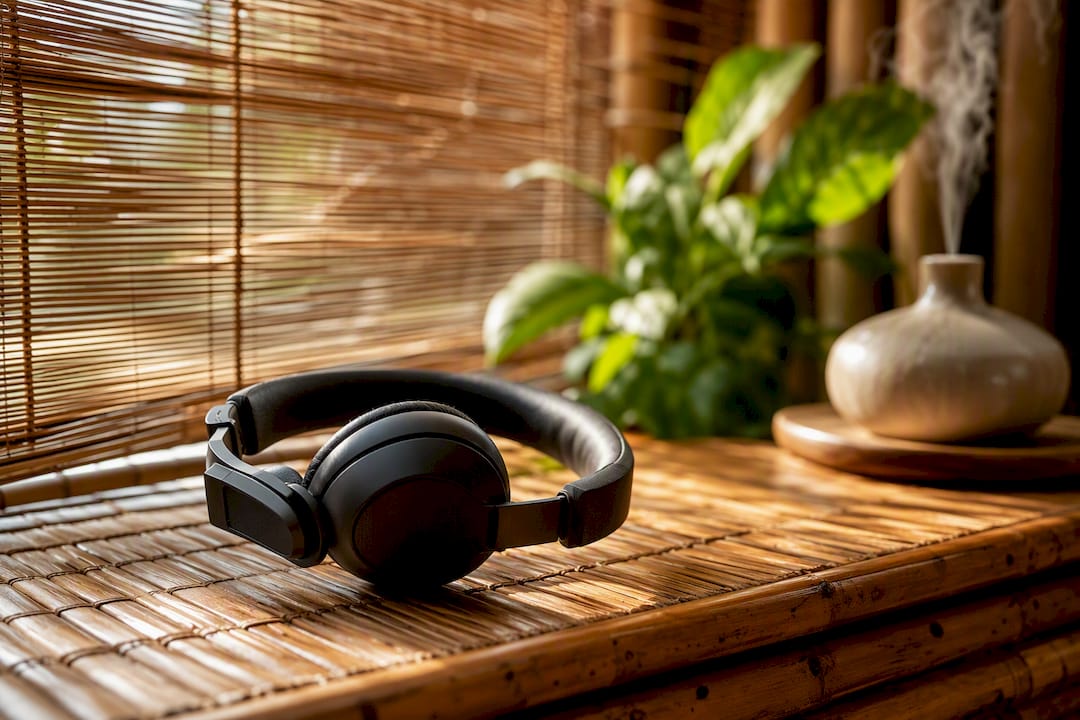
The limits show up over time. Some meditators lean on the voice so heavily that sitting without one feels impossible, which is the dependency trap. Others find a particular narrator's tone grating after a few weeks (voice intrusion is a real, underdiscussed friction point), and app subscriptions add a recurring cost just to keep practicing.
A few ways to sidestep those pitfalls:
- Rotate between two or three different guided voices so you don't over-attach to one style.
- Choose sessions in the 5 to 15 minute range for daily use, saving longer 30 minute tracks for deep sleep or weekend resets.
- Try trimming the last minute of narration yourself once you know the sequence, letting silence take over early.
- Favor body scan or breath-focused formats over heavily scripted visualization if your goal is eventual independence.
- Skip sessions with excessive music or sound effects if voice intrusion bothers you.
Pro Tip: End every guided session with one to three minutes of silence before you open your eyes. It's a small habit, but it's the single most effective bridge toward comfortable silent practice.
What to Expect From Self-Directed Meditation
Self-directed meditation, sometimes called silent or unguided practice, drops the narrator entirely. You choose an internal anchor, your breath, body sensations, ambient sound, or a repeated word, and return to it whenever your attention drifts. There's no one telling you when to notice tension in your shoulders or when the session ends. You decide.

The payoff is independence. Once you can sit without a voice, you can meditate anywhere: an airport gate, a hotel room, a park bench between meetings. Over months, silent sits also train a subtler skill than guided practice can: noticing you've drifted before someone reminds you to. That self-monitoring is the whole point of the exercise, and it only develops without a running commentary telling you what to feel next.
The early sessions are rarely pleasant. Your mind wanders constantly, environmental noise feels louder than it should, and two minutes can feel like twenty. This is normal, not a sign you're doing it wrong.
A gentler way in:
- Start with 1 to 5 minute sits rather than forcing a full 20 minutes on day one.
- Pick a single anchor (just the breath, or just the feeling of feet on the floor) and stay with only that for the entire sit.
- Set a phone timer with a soft bell at the start and end so you're not clock watching.
- Add light ambient sound (rain, ocean waves) if total silence feels too stark at first, since scaffolding with timers and soundscapes still counts as self-directed practice.
- Expect drift. Notice it, return to your anchor, and count that return as the actual practice, not a failure of it.
A 4-Week Plan for Moving From Guided to Silent
You don't need to choose one format forever. A short, structured transition turns the guided vs self meditation question into a simple habit shift, not an all-or-nothing decision.
- Week 1: Do a 10 minute guided session daily, adding 1 minute of silence at the end.
- Week 2: Cut the guided portion to 7 minutes, extend the closing silence to 3 minutes.
- Week 3: Use guided only for the first 3 minutes as a warmup, then sit silently for 7.
- Week 4: Try a fully silent 10 minute sit, keeping a guided track on standby for restless days.
| Week | Guided Time | Silent Time | Focus |
|---|---|---|---|
| 1 | 10 min | 1 min | Build the habit |
| 2 | 7 min | 3 min | Shift the ratio |
| 3 | 3 min | 7 min | Silent becomes primary |
| 4 | 1 to 3 min | 10 min | Full independence, guided as backup |
On busy days, skip the full sit and try a 1 to 3 minute silent add-on right after brushing your teeth or before a meeting starts, following expert time management tips for investors that emphasize short, effective routines. Timers, interval bells, and a single body-scan anchor are the only tools this plan requires. If you notice you're avoiding silence entirely by week three, that's the signal to slow down rather than skip ahead. Consistent short sessions beat occasional long ones for building this kind of independence.
A Simple Way to Choose Right Now
Run through five quick questions before you sit down: What's your goal tonight (sleep, focus, stress relief)? What's your environment (quiet room, noisy travel, shared space)? How experienced are you? Does a voice help or distract you? How much time do you actually have?
A few common scenarios make the choice concrete:
- Bedtime: Guided body scan or yoga nidra, since external pacing eases the transition into sleep better than silence for most beginners.
- Workplace break: A short 3 to 5 minute guided session gives you a predictable start and stop between meetings.
- Travel: Either format works, but download guided tracks in advance since airport wifi is unreliable.
- Acute anxiety spike: Guided, every time. This is not the moment to practice independence.
Watch for one red flag: if you feel anxious or incapable at the thought of sitting without a voice, that's dependency, not preference. The fix isn't quitting guided meditation. It's shrinking the silent portion back down to one minute and rebuilding from there.
Pro Tip: Keep one guided track saved offline for emergencies (a bad flight, a rough night) even after you've moved mostly to silent practice. Independence doesn't mean never reaching for support again.
A Wellness Perspective on Blending Both Practices
Guests who come through Luana inn for a wellness stay often arrive assuming they have to pick a lane, guided or silent, and stick with it. That's not how it plays out in practice, and it's not how we frame it onsite. A typical morning might open with a short guided breath session to settle travel fatigue, followed by a silent mid-day sit of just a few minutes between spa treatments or a soak in the hot tub. Evenings tend to close with a guided sleep-focused body scan, since a full day of hiking or exploring Kealakekua Bay leaves most guests wanting pacing, not another decision to make.
What we've noticed is that the property itself does some of the scaffolding that a voice or timer would otherwise provide. Ocean sound, mountain air, and a quiet room replace some of the structure guided tracks exist to supply. If you're planning a stay built around rest and reset, our vacation packages include time built in for exactly this kind of low-pressure practice, guided when you want it, silent when you're ready for it.
Where This Guidance Comes From
- Mindful's guide on guided vs. silent meditation covers when each format serves specific goals like sleep and stress.
- Meditation Authority's comparison explains the mind-wandering research behind why guided voices help beginners.
- The Mindfulness App's breakdown compares cost, flexibility, and dependency risk in more depth.
- Meditations offers starter sit lengths and scaffolding ideas for silent practice.
Why This Debate Misses the Point
Most articles on guided vs self meditation treat it like a personality test, as if you're either a "guided person" or a "silent person" for life. That framing doesn't hold up against how people actually practice. The real skill isn't picking a side. It's recognizing which tool your nervous system needs on a given day and having both available.
What gets underestimated is how much dependency sneaks in without anyone noticing. You don't wake up one day unable to meditate without a voice. It happens one convenient session at a time, until silence itself starts to feel like the hard version of meditation instead of just a different version. The fix isn't abstinence from guided tracks. It's the deliberate, almost boring discipline of tacking on an extra minute of silence, week after week, until your own attention becomes the anchor instead of someone else's voice.
If there's one thing worth pushing back on, it's the idea that self-directed practice is the "advanced" tier you graduate into. Plenty of experienced meditators still open with a guided track most days, not because they can't sit in silence, but because pairing both formats keeps the practice sustainable instead of turning it into another thing to white-knuckle through.
— Nicole
Sources
- Guided vs. Silent Meditation: Which to Try and When | Mindful
- Guided vs Unguided Meditation: Which Approach Is Right for You | Meditation Authority
- Guided vs Self-Directed Meditation: Which Works? | The Mindfulness App
- Meditations