A typical infrared sauna draws between 1,200 and 3,000 watts and burns roughly 1 to 3 kWh per session. At the U.S. residential average electricity price, that works out to somewhere between $0.15 and $0.75 a session, or roughly $5 to $16 a month with regular use. That's a fraction of what a traditional electric sauna costs to run.
TL;DR:
- Infrared sauna energy costs range from about $0.15 to $0.75 per session, depending on size, insulation, location, and usage habits.
- Larger cabins with full-spectrum emitters can draw up to 4.5 kW, increasing operational costs, especially with frequent use or poor insulation.
- Shorter preheat times, back-to-back sessions, and scheduling outside peak hours can significantly reduce electricity expenses.
- Comparing infrared to traditional saunas reveals energy savings of 60 to 80 percent, mainly due to radiant heating that avoids heating entire air volume.
- Occasional users benefit more from visiting a wellness center than owning a sauna, especially if they only plan brief, infrequent sessions.
Table of Contents
- What Is Typical Infrared Sauna Energy Use By Size and Type?
- How Do You Calculate Your Sauna's Energy Use and Cost?
- How Does Infrared Sauna Energy Use Compare to Traditional Saunas?
- What Factors Change Real-World Infrared Sauna Power Consumption?
- Three Worked Examples of Infrared Sauna Electricity Cost
- How Do You Measure Your Actual Sauna Electricity Usage?
- Simple Ways to Lower Your Infrared Sauna Electricity Cost
- When Does Visiting Beat Buying?
- A Wellness Retreat Alternative to Buying Your Own Unit
- Sources
- FAQ
What Is Typical Infrared Sauna Energy Use By Size and Type?
Power draw scales with cabin size and heater type, and the spread is wide enough that "how much does an infrared sauna use" really depends on which unit you're picturing. A portable, tent-style unit sips power. A full-spectrum four-person cabin behaves more like a small space heater running for an hour.
Here's how the typical wattage bands break down and what they translate to in kWh for a standard 30- to 45-minute session:
- Portable/1-person tent units: 500–1,200 watts, heat up in 5–10 minutes
- 1-person cabin units: 1,400–1,600 watts, heat up in 10–15 minutes
- 2-person mid-range cabins: 1,600–2,500 watts, heat up in 15–20 minutes
- 3–4 person full-spectrum cabins: 2,500–4,500 watts, heat up in 15–25 minutes
The conversion is simple: watts divided by 1,000 gives you kilowatts, and kilowatts multiplied by hours of use gives you kilowatt-hours, the unit your utility actually bills you for.
How Do You Calculate Your Sauna's Energy Use and Cost?
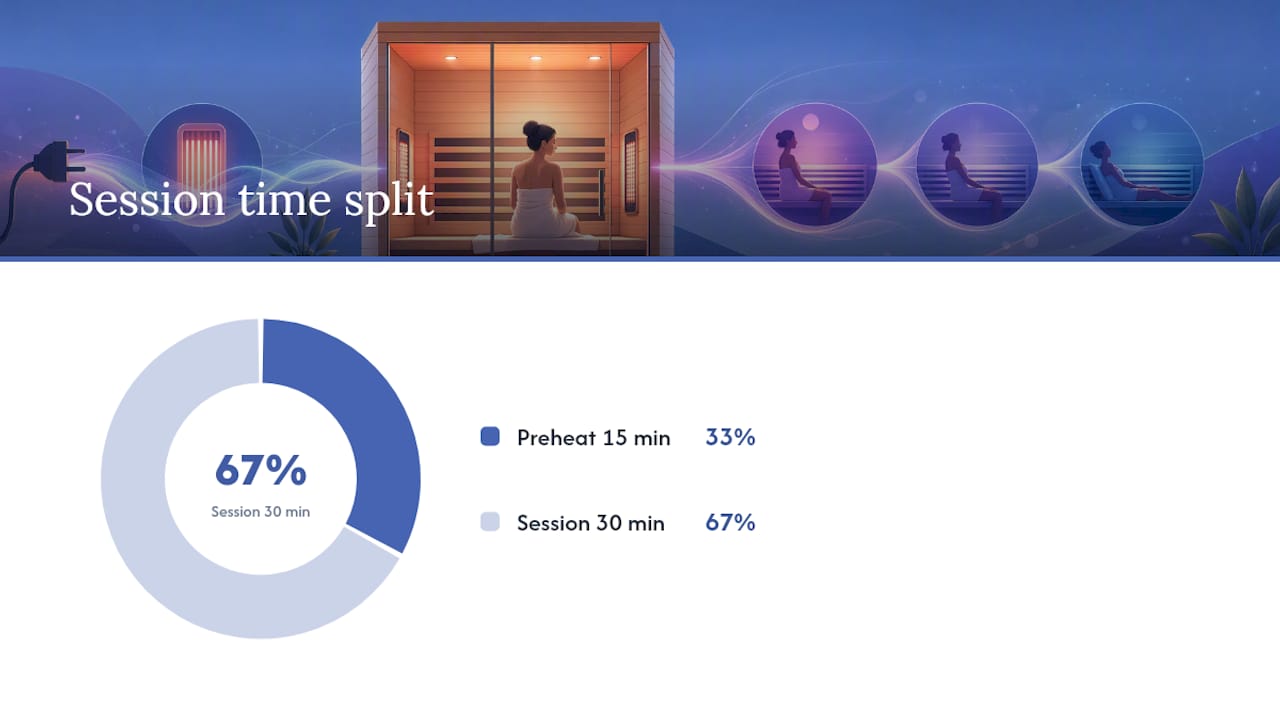
The formula is one you can do on a phone calculator: kWh = (watts ÷ 1,000) × hours used. The trick isn't the math, it's remembering that a sauna almost never runs at full rated wattage the entire time. Thermostat cycling kicks the heater on and off once your cabin hits target temperature, so measured consumption usually runs lower than the "worst case" number you'd get by assuming full power for the whole session.
Here's how to work it out for your own setup:
- Add preheat time to session time to get total minutes the unit draws power.
- Convert minutes to hours (divide by 60).
- Multiply hours by rated kilowatts to estimate kWh.
- Multiply kWh by your utility's marginal rate per kWh.
Quick math: A 1,750 watt cabin run for a 15-minute preheat plus a 30-minute session (45 minutes total) uses about 1.31 kWh. At $0.16/kWh that's roughly $0.21. At $0.30/kWh, closer to $0.39. The math is the same. Only the rate changes.
How Does Infrared Sauna Energy Use Compare to Traditional Saunas?
The gap between infrared and traditional electric saunas isn't subtle. A traditional electric sauna heater commonly draws 6 to 9 kilowatts and needs 30 to 60 minutes to preheat a room full of air to 150 to 195 degrees Fahrenheit. Infrared units heat your body directly with radiant panels, so the cabin air stays much cooler and the heater rarely exceeds 3 kW.
Running the numbers on identical usage patterns tells the story:
- A traditional sauna session (preheat plus 30 minutes) can use 5 to 8 kWh, versus 1 to 3 kWh for infrared.
- That's often a 60 to 80% reduction in energy use for a comparable session.
- Most of the savings come from preheat time alone, since radiant heating warms occupants directly instead of heating a whole room of air first.
For anyone comparing operating costs before buying, that preheat difference is the single biggest line item.
What Factors Change Real-World Infrared Sauna Power Consumption?
Two identical sauna models can post very different electric bills depending on where and how they're installed. Location matters: an outdoor unit in a cold climate fights ambient temperature loss and cycles its heater more often than the same cabin sitting in a heated garage or basement. Insulation quality inside the cabin walls has a similar effect, since a poorly sealed unit bleeds heat and forces longer run times to hold temperature.
Spectrum type matters too. Full-spectrum units add near and mid-infrared emitters on top of far-infrared, which pushes wattage higher, often into the 2.5 to 4.5 kW range for larger cabins, compared with far-infrared-only units in the 1.4 to 2 kW band.
- Longer preheat times directly add kWh before you even start your session.
- Frequent short sessions with a cold start each time cost more than back-to-back sessions that share one preheat.
- Time-of-use and tiered utility rate plans can shift the same kWh from a few cents to nearly double, depending on when you run the sauna.
Pro Tip: Check your utility bill for your marginal rate, the price of your next kWh, not your average blended rate. On tiered plans, that marginal rate can be significantly higher than the number advertised on your utility's rate sheet.
Three Worked Examples of Infrared Sauna Electricity Cost
Numbers land better with real scenarios attached. Here are three common setups, using low ($0.12), average ($0.17), and high ($0.30) per kWh rates to reflect the range the EIA's residential price tables show across states.
Scenario A: Portable 1-person unit, 900 watts, 10-minute preheat plus 25-minute session, used 4 times a week. Scenario B: 2-person mid-range cabin, 2,000 watts, 15-minute preheat plus 35-minute session, used 3 times a week. Scenario C: 3–4 person full-spectrum cabin, 3,500 watts, 20-minute preheat plus 40-minute session, used 5 times a week.
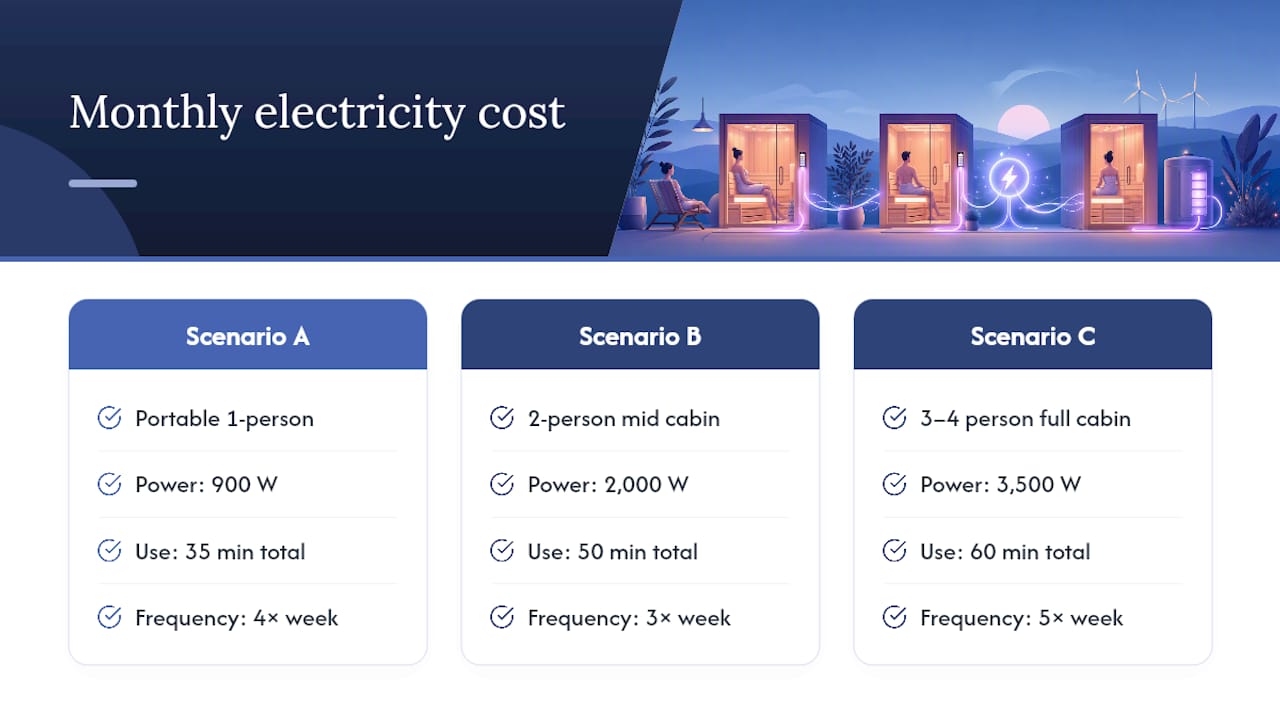
Scenario A barely registers on a monthly bill. Scenario C, run daily-ish by a heavy user, starts to look like a real appliance load, comparable to running a window AC unit part-time. That gap is worth sitting with before you buy a bigger cabin than you'll actually use.
How Do You Measure Your Actual Sauna Electricity Usage?
Estimates get you close. A meter gets you exact. Here's how to check real consumption once your unit is installed:
- Buy a plug-in kWh monitor (widely available for $20 to $30) and plug the sauna directly into it, or use a breaker-panel submeter if the unit is hardwired.
- Record preheat minutes and session minutes separately for at least three to five sessions to average out thermostat cycling variation.
- Note the kWh reading at the end of each full cycle rather than estimating from wattage alone.
- Pull your marginal all-in rate from your latest utility bill, not the advertised base rate, since delivery charges and time-of-use pricing both affect what you actually pay per kWh.
Multiply your measured average kWh by that marginal rate, and you'll have a number that beats any spec-sheet estimate.
Simple Ways to Lower Your Infrared Sauna Electricity Cost
Cost isn't fixed once you own the unit. Small habits change the bill more than people expect.
Quick wins cost nothing: shorten preheat to the minimum your model needs, stack sessions back-to-back so you're not repeating a cold start, and schedule use outside peak utility hours if you're on a time-of-use plan.
Medium-effort upgrades pay off over months: add insulation around an outdoor or garage installation, install a smart timer so preheat starts right before you're ready, and dial thermostat settings down a few degrees since infrared doesn't need traditional-sauna heat levels to work.
- Shorter preheat and stacked sessions
- Off-peak scheduling on tiered plans
- Better cabin insulation and sealing
- Smart timers instead of manual "run and forget" habits
Pro Tip: If you're shopping for a unit, size it to your actual household use. A 4-person cabin run by one person several times a week almost always costs more to operate than a right-sized 1 or 2-person unit used the same amount.
When Does Visiting Beat Buying?
Buying a sauna only pays off if you'll use it often enough to justify the upfront cost and the ongoing kWh. For occasional users, travelers, or anyone still testing whether infrared heat delivers real benefits for them, visiting a facility carries none of that risk.
Athletes get real value from short, targeted sessions after training, and travelers often use a pre-bed session to ease jet lag. Both use cases need a sauna a handful of times, not daily access, which makes ownership hard to justify.
A Wellness Retreat Alternative to Buying Your Own Unit
If the math above has you leaning toward "occasional user" rather than "daily owner," you don't need to buy a cabin or figure out watts, preheat, and utility rates on your own. Luana Inn's infrared sauna is included as part of a broader wellness stay, so you get the session without the electric bill, the installation, or the guesswork about sizing the right unit for your space.

That setup suits travelers testing infrared benefits for the first time, athletes wanting a few focused recovery sessions, and anyone who'd rather book a stay than commit to appliance shopping. Pair your sauna time with a treatment from the spa menu, from massage to reflexology, or build a full stay around it with one of the vacation packages that bundle spa access with your room. Check availability and book your stay to try it before you buy anything.
Sources
Your own numbers will beat any average in this article, so verify with primary sources. The EIA's Electric Power Monthly tables give state-by-state residential rates for a real starting point, and the Department of Energy's radiant heating pages explain the efficiency principles behind why infrared saunas draw less power. A $20 plug-in kWh monitor will confirm your actual usage faster than any calculator.
- Electric Power Monthly - U.S. Energy Information Administration (EIA)
- How Much Electricity Does an Infrared Sauna Use? (Peak Saunas)
- Cost to Run a Sauna - Electricity Data & Real Numbers 2026 | UseSauna
FAQ
What Is the "200 Rule" for Saunas?
The 200 rule is a rough comfort guideline, not an energy rule: it suggests that the sauna's temperature in Fahrenheit plus the time in minutes should add up to around 200. Cooler or warmer temperatures can be paired with varying session lengths depending on user preference. It has no direct bearing on kWh use, though longer sessions at any temperature do mean more energy drawn overall.
How Many Calories Do You Burn in 30 Minutes in an Infrared Sauna?
Calorie burn from sitting in an infrared sauna is modest and comes mostly from your body working to cool itself, not from muscular effort. Estimates vary widely by individual and aren't tied to the sauna's energy consumption. Most wellness sources frame infrared sessions as a recovery and relaxation tool rather than a calorie-burning workout.
Is 20 Minutes in an Infrared Sauna Enough?
Twenty minutes is a reasonable session length for most users, especially beginners, and it draws noticeably less energy than a 45-minute session on the same unit. Many athletes stick to 10 to 20 minute post-workout sessions specifically because shorter sessions still deliver recovery benefits without the added heater run time.
How Much Does It Cost to Run an Infrared Sauna for One Hour?
A one-hour run on a mid-range 2 kW infrared cabin uses roughly 2 kWh, which costs somewhere between $0.24 and $0.60 depending on your electricity rate, based on the EIA's residential rate ranges. A comparable hour on a traditional electric sauna, drawing 6 to 9 kW, would cost several times more for the same duration.
Does Luana Inn Include Infrared Sauna Access in Its Stays?
Luana Inn offers wellness amenities including spa treatments and a chlorine-free pool and hot tub. Current pricing for individual spa services and packages is listed on the spa page.