The sweet spot for most people is 120°F to 140°F, and if you are new to infrared heat, start closer to 100°F to 115°F for your first few sessions. Keep sessions to 20 to 30 minutes, drink water before and after, and step out the moment you feel lightheaded. Clinical protocols occasionally run hotter under supervision, but for home and spa use, moderate and consistent beats hot and occasional.
TL;DR:
- Beginners should start at 100°F to 115°F for 15 to 20 minutes to allow their bodies to build tolerance to infrared heat.
- Regular users commonly operate between 120°F and 140°F for 20 to 35 minutes, benefiting from muscle relaxation and improved sleep.
- Advanced users can push to 140°F to 150°F, but should limit sessions to 15 to 25 minutes and increase hydration due to faster fluid loss.
- Infrared heat penetrates directly into tissues, allowing effective core temperature increases at lower ambient temperatures than traditional saunas.
- Be aware of safety risks for those with health conditions, and verify home units against recalls, especially those related to fire hazards.
Table of Contents
- Infrared Sauna Temperature Guide by Experience Level
- Why Infrared Feels Cooler but Still Heats Your Body
- Infrared Sauna Safety: Contraindications and a Recent Recall
- Setting Up Your Session: Preheat Times and Measuring Real Temperature
- Session Templates by Goal
- Nicole's Notes From Guiding Sessions at Luana Inn
- Consistency Beats Extremes
- Experience Guided Infrared Sessions at Luana Inn
- Sources
- FAQ
Infrared Sauna Temperature Guide by Experience Level
Your ideal setting depends less on what the display allows and more on what your body has adapted to. Think of it the way you'd think about sun exposure: a little consistent time builds tolerance, while jumping straight to the maximum setting just leaves you red and regretful.
Beginners should stay in the 100°F to 115°F range for their first sessions, keeping the clock to 15 to 20 minutes. This lets your body learn how infrared heat feels, since it warms your tissue directly rather than just heating the air around you. If you finish a session feeling calm rather than wrung out, you are in the right zone.
Regular users tend to settle into 120°F to 140°F for 20 to 35 minutes, and this is where most of the reported wellness benefits, from muscle relaxation to easier sleep, tend to show up. Healthline's guidance on infrared sauna safety places this band as the standard range once your body has adjusted to regular heat exposure.
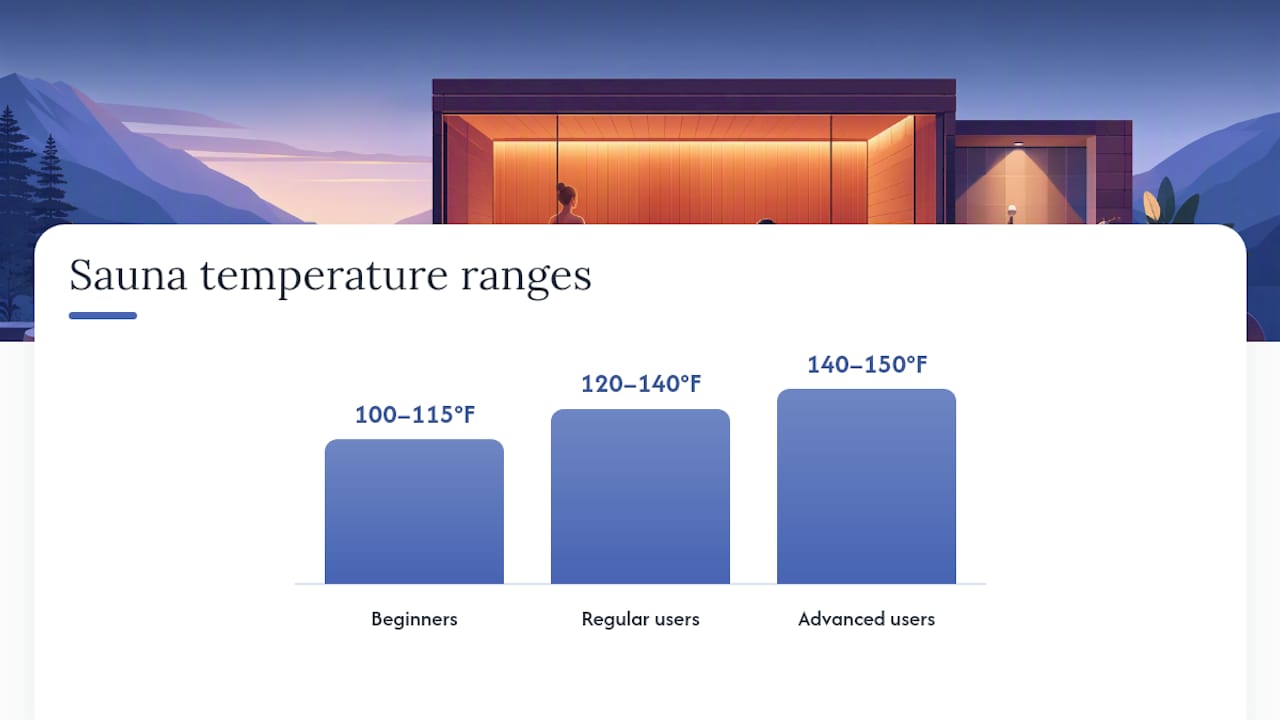
Advanced users who have built up tolerance over months can push to 140°F to 150°F, but the smart move is to shorten the session to 15 to 25 minutes and increase hydration accordingly. Higher heat means faster fluid loss, so this is not a range to treat casually.
A simple, sustainable way to progress looks like this:
- Spend your first 3 to 7 sessions at 100°F to 115°F, focusing on comfort, not endurance.
- Raise the temperature by about 5°F once you consistently feel fine at the end of a session.
- Repeat that pattern every 3 to 7 sessions until you reach your personal comfort ceiling, usually somewhere in the 120°F to 140°F range.
- Only move into 140°F to 150°F territory if you have months of regular use behind you and no health concerns that need monitoring.
A few practical notes worth keeping in mind as you climb the scale:
- Your first sweat is not a failure. Some people don't perspire heavily until their third or fourth session.
- Comfort should always outrank ambition. There's no prize for hitting 150°F in week one.
- Consistency across weeks matters more than any single "hot" session.
Why Infrared Feels Cooler but Still Heats Your Body
Traditional saunas heat the air around you, which then warms your skin through convection. Infrared saunas skip that step entirely. Radiant infrared energy passes through the air with little resistance and penetrates about 1 to 2 centimeters into your tissue directly, according to guidance from the International Commission on Non-Ionizing Radiation Protection. That's why a 130°F infrared cabin can produce a core temperature response similar to a much hotter traditional sauna. Your skin doesn't register the air as scorching, but your internal temperature is still climbing.
Clinical research backs this up in a more intensive setting. Waon therapy, a supervised heat treatment protocol studied for cardiovascular patients, typically uses far-infrared cabins near 140°F for sessions of about 15 minutes.
Far-infrared exposure at approximately 140°F for short, supervised sessions has been associated with measurable cardiovascular improvements in specific patient groups, according to clinical reviews published through NCBI.
That 140°F figure is worth remembering. It's the same upper range advanced home users work toward, but in Waon therapy, it happens under medical supervision with careful monitoring, not as a casual after-work routine. The takeaway isn't that everyone should chase 140°F. It's that infrared's deeper tissue penetration means meaningful physiological effects can happen at temperatures that would feel mild in a traditional steam room.
Infrared Sauna Safety: Contraindications and a Recent Recall
Heat therapy isn't risk-free, and some people need a conversation with a doctor before they ever step into a cabin. That list includes anyone with cardiovascular disease, uncontrolled blood pressure, kidney disease, or a pregnancy. Certain medications, especially those affecting blood pressure or heat regulation, can also change how your body handles infrared exposure. Mayo Clinic notes that infrared saunas produce responses similar to moderate exercise, which is exactly why anyone who'd need clearance to exercise vigorously should get clearance here too.
Watch for these warning signs during any session:
- Dizziness or lightheadedness
- Nausea or a severe headache
- Fainting, or feeling like you might
- Unusually rapid heartbeat that doesn't settle
If any of these show up, step out immediately, sit somewhere cool, and rehydrate slowly. Don't tough it out for the sake of finishing your timer.
Hydration deserves its own mention here. At 130°F for 30 minutes, expect to sweat somewhere in the range of 16 to 24 ounces of fluid; push past 140°F and that can climb toward 24 to 32 ounces or more. Drink water before your session, not just after.
There's also a current product safety issue worth knowing about. The Consumer Product Safety Commission issued Recall 26-784 affecting approximately 41,580 Sauna360 infrared and hybrid saunas sold between May 2013 and July 2026, citing fire and burn hazards. If you own a home unit, check your model against that recall list and stop using it immediately if it's included. Older adults and anyone with implants or heat-sensitive medications should treat that same caution as standard practice, recall or not.
Setting Up Your Session: Preheat Times and Measuring Real Temperature
Getting an accurate reading starts with where you measure, not just what the display says. Wall panels often read differently than the air at bench or chest height, where your body actually sits.
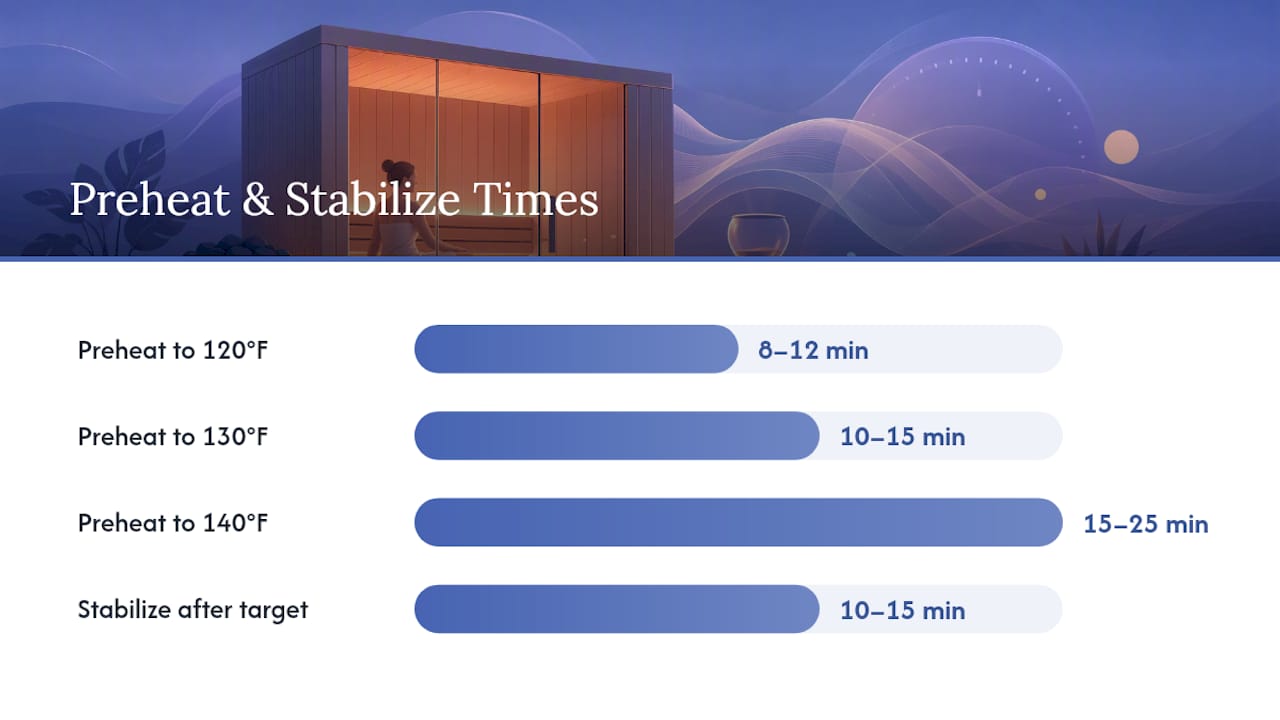
- Preheat to 120°F typically takes 8 to 12 minutes.
- Reaching 130°F takes closer to 10 to 15 minutes.
- Getting to 140°F can take 15 to 25 minutes, especially in larger cabins or cold rooms.
- Once you hit your target, give it 10 to 15 minutes to stabilize before you start your session clock.
A digital probe thermometer accurate to about ±1°F, placed at bench height, gives you a far more reliable number than the built-in panel display.
Pro Tip: If you're using a portable fabric sauna in a cold room, preheat times can run noticeably longer. Warming the room itself first, even a few degrees, shaves real minutes off your wait.
If a session starts feeling too intense, don't power through. Drop the setting 5°F to 10°F and give it 5 to 10 minutes to register before deciding whether you need to adjust further.
Session Templates by Goal
Different goals call for different settings, and matching them correctly makes the time you spend actually worth it.
- Relaxation: 120°F to 130°F for 20 to 30 minutes, 3 to 4 times a week, is the standard routine for stress relief and general wellness.
- Cardiovascular stimulus: 130°F to 140°F for 15 to 25 minutes can elevate heart rate similarly to light exercise, though anyone with cardiac risk factors needs medical clearance first.
- Athletic recovery: 120°F to 135°F for 20 to 30 minutes after a workout is a popular pairing, though you should rehydrate before heading in rather than going straight from a sweaty workout into more heat while dehydrated.
- Sleep and jet lag: 120°F to 125°F, either 45 to 60 minutes before bed or 60 to 90 minutes earlier to allow your body to cool down first, is a technique travelers use to reset their internal clock faster.
Nicole's Notes From Guiding Sessions at Luana Inn
We've watched enough guests move through infrared sessions here to know that the numbers above play out differently depending on why someone walked in. Travelers dealing with jet lag lean toward the cooler, longer sessions before bed. Guests coming off a massage or bodywork session often prefer a shorter warm-up beforehand to loosen tight muscles before hands-on treatment begins.
A few patterns we've noticed:
- First-time guests almost always do better starting cooler than they expect to need.
- People chasing sleep benefits get more out of the 120°F range than pushing hot before bed.
- Consistency across a stay matters more than any single "big" session.
Our blog post on infrared sauna benefits covers more of what guests report feeling across a typical retreat stay.
Consistency Beats Extremes
The biggest misconception I run into is that hotter equals better, as if the sauna were a personal record you're trying to beat. It isn't. Guests who come back season after season and actually stick with infrared use are the ones who found a temperature they enjoy returning to, not the ones who bragged about hitting 150°F once and never went back. Pick a setting you'd happily repeat three times this week. That's the number that actually improves your health, not the one on the leaderboard in your head.
— Nicole
Experience Guided Infrared Sessions at Luana Inn
Reading about temperature bands only gets you so far. Guided infrared sauna sessions are often available as part of wellness packages, where staff help guests settle into the right range for their experience level instead of guessing at a dial.

Whether you're easing in at a gentle 110°F or working toward a steady 130°F routine, our team walks you through preheat timing, hydration, and session length so you're never left second-guessing the display. It's the difference between fumbling through settings alone at home and having someone who does this daily adjust things for you in real time. Guests combining a sauna session with massage or bodywork often build both into the same afternoon for a smoother transition between the two. If you're ready to try a properly guided session instead of troubleshooting a home unit, check availability through our spa services or browse our wellness packages to find a stay built around it.
Sources
For safety checks, verify your home unit against the CPSC's Sauna360 recall notice. For general health context, Harvard Health's review of sauna use and heart health and the Mayo Clinic's infrared sauna FAQ offer balanced, clinically grounded perspectives on what the evidence does and doesn't support.
This article is general information, not a substitute for advice from a qualified doctor. Consult a qualified healthcare professional about your own circumstances before acting on anything here.
- Infrared sauna dangers and guidelines — Healthline
- CPSC recall: Sauna360 infrared and hybrid saunas
- NCBI / PMC clinical studies and reviews referencing Waon therapy
- Mayo Clinic FAQ on infrared saunas
FAQ
Is 30 Minutes Too Long in an Infrared Sauna?
For most regular users, 30 minutes fits comfortably within the recommended 20 to 35 minute range at 120°F to 140°F, according to Healthline's guidelines. It becomes too long if you're a beginner, dehydrated, or experiencing any dizziness, in which case cutting the session short is the right call regardless of the clock.
Is 130°F Hot Enough for an Infrared Sauna?
Yes. 130°F sits squarely in the regular-user sweet spot of 120°F to 140°F and is enough to produce a meaningful physiological response, since infrared heats tissue directly rather than relying on hot air alone. Many people find 130°F delivers the relaxation and recovery benefits they're after without the faster dehydration that comes with pushing past 140°F.
What Temperature Should a Beginner Start At?
Start at 100°F to 115°F for your first several sessions, keeping the time to 15 to 20 minutes. This lets your body adjust to radiant heat before you progress toward the 120°F to 140°F range most regular users settle into.
How Do I Know if an Infrared Sauna Is Too Hot for Me?
Signs it's too hot include dizziness, nausea, a severe headache, or a heartbeat that feels unusually fast and doesn't settle down. If any of these appear, step out immediately, cool down, and rehydrate before considering another session at a lower setting.
Does Luana Inn Offer Guided Infrared Sauna Sessions?
Yes, infrared sauna access is available as part of Luana Inn's spa and wellness packages, where staff help guests choose an appropriate temperature and session length. Pricing for spa services is listed directly on the site.