
What does "oceanview accommodation" actually mean?
An oceanview accommodation is any room, suite, or lodging unit where you can see the ocean from inside, whether through a window, from a balcony, or from a specific spot in the room. That sounds simple, but the reality is a little more nuanced. The industry definition is flexible: a property can label a room "oceanview" if even a small sliver of water is visible from any vantage point. You might get a sweeping panorama of the Pacific, or you might catch a thin blue strip between two buildings if you stand at just the right angle on the balcony.
Here is what you can generally expect from an oceanview stay:
- View quality varies widely. Views range from partial and angled to distant glimpses, depending on the property's layout and your floor level.
- You are not guaranteed a direct, unobstructed sightline. The ocean will be visible, but it may not be the first thing you see when you look outside.
- Oceanview rooms sit further inland than oceanfront rooms and are typically positioned so the ocean appears in the frame rather than filling it.
- Pricing lands in the middle tier. Oceanview rooms cost more than standard or garden-view rooms but less than oceanfront or beachfront options.
- Floor level changes everything. A third-floor oceanview room at a hillside property can deliver a far better sightline than a ground-floor oceanview room at a flat resort.
- Terms like "partial oceanview" or "side oceanview" signal a limited perspective and deserve extra scrutiny before you book.
The bottom line: oceanview lodging gives you some connection to the sea, but the depth of that connection depends entirely on the specific property and room.
How do oceanview, oceanfront, and beachfront rooms compare?
These three terms get used interchangeably all the time, and that is where most booking disappointments begin. Each one describes a genuinely different experience.
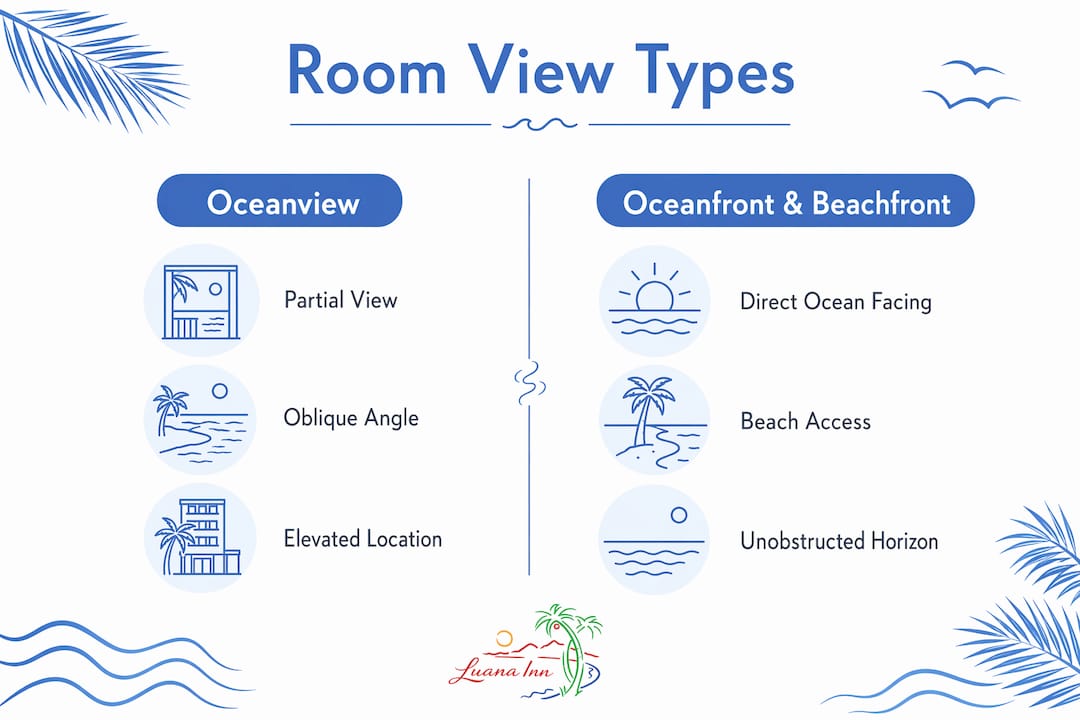
Oceanview means the ocean is visible from your room, but your room does not necessarily face the water directly. You might be on an upper floor of an inland-facing wing, looking out at an angle toward the horizon. The ocean is there; it just may not dominate the window.
Oceanfront means your room faces the ocean head-on. There are no buildings or major structures between your window and the water. You can typically hear the waves with the window open, and the view tends to be panoramic. An oceanfront room is, by definition, also an oceanview room, but the reverse is not true.

Beachfront means your room sits directly on or overlooking the sand, with immediate access to the beach. Surprisingly, beachfront does not always guarantee a clear ocean view. Ground-level placement, dense vegetation, or a private garden can block the sightline even when the beach is steps away.
| Room type | Faces the ocean directly? | Near the waterline? | Beach access? | Typical price tier |
|---|---|---|---|---|
| Standard/garden view | No | No | No | Lowest |
| Oceanview | Partially or angled | Not necessarily | No | Mid |
| Oceanfront | Yes | Yes | Not always | Higher |
| Beachfront | Usually | Yes | Yes | Highest |
A few things worth keeping in mind:
- Terminology is not standardized across properties. One resort's "oceanview" may be another's "partial ocean glimpse."
- Hotels sometimes apply "oceanview" liberally, so the ocean might only be visible from one corner of the balcony.
- Oceanfront rooms offer immersive sea experiences but may be smaller or noisier due to how properties maximize that prime ocean-facing wall.
- Beachfront rooms prioritize access over views, which suits travelers who want to step directly onto the sand.
Real-world examples that show the difference
Putting these categories into concrete scenarios makes the distinctions click.
Oceanview room examples:
- A fourth-floor room at a hillside Hawaiian property where Kealakekua Bay fills the left half of the window, with mountain foliage framing the right. The view is real and beautiful, but it is not wall-to-wall water.
- A resort suite where the ocean appears between two wings of the building. You see it clearly from the balcony, but the interior of the room faces a courtyard.
- An upper-floor room at a property like Luana inn, where the elevated foothills position above Kealakekua Bay creates a wide, sweeping bay view that a ground-level oceanview room simply cannot match.
Oceanfront room examples:
- A suite where the balcony looks straight out over open water with no obstructions, close enough to hear waves when the door is open.
- A room positioned on the first row of a resort's ocean-facing wing, with floor-to-ceiling windows framing the horizon.
- A property where every room in the oceanfront category has a private balcony oriented directly toward the sea.
Beachfront room examples:
- A ground-floor villa where you step off the patio directly onto sand. The ocean is right there, but a row of palm trees partially screens the view from inside.
- A suite with a private garden between the room and the beach. You are steps from the water, but the garden blocks the sightline from the bed or couch.
- A room at a property like Ke'ei Beach where the shoreline is immediately accessible but the room itself sits at an angle to the water.
The pattern is consistent: proximity and view quality do not always travel together. A hillside oceanview room can outperform a ground-level beachfront room in terms of what you actually see from your pillow.
How to choose the right oceanview accommodation for your trip
Picking the right room comes down to knowing what you actually want from the view and being honest about how you will spend your time.
- Read the fine print on view descriptions. "Partial oceanview," "side oceanview," and "ocean glimpse" all signal something limited. Do not assume "oceanview" means a panoramic sweep of the water.
- Ask for photos or a video walkthrough of the specific room category. Booking transparency makes a real difference; a short video of the actual view tells you more than any marketing photo.
- Check guest reviews, not just promotional images. Promotional photos show the best-case scenario, not the typical one. Guests who stayed in that specific room type will tell you the truth.
- Think honestly about how much time you will spend in the room. If your days are packed with snorkeling, hiking, and exploring, upgrading to a premium view may not deliver enough return on the extra cost.
- Consider floor level and room orientation. Higher floors and corner rooms often deliver better sightlines within the same "oceanview" category.
- Weigh view quality against room size and comfort. Properties sometimes squeeze more rooms along the ocean-facing wall, which can mean smaller spaces or thinner walls.
- Call or email the property directly before booking. Ask specifically: "What percentage of the window view is ocean?" or "Is the ocean visible from the bed?" A good property will answer honestly.
Pro Tip: When you contact a property, ask them to describe the view in one sentence without using the word "beautiful." That small constraint tends to produce honest, specific answers like "you can see the bay from the left side of the balcony" rather than polished marketing language.
Staying at a bed and breakfast rather than a large resort often gives you a more transparent booking experience, since the hosts know each room personally and can describe the view with real specificity.
What Luana inn's perspective on oceanview lodging can teach you
Luana inn sits in the foothills above Kealakekua Bay on the Big Island of Hawaii, and that elevated position shapes how the property thinks about ocean views. Rather than marketing a "guaranteed oceanview" and leaving guests to figure out what that means, Luana inn describes its outlook plainly: the bay is visible from the property, sunsets shift colors across the water every evening, and the vantage point from the hillside gives guests a wider perspective than a ground-level room at the shoreline would.
That approach reflects something worth carrying into any booking decision. The best oceanview experiences come from properties that describe what you will actually see, not just what sounds appealing in a listing.
At Luana inn, the view over Kealakekua Bay changes every hour. Pastel sunrises climb over Mauna Loa behind you while the bay catches the light below. By late afternoon, the water shifts from turquoise to deep blue, and the sunsets paint the whole horizon. That kind of elevated coastal perspective is what "oceanview" can mean when a property is honest about what it offers and thoughtful about where it places its guests.
Elevated lodging like Luana inn's also sidesteps one of the most common oceanview disappointments: the ground-level room where a hedge or a parking structure cuts off the sightline. Height gives you the view that proximity alone cannot. If you want to understand what elevated coastal lodging can look like in practice, Kealakekua Bay from the foothills of Mauna Loa is a good reference point.
The broader lesson is simple. Ask questions, request real photos, and look for properties that describe their views with specifics rather than superlatives. That habit will serve you well whether you are booking in Hawaii, the Caribbean, or anywhere along the coast.
Key Takeaways
An oceanview accommodation gives you a visible ocean sightline from your room, but the quality of that view ranges from a partial glimpse to a wide bay panorama depending on the property's layout and your room's position.
| Point | Details |
|---|---|
| Oceanview definition | Any room where some portion of the ocean is visible, even if partial, angled, or distant. |
| Pricing tier | Oceanview rooms cost more than standard rooms but less than oceanfront or beachfront options. |
| Oceanfront vs. oceanview | Oceanfront rooms face the ocean directly; oceanview rooms may be angled or set further inland. |
| Beachfront caveat | Beachfront rooms offer beach access but do not always guarantee a clear ocean sightline. |
| Booking tip | Request actual room photos or a video walkthrough before booking to confirm the real view. |