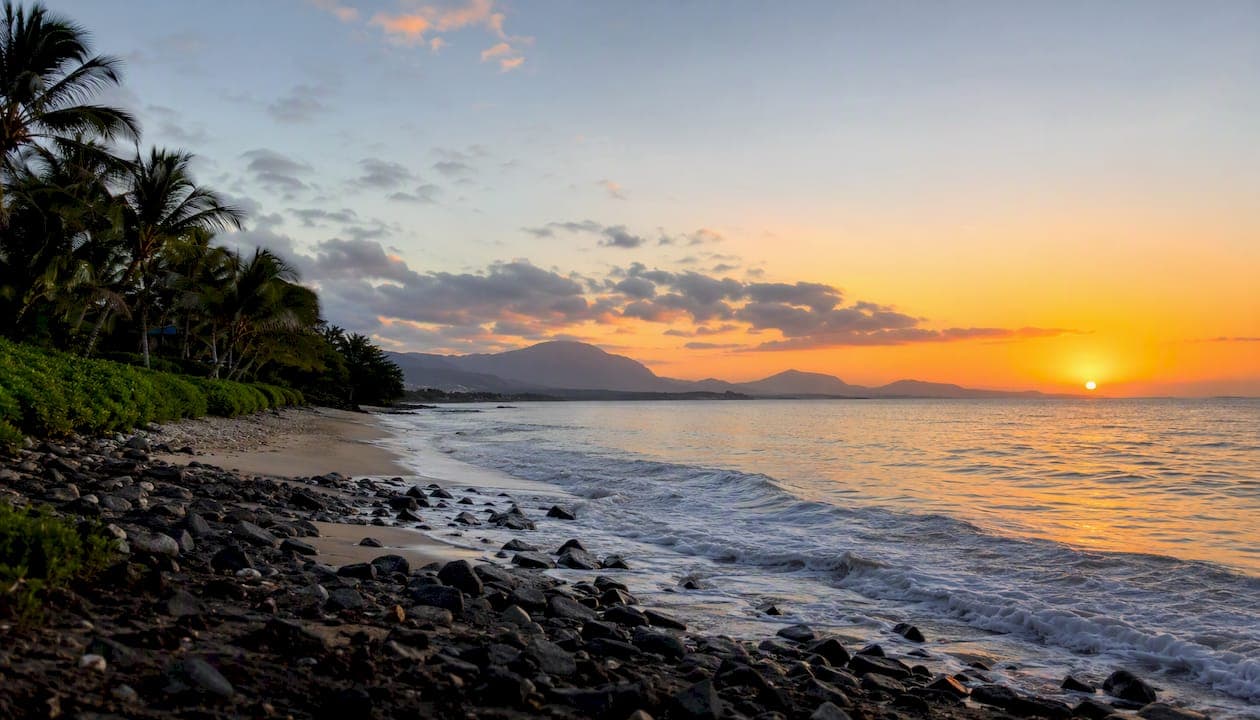
Sunrise in Hawaii shifts your perspective more reliably than sunset because of three things working together: the island chain's tropical solar geometry, its trade wind and cloud microclimates, and the quieter, more reflective mood that only exists before the rest of the world wakes up. You get a different quality of light and a different state of mind, and the two reinforce each other in ways sunset simply can't replicate.
Here's what drives that shift, in short:
- Solar geometry — Hawaii sits at 19° to 22° north latitude, close enough to the tropics that the sun's angle at dawn creates the twice-yearly Lāhainā Noon zero-shadow phenomenon, a distinct signature of how directly overhead the sun travels here.
- Atmospheric behavior — cooler morning air, ocean-driven temperature inversions, and low-angle scattering stretch color and sometimes distort the sun's shape in ways afternoon light rarely matches.
- Experience and context — fewer people, cooler temperatures, and a culturally rooted sense of ritual make dawn feel personal rather than performative.
If you're a photographer or a traveler chasing a mood shift instead of just a nice photo, sunrise is where you'll find it. Sunset in Hawaii is beautiful and social. Sunrise is beautiful and solitary, and that difference matters more than most guides admit.
Key Takeaways
Hawaii's sunrises shift perspective because tropical solar geometry, ocean-driven atmospheric effects, and dawn's social quiet combine in a way no other time of day matches.
| Point | Details |
|---|---|
| Solar geometry drives the look | Hawaii's 19° to 22° north latitude produces steep sun angles and the twice-yearly Lāhainā Noon zero-shadow event. |
| Atmosphere shapes the color | Cooler air, ocean inversions, and low-angle scattering stretch reds and oranges further than sunset typically does. |
| Fewer people, better conditions | Sunrise beaches are quieter, sand and tide pools are undisturbed, and pre-dawn color often lasts longer than post-sunset color. |
| Plan around tide, weather, and altitude | Check tide charts for reflections, confirm permits for summit access, and acclimatize before high-elevation sunrise trips. |
| Stay close to the light | Luana inn's foothills location above Kealakekua Bay gives early risers quick, easy access to sunrise views without a pre-dawn drive. |
Table of Contents
- Why Hawaii Sunrises Shift Perspective Through Light Alone
- How Sunrise Rewires Your Attention, Not Just Your Eyes
- The Practical Case for Choosing Sunrise Over Sunset
- Where and When Hawaii's Sunrise Light Hits Hardest
- Composition Approaches That Capture the Shift
- What Lāhainā Noon Reveals About Hawaii's Light
- Your Sunrise Planning Checklist
- A Local Host's View on Watching the Day Begin
- Where to Stay for Easy Sunrise Access
- Sources
Why Hawaii Sunrises Shift Perspective Through Light Alone
The light itself behaves differently here, and that's not just a poetic notion. It comes down to where Hawaii sits on the globe and what the atmosphere is doing above the water at 6:00 AM versus 6:00 PM.
Hawaii's position between roughly 19° and 22° north latitude puts it near enough to the equator that the sun's path is steep and direct for a large part of the year. That geometry produces Lāhainā Noon, the twice-annual moment when the sun sits close enough to directly overhead that vertical objects cast almost no shadow. It's a striking reminder that the islands receive sunlight at angles most of the mainland United States never experiences, and that same steep trajectory is part of why sunrise here climbs and intensifies faster than in higher latitudes.
At low sun angles, two optical effects take over. Rayleigh scattering bends shorter blue wavelengths out of the direct path while letting reds and oranges dominate, and that effect is strongest exactly when the sun sits near the horizon, whether at dawn or dusk. What tips the balance toward sunrise is what happens overnight: cooler air pools near the ocean surface, sometimes creating a temperature inversion that traps moisture and haze low over the water. That layer refracts light unevenly, occasionally flattening or "squashing" the visible solar disk and deepening the color gradient right along the horizon.
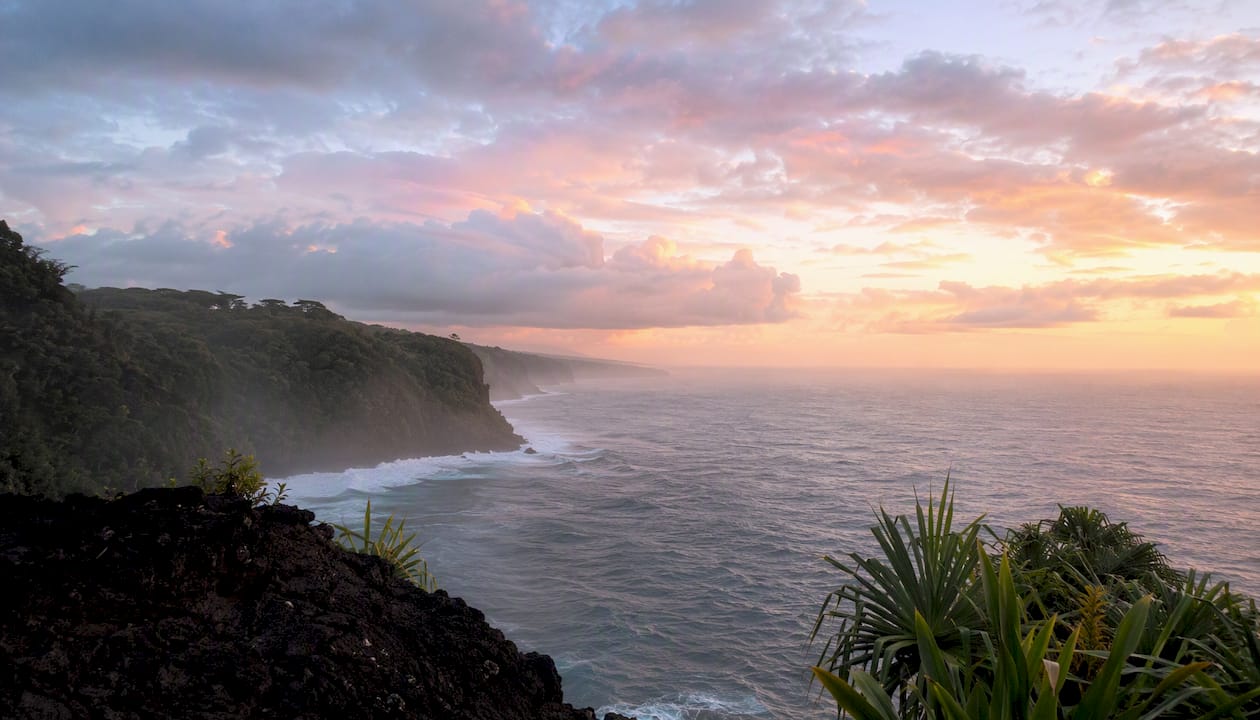
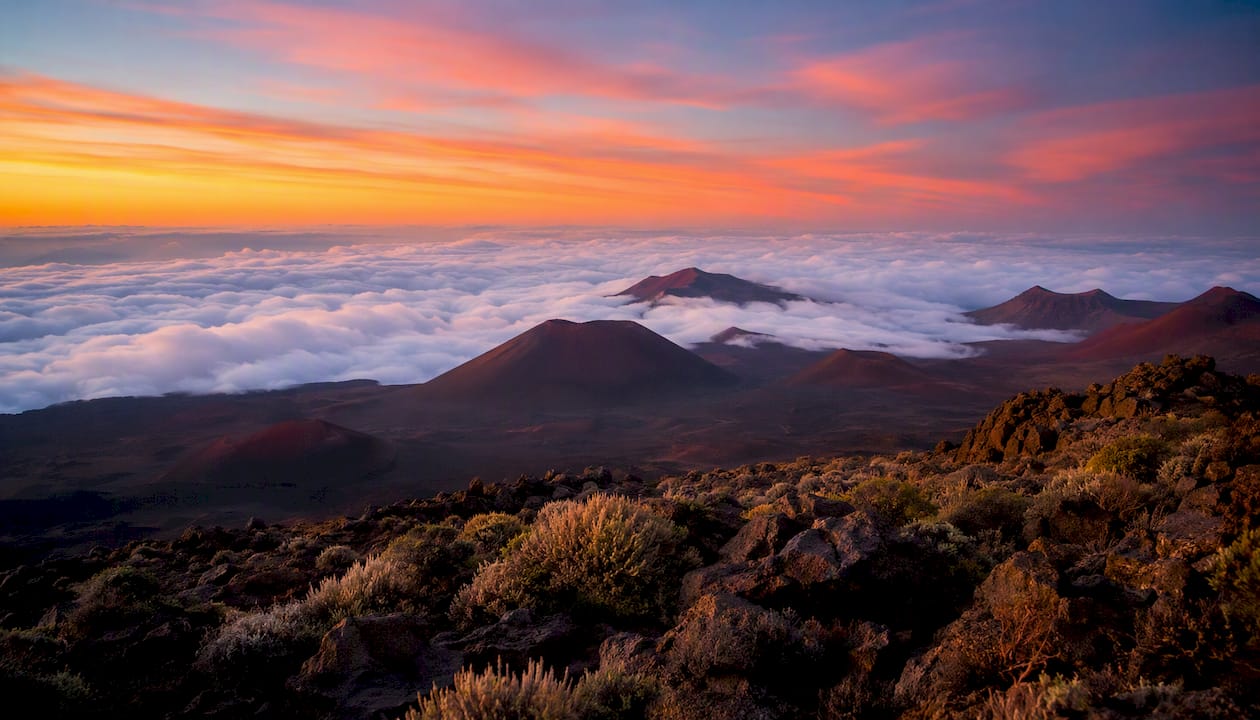
Trade winds add another layer of variation. Windward coasts, the ones facing into the prevailing northeast trades, tend to build cloud banks overnight that catch the first light and scatter it into long bands of pink and gold. Leeward coasts stay drier and clearer, which gives you crisper colors but less drama in the sky itself. Altitude changes everything again. Summit locations like Haleakalā and Mauna Kea sit above the marine cloud layer entirely, so sunrise there often means watching color break across a sea of clouds instead of ocean.
| Factor | Measurement or Pattern |
|---|---|
| Latitude range | Approximately 19°N to 22°N across the island chain |
| Lāhainā Noon frequency | Twice yearly, typically late May and mid to late July |
| Cross-island timing variance | Roughly six minutes, due to longitude differences |
| Summit elevation (Mauna Kea) | summit elevation above the typical marine cloud layer |
Lāhainā Noon happens only twice a year, and the exact time varies by a few minutes from island to island, a small but telling detail that shows how much solar geometry shifts across a chain of islands that spans several hundred miles.
Pro Tip: Check a sunrise app the night before rather than relying on general island averages. A six-minute swing sounds small, but at low sun angles the color window can close that fast, and you don't want to be adjusting your tripod when the best light hits.
How Sunrise Rewires Your Attention, Not Just Your Eyes
Sunrise shifts perspective because it changes where your attention goes. Sunset invites you to look outward, toward a horizon shared with everyone else on the beach. Sunrise, especially in Hawaii, tends to pull your focus inward, because there's usually no one else around to perform the moment for.
Local photographers describe this constantly. Shooting at dawn in Oahu means quieter beaches, smoother untouched sand, and a mood that reads as intimate rather than crowded. That absence of social noise changes what you notice. You hear the waves instead of conversation. You watch the color build in stages instead of snapping a photo and moving on to dinner.
Travel-wellness writers frame this as a kind of rhythmic reset, the idea that watching the day begin synchronizes you to a natural cycle in a way that sunset's communal wind-down doesn't quite match. Sunset says "day is ending, relax with others." Sunrise says "day is beginning, and you're the only one here to see it." Some photographers put it even more directly: the light at golden hour is technically similar in both directions, but sunrise carries a different emotional charge precisely because of the solitude.
Dawn on a Hawaiian coastline strips away the performance of sunset. There's no applause, no crowd exhaling together. It's just you, the water, and a color shift that feels like it's happening for you alone.
Hawaiian tradition adds real weight to this. Solar events like Lāhainā Noon carried navigational and seasonal significance for Polynesian voyagers, who tracked the sun's path across the sky as part of wayfinding and seasonal planning long before instruments did it for them. That history isn't decorative. It's a reminder that watching the sun rise over these islands taps into something locals have paid close attention to for centuries.
Pro Tip: Leave the phone in your bag for the first ten minutes after you arrive. Watch the sky change without narrating it for social media. That short window of undocumented attention is often what makes the sunrise feel different from every other sunrise you've watched through a screen.
The Practical Case for Choosing Sunrise Over Sunset
Beyond the mood, sunrise wins on pure logistics if you're a photographer or an early-rising traveler who wants clean shots without negotiating around a crowd.
- Beaches are close to empty, so you're not fighting for foreground space or editing strangers out of your frame later.
- Air and sand temperatures are cooler, which matters more than people expect if you're hiking to a viewpoint or standing still for twenty minutes waiting on light.
- Tide pools and wet sand tend to be undisturbed, giving you smoother reflective surfaces than the same spot will have by afternoon.
- Pre-dawn color often runs longer than post-sunset color, giving you more usable shooting time before the light flattens out.
For camera settings, sunrise scenarios split into a few common situations. Silhouettes against the brightening sky usually call for a narrow aperture around f/8 to f/11, a fast enough shutter to avoid overexposing the sky, and low ISO since you have plenty of light behind your subject. Long exposures on tide pools benefit from a tripod, a shutter speed of one to several seconds, and often a neutral density filter to smooth moving water without blowing out the sky. Backlit portraits at dawn want a wider aperture, f/2.8 to f/4, to soften the background and let the low sun rim-light your subject.
- Headlamp with a red-light mode, so you preserve your night vision while setting up gear
- Tripod rated for uneven, sandy, or rocky terrain
- Graduated neutral density filter for balancing bright sky against darker foreground
- Spare batteries, since cold, damp pre-dawn air drains them faster than midday heat
- Light rain shell or dry bag, since coastal mornings can carry surprise mist
Pro Tip: Arrive at least thirty minutes before official sunrise, not for the sunrise itself but for the twenty minutes of pre-dawn color that builds before the sun actually clears the horizon. That window, called civil twilight, is often when the sky produces its most painterly gradients, and most casual visitors miss it entirely by timing their arrival to the official sunrise clock.
Where and When Hawaii's Sunrise Light Hits Hardest
Windward coasts, high-elevation summits, and less-visited eastern points reliably produce the most dramatic dawn light, and a handful of specific places show why. Haleakalā's summit on Maui sits above the cloud layer, so sunrise there means watching color break over a sea of white rather than ocean. The Hamākua Coast and Laupāhoehoe Point on the Big Island face directly into the open Pacific, giving you an unobstructed horizon and, at low tide, mirror-flat tide pools that double the color show in reflection. On Oahu, ridgelines near Diamond Head offer a similar east-facing advantage without the altitude commitment.
Season matters more than most first-time visitors realize. Winter trade winds tend to stack more cloud along windward coasts, which can mean either spectacular color or a fully socked-in horizon depending on the morning. Wetter months bring more humidity and haze, which softens colors but can also produce those long pastel gradients photographers chase. If you want dramatic, layered clouds, aim for windward locations during trade wind season. If you want clean pastel simplicity, leeward and drier months tend to deliver more consistent results.
Pick your spot based on what you're after. Summits give you clouds and scale. Ocean-level east coasts give you unobstructed horizon and reflection opportunities. Volcanic terrain near the Big Island's active zones occasionally adds a red glow to the pre-dawn sky that no other island offers.
Pro Tip: Check the tide chart before you check the weather. A rocky coastline like Laupāhoehoe only gives you those mirror reflections during low tide, and if you show up at high tide the same spot just looks like wet rocks under a nice sky.
Composition Approaches That Capture the Shift
The shot types that work best at sunrise all lean into stillness and layering rather than motion and crowd energy. Foreground reflections in tide pools, layered silhouettes of distant ridgelines, soft backlit portraits, and wide panoramas from summit viewpoints each translate the quiet of dawn into something visual.
- Use leading lines from shoreline rocks or trail edges to pull the eye toward the brightening horizon.
- Leave generous negative space in the sky when the mood is the subject, not the landscape detail.
- Keep horizons low in the frame to give the color gradient room to breathe.
- Preserve some shadow detail in the foreground rather than exposing purely for the sky, since that contrast is what gives a sunrise image depth instead of flatness.
A workable shot list for a single sunrise session: one wide establishing shot before the sun clears the horizon, one tide pool reflection at low tide, one silhouette of a person or landmark against the brightest part of the sky, one tighter detail shot of light hitting texture (rock, water, palm fronds), and one final wide shot once full color has developed.
Pro Tip: Shoot in RAW and bracket your exposures by one stop in each direction. Sunrise color shifts fast, and RAW files give you the latitude to recover subtle transitions in post that a compressed JPEG will have already thrown away.
What Lāhainā Noon Reveals About Hawaii's Light
Lāhainā Noon is a twice-yearly moment when the sun sits close enough to directly overhead that a vertical pole casts almost no visible shadow, and it exists here specifically because of Hawaii's tropical latitude. It happens roughly in late May and again in mid to late July, with the exact timing shifting by about six minutes from island to island due to longitude differences across the chain.
Local reporting captured one recent example precisely: Honolulu recorded its zero-shadow moment around midday on May 26, with the second annual occurrence falling around mid-July. That kind of precision is a direct reminder of how far south the islands sit compared to most of the continental United States, and it's part of the same solar geometry that makes sunrise here climb faster and hit harder than it does at higher latitudes.
Lāhainā Noon occurs twice each year, with timing that shifts by a few minutes across the islands. That's a small window, but it's a vivid demonstration of just how directly the sun tracks over Hawaii for part of the year.
One safety note worth repeating regardless of how remarkable the event is: never look directly at the sun, even during Lāhainā Noon or at sunrise itself. The angle changes, but the risk to your eyes doesn't.
Your Sunrise Planning Checklist
- Check the official sunrise time and civil twilight start, usually 20 to 30 minutes earlier, the night before.
- Review the weather forecast for cloud cover and the tide chart if you're heading to a coastal or tide pool location.
- Confirm parking availability and any permit or reservation requirements, especially for summit access at Mauna Kea or Haleakalā.
- Set an alarm with real buffer time, and pack a headlamp with a red-light setting for the drive and walk in.
- Plan to arrive 30 to 45 minutes before official sunrise to catch pre-dawn color and set up your composition.
- Bring water and dress in layers, since coastal mornings and especially summit mornings run colder than daytime temperatures suggest.
Quick gear check before you leave the room: tripod, filters, spare batteries, and a lens cloth for morning condensation. If you're heading to elevation, acclimatize at around 9,200 feet for at least thirty minutes before continuing to a summit like Mauna Kea, since altitude sickness is a genuine risk at that height, and a 4WD vehicle is typically required for the final stretch of road.
Pro Tip: Always have a backup location in mind. If your primary spot is clouded out or the tide is wrong, a second option ten minutes away can save the entire morning. Coastal Hawaii weather changes fast, and flexibility beats a perfect plan that falls apart at 5:30 AM.
A Local Host's View on Watching the Day Begin
Sunrise matters to us at Luana inn because it's the version of Hawaii most visitors never plan around, and it's usually the one they remember longest. Sunsets get the reputation and the crowds. Mornings get the quiet, and quiet tends to stick with people.
I've watched dawn break over Kealakekua Bay enough times to notice a pattern: the color builds slowly, almost hesitantly, then arrives all at once across the water in a way that feels different from the slow fade of evening. Guests who make the effort to be outside for it, coffee in hand, tend to describe the rest of their day differently. Something about starting from stillness changes the pace of everything that follows.
[Editor's note: insert Nicole's credentials and any relevant guest quotes or occupancy signals here as proof points.]
Where to Stay for Easy Sunrise Access
Luana inn sits in the foothills above Kealakekua Bay, which means sunrise viewers get a rare advantage: elevation and an ocean-facing outlook without the pre-dawn drive most photographers have to make. It's a practical option if you want to roll out of bed and be in position within minutes rather than navigating unfamiliar roads in the dark.

The property's setting adds more than convenience. Mornings here are quiet by design, and the foothills vantage point gives you a wider view of the bay's color changes than most beachfront rooms allow. Between the chlorine-free pool, the infrared sauna, and quiet space for a short meditation or stretch before heading out, Luana inn supports the kind of early-riser rhythm that sunrise chasing depends on. If you're the type who wants a slower start to the day built into your stay, browse the rooms overview or check current vacation packages to find a stay that puts you close to the light before the rest of the island wakes up.
Sources
These are the sources behind the science and the on-the-ground advice in this article, useful if you want to dig deeper into the geometry, safety guidance, or local photography angles.
- What is Lāhainā Noon? How Honolulu’s zero-shadow day connects science and Hawaiian tradition — Honolulu Wire
- Sunrise
- Sunrise Vs. Sunset Photography In Oahu, Hawaii — Jolene Kaneshige Photography
- Maunakea visitor information — University of Hawai‘i at Hilo (public safety / visitor guidance)