
Yes, gentle, restorative yoga plus breathwork can help reset your nervous system and support burnout recovery, though it works best as part of a phased plan rather than a quick fix. Start now with legs-up-the-wall for three minutes, followed by five slow exhales twice as long as your inhale. That single move signals safety to a nervous system that has been stuck in overdrive, and it's the same principle behind everything that follows.
TL;DR:
- Restorative yoga and slow breathwork can effectively support early burnout recovery, especially when practiced consistently over weeks or months.
- Activities that activate the vagus nerve, like slow exhalations and extended low-intensity yoga, lower stress markers such as cortisol and improve emotional regulation.
- During active burnout, avoid dynamic or heat-intensive yoga styles like power yoga or vinyasa, focusing instead on gentle, supported poses and slow pranayama.
- A phased recovery plan recommends starting with supported poses for at least two weeks, then gradually adding breathwork, yin, and gentle movement over several weeks.
- Severe symptoms such as suicidal thoughts, inability to function, or physical concerns require professional medical support, as yoga supplements but does not replace clinical care.
Table of Contents
- What Burnout Actually Is and What Recovery Looks Like
- How Does Yoga Help Burnout Recovery?
- Which Yoga Styles Help (and Which Ones to Avoid)
- Your 12-Week Phased Recovery Plan
- Breathing Practices You Can Start Tonight
- Daily Habits That Support the Work Off the Mat
- When Yoga Isn't Enough: Signs You Need Professional Support
- Why a Restorative Environment Changes the Recovery Curve
- A Restorative Stay Built for This Exact Phase of Recovery
- Where to Read More on the Evidence
- Sources
What Burnout Actually Is and What Recovery Looks Like
Burnout isn't just tiredness. The clinical picture centers on three features: exhaustion that doesn't lift with a weekend off, depersonalization (a numb, checked-out feeling toward your work or the people in it), and a nagging sense that nothing you do matters anymore. If you recognize all three, you're not imagining it. You're describing a recognized occupational syndrome, not a character flaw.
The signs show up in ways that feel scattered until you see the pattern:
- Sleep that's either broken or unsatisfying even when you get enough hours
- Trouble concentrating on tasks that used to take no effort
- Emotional flatness, or the opposite: irritability that surprises even you
- Physical symptoms like tension headaches, jaw clenching, or a racing heart at rest
- A creeping cynicism about work, relationships, or your own competence
Recovery is rarely linear, and it's almost never fast. Most people need weeks to months of consistent nervous-system care before they feel like themselves again, not days. The encouraging part is that progress has trackable markers long before you feel "fully recovered." Improved sleep quality, steadier mood from one day to the next, the ability to hold focus for 20 minutes without your mind sliding away, and small upticks in energy tend to show up first and often precede full functional recovery. Watch for those signals instead of waiting to "feel normal" again, because that finish line moves.
How Does Yoga Help Burnout Recovery?
The mechanism is simpler than most wellness content makes it sound. Slow, extended exhales activate the vagus nerve, which shifts your body out of sympathetic (fight-or-flight) dominance and into parasympathetic recovery mode. Do this consistently, and you're not just feeling calmer in the moment. You're retraining a nervous system that has forgotten how to downshift.
The research backs this up with more nuance than most headlines suggest. Comprehensive reviews of biosignal data show that yoga-based practices lower sympathetic nervous system activity and improve heart rate variability, a key marker of how well your body handles stress. That autonomic regulation effect is measurable, not just anecdotal.
Harvard Health has summarized studies showing regular yoga practice can raise GABA levels in the brain, a neurotransmitter that calms overactive neural firing, alongside structural brain changes linked to improved mood and sharper cognitive function. That's a meaningfully different claim than "yoga is relaxing." It's closer to "yoga changes brain chemistry associated with anxiety."
A 2024 health-technology assessment reviewing randomized controlled trials across multiple countries found yoga produced clear positive effects on subjective stress and on specific burnout subscales, particularly depersonalization, though results were mixed for overall burnout severity as a single composite score.
That mixed finding from the HTA report matters because it keeps expectations honest. Yoga isn't a cure for burnout in the way antibiotics cure an infection. It's a regulation tool that reliably moves specific symptoms in the right direction, especially the emotional detachment that makes burnout so isolating.
Clinical trials show that around 20 minutes of daily gentle yoga, sustained over eight weeks, measurably lowers emotional exhaustion and cortisol in working adults. That's a specific, achievable dose, not an abstract wellness goal.
What does this mean day to day? Fewer 3 a.m. wake-ups with your heart pounding for no reason. More capacity to sit through a hard conversation without your chest tightening. A slower fuse when your inbox hits triple digits. Those are the practical translations of vagal tone and lower cortisol, and they're what you're actually training for.
Which Yoga Styles Help (and Which Ones to Avoid)
Not all yoga is created equal for a depleted nervous system, and this is where a lot of well-meaning advice goes wrong. The style that helps you most depends entirely on where you are in recovery.
Here's how the phases map to practice type:
- Acute exhaustion (early recovery): Restorative yoga only. Long-held, supported poses with props, minimal movement, and an emphasis on stillness.
- Subacute phase (stabilizing): Add slow pranayama and one weekly yin session. Yin's long-held stretches (three to five minutes per pose) build tolerance for stillness without demanding output.
- Rebuilding phase: Introduce gentle hatha once a week alongside continued restorative and yin work, slowly reintroducing movement and strength.
Each style earns its place for a different reason:
- Restorative yoga requires zero effort or skill and is the safest entry point when your body is running on fumes.
- Yoga nidra (guided lying-down meditation) works even when you're too tired to hold a pose, making it ideal for the earliest weeks.
- Yin yoga slowly rebuilds tolerance for discomfort and stillness without triggering a stress response.
- Gentle hatha reintroduces light movement once your baseline energy has stabilized, usually a few weeks in.
- Pranayama (breathwork) works at every phase but should stay slow and unforced early on, never fast or breath-holding.
Pro Tip: If you're not sure which phase you're in, default to restorative. Overestimating your capacity is the single most common way people set back their own recovery.
Avoid power yoga, hot yoga, and competitive vinyasa flows during active burnout. These styles spike heart rate and body temperature in ways that mimic the exact sympathetic overdrive you're trying to exit. Practitioner guidance consistently warns that dynamic, heat-intensive practices can worsen exhaustion when your baseline reserves are already low, even though they're marketed as "stress relief." Intense, fast pranayama (rapid breath of fire style techniques) belongs in the same avoid category early on for the same reason.
Your 12-Week Phased Recovery Plan
A phased progression, restorative first, then slow pranayama, then yin and gentle hatha, reduces the risk of what practitioners call sympathetic overshoot: pushing your body back into stress mode by trying to "power through" recovery. Here's how that plays out week by week.
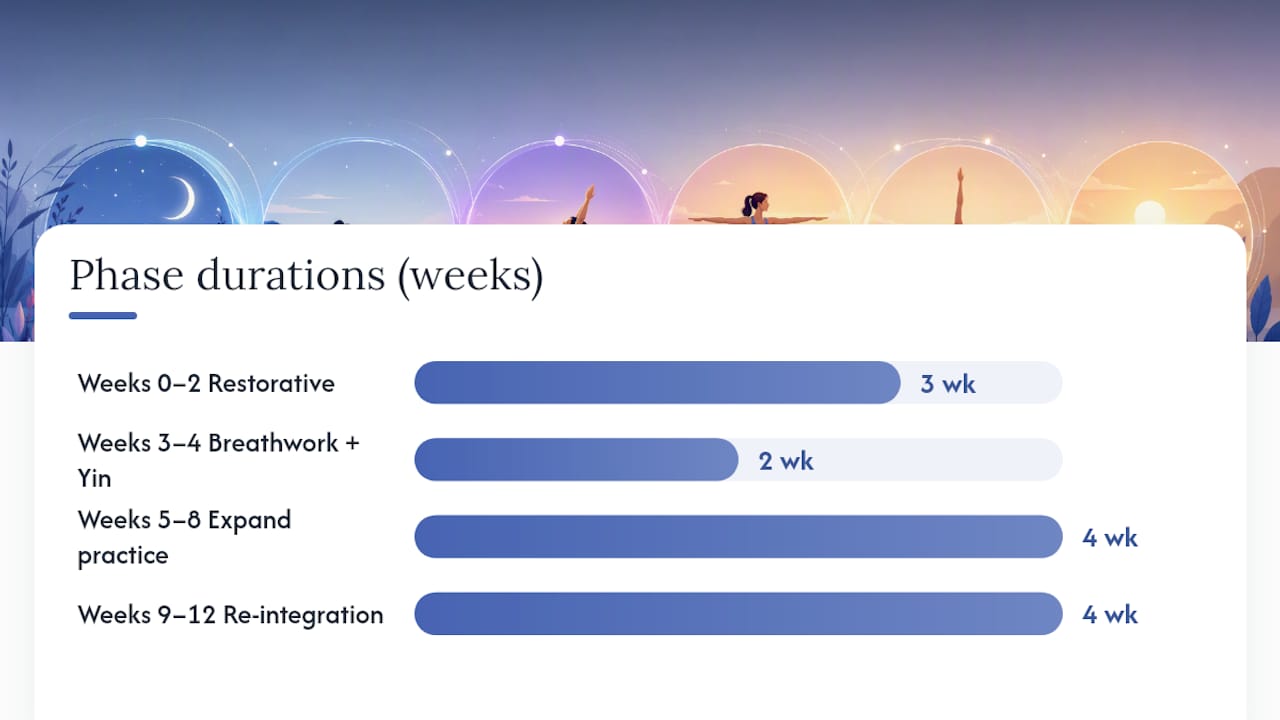
Weeks 0 to 2: Restorative only. Three poses, 15 to 20 minutes total, done at the same time each day if possible.
- Supported child's pose with a bolster under your torso, held 5 minutes
- Legs-up-the-wall against a wall or chair seat, held 8 minutes
- Reclined bound angle pose with pillows under each knee, held 5 to 7 minutes, ending in stillness
Weeks 3 to 4: Add breathwork and one yin session weekly. Keep the restorative base but layer in five minutes of slow nasal breathing before or after your sequence, plus a single 20 minute yin class or home session focused on hips and shoulders.
Weeks 5 to 8: Expand duration and variety. Sessions grow to 20 to 30 minutes. Alternate restorative and yin days, and introduce one gentle hatha class per week, something with slow sun salutations and no rapid transitions.
Weeks 9 to 12: Re-integration. This is where most people either succeed or relapse, so go slowly.
- Add movement gradually, watching how you feel 48 hours after each new session rather than just immediately after
- Return to a regular studio class no more than once weekly at first, choosing gentle or beginner-labeled sessions
- Keep at least three restorative or yin sessions weekly even as you add more active practice
- If fatigue spikes or sleep worsens after a session, drop back a phase for a week before trying again
A sample morning micro-practice: two minutes of legs-up-the-wall plus five extended exhales before you check your phone. A sample evening yoga nidra outline: lie down, scan from feet to head noticing sensation without changing anything, then rest in stillness for 15 to 20 minutes while a recorded voice (or your own memory of the sequence) guides attention slowly through the body. A full 20 minute restorative session: supported child's pose (5 min), legs-up-the-wall (8 min), reclined twist each side (3 min each), ending in savasana (5 min).
Guided sequences of this length and structure, published for general audiences by sources like Yoga Journal, are a reliable place to find beginner-friendly scripts if you'd rather follow along than build your own.
Breathing Practices You Can Start Tonight
Breathwork is the fastest lever you have, and unlike a full yoga sequence, you can do it anywhere: at your desk, in a parked car, before a hard meeting.
- 4-7-8 breathing: Inhale through your nose for 4 counts, hold for 7, exhale slowly through your mouth for 8. Repeat 4 rounds, twice daily.
- Alternate nostril breathing (Nadi Shodhana): Close your right nostril, inhale left for 4 counts, switch, exhale right for 4 counts, then inhale right, switch, exhale left. Continue for 3 to 5 minutes.
- Bhramari (humming bee breath): Inhale normally, then exhale while humming with your mouth closed, feeling the vibration in your skull. Do 5 to 10 rounds.
Extended-exhale techniques like these are linked to vagal-stimulating effects that reduce subjective arousal within minutes, which is why they work as an immediate reset, not just a long-term practice.
Start with two minutes of any single technique, not all three at once, and only increase duration once it feels easy. Never force the breath or hold past comfort, and stop immediately if you feel lightheaded or dizzy. If you have a history of panic attacks, low blood pressure, or a cardiovascular condition, check with a clinician before starting breath-holding techniques like 4-7-8.
Pro Tip: Pair one breath protocol with an existing habit, like brushing your teeth or waiting for coffee to brew, so it doesn't depend on willpower you don't currently have.
These short protocols are what make the 12-week plan realistic. You don't need a studio or an hour to regulate your nervous system daily.
Daily Habits That Support the Work Off the Mat
Yoga does more when it's not fighting against a chaotic daily rhythm. A few off-the-mat habits compound your progress considerably.
- Take a two minute breath break every few hours, especially before and after high-stress meetings
- Do five minutes of legs-up-the-wall in the late afternoon, a natural energy dip point for many recovering from burnout
- Take a slow, phone-free walk outdoors for 10 minutes, ideally somewhere with natural light and greenery
- Keep a consistent sleep and wake time, even on weekends, and keep your bedroom dark and slightly cool
- Reduce late-day caffeine and lean toward whole foods with anti-inflammatory properties like fatty fish, leafy greens, and berries
Boundary-setting matters as much as any pose. If you're returning to work, negotiate a graded reentry where possible: shorter days at first, fewer high-stakes meetings in week one, and explicit permission to decline nonessential commitments for a defined period. Some workplaces now build structured wellness support into HR policy, and if yours does, a structured employer wellness program can make this transition considerably smoother than negotiating it alone.
Nature-based resets pair naturally with yoga's nervous-system work too. If a walk in greenery feels good, there's a reason for that, and it's worth exploring nature immersion practices as a complement to your mat time.

When Yoga Isn't Enough: Signs You Need Professional Support
Yoga is a genuine support tool, not a substitute for clinical care when burnout has tipped into something more serious. Certain signs mean you should reach out to a doctor or therapist immediately rather than waiting to see if breathwork helps.
- Thoughts of suicide or self-harm, at any intensity, warrant immediate professional contact or a crisis line
- Inability to function at work or home for more than a few days running
- Symptoms consistent with a major depressive episode: persistent low mood, loss of interest in nearly everything, appetite or weight changes
- Physical symptoms that concern you, like chest pain or fainting, which need medical evaluation before any exercise, yoga included
If you're already working with a therapist or physician, tell them what you're doing on the mat. Mention session length, how intense the practice is, and any changes you've noticed in sleep, mood, or concentration. That detail helps a clinician calibrate other treatment, whether that's therapy, medication, or a structured rehabilitation program.
Yoga works well as an adjunct alongside professional treatment, not as a replacement for it. The Mayo Clinic's guidance on burnout makes a similar point: gentle movement and breathwork support recovery, but persistent or severe symptoms deserve a clinician's involvement.
Why a Restorative Environment Changes the Recovery Curve
The evidence on phased, restorative-first practice convinces me, but what it doesn't fully capture is how much environment shapes whether people actually stick with it. Trying to hold stillness in a house full of demands, with a phone buzzing nearby, works against the exact regulation you're attempting. A space built around low-demand practice, quiet, unhurried, without decisions to make, removes the friction that derails most people's good intentions in week two.
That's not a claim that a retreat replaces therapy or medical care. It's a claim that environment accelerates adherence, and adherence is what the research actually depends on.
— Nicole
A Restorative Stay Built for This Exact Phase of Recovery
If the twelve week plan above sounds right but your home doesn't offer anywhere quiet enough to actually do it, that's the gap Luana inn was built to close. Set on the eco-friendly grounds overlooking Kealakekua Bay, Luana inn pairs private rooms with an infrared sauna, a chlorine-free pool, and quiet outdoor spaces designed for exactly the kind of unhurried, low-demand practice your nervous system needs right now.

Guests working through restorative or early rebuilding phases tend to get the most out of a stay here: farm-to-table meals mean one less decision to make each day, and the property's wellness packages can include guided sessions that match the pacing this article describes rather than pushing you into anything intense. If you want a fuller sense of what a restorative environment offers before committing, the wellness gallery walks through the spaces and amenities in detail, and our guide to choosing the right burnout recovery retreat can help you decide what kind of stay actually fits your phase.
Ready to see what's available? Check current vacation packages or browse room options to find a few restful nights that fit your recovery timeline.
Where to Read More on the Evidence
For readers who want the underlying research: the 2024 health-technology assessment offers the clearest picture of what yoga does and doesn't fix in burnout. Harvard Health's overview explains the brain chemistry in plain terms, and the PMC review on biosignals covers the autonomic nervous system data in depth. The Mayo Clinic's burnout guide rounds it out with practical, clinician-reviewed guidance.
Sources
- Yoga as Potential Therapy for Burnout: Health Technology Assessment Report
- Yoga for better mental health — Harvard Health
- Study evidence and surveys on yoga for stress reduction — PMC