
A 1–3 night stay at a luxury rural B&B reliably lowers physiological stress and restores mental clarity in ways a typical urban break simply cannot match. One night delivers immediate relief: lower perceived stress, quieter mental chatter, and a body that starts to unwind. Two to three nights bring clearer mood, better sleep, and measurable shifts in stress hormones. Luana inn, perched in the foothills of Mauna Loa and overlooking Kealakekua Bay, offers exactly the kind of setting the research points to: open water views, birdsong, farm-to-table meals, and spa amenities that support every stage of that recovery arc.
Key Takeaways
A 1–3 night luxury rural B&B stay produces measurable reductions in cortisol and blood pressure and restores mood and attention, with benefits appearing within two days for most guests in natural settings.
| Point | Details |
|---|---|
| Recommended stay length | One night for immediate stress relief; two to three nights for mood, sleep, and cortisol improvements. |
| Top features to prioritize | Water views, birdsong-facing rooms, guided nature walks, and on-site spa or sauna access. |
| Evidence strength | A meta-analysis of 25 studies (1,876 participants) found a pooled SMD of −0.71 for stress reduction, with substantial heterogeneity. |
| Safety note | Rural stays complement but do not replace clinical care; consult a clinician for serious mental health conditions. |
| Luana inn | Offers bay views, chlorine-free pool, hot tub, infrared sauna, and farm-to-table breakfasts in a quiet Big Island setting. |
Table of Contents
- Why rural retreats aid recovery: the science behind the calm
- Which retreat features actually drive the benefits
- How to pick a luxury rural B&B for an overnight restorative stay
- What you'll likely feel during and after your stay
- A 2–3 day restorative itinerary for couples and solo travelers
- How strong is the evidence, and what researchers still don't know
- What we've learned from building restorative stays at Luana inn
- Ready to rest? Here's how to book a restorative stay at Luana inn
- A perspective on what the research actually means for your next stay
- Sources
Why rural retreats aid recovery: the science behind the calm
Two frameworks explain most of what happens when you step away from city life into a quiet rural setting. Attention Restoration Theory (ART) holds that natural environments engage "soft fascination," a gentle, effortless attention that lets your directed-attention system rest and rebuild. Stress Reduction Theory (SRT) adds the physiological side: unthreatening natural settings reduce sympathetic nervous system arousal and activate the parasympathetic branch, the one responsible for rest, digestion, and repair.
Researchers measure these shifts with concrete markers. Salivary cortisol tracks the body's primary stress hormone. Heart rate variability (HRV), specifically parasympathetic indices like RMSSD, reflects how well your nervous system can flex between effort and rest. Blood pressure and pulse rate round out the picture. Psychologically, the Profile of Mood States (POMS) and directed-attention tasks capture what you feel and how clearly you think.
A controlled 3-day crossover field study found that rural exposure reduced salivary cortisol, lowered pulse rate and blood pressure, increased parasympathetic activity, and improved POMS mood scores compared with urban conditions. A separate RCT (N=80) showed that even a 30-minute guided walk in an urban forest produced significantly greater improvements in directed attention, mood, reduced cortisol, and increased parasympathetic HRV versus an indoor control.
| Physiological marker | Typical direction after rural/nature exposure |
|---|---|
| Salivary cortisol | Decreases |
| Parasympathetic HRV (RMSSD) | Increases |
| Blood pressure | Decreases |
| POMS mood score | Improves (less tension, fatigue, confusion) |
| Directed attention | Improves |
One important caveat: a meta-analysis of 25 studies covering 1,876 participants reported a pooled medium-to-large short-term stress reduction (SMD = −0.71), but heterogeneity was substantial (I² > 74%). The signal is real and consistent; the magnitude varies by person, setting, and duration.
Which retreat features actually drive the benefits
Not every rural property delivers the same results. The landscape, soundscape, and built environment each contribute, and the combination matters more than any single element.
Landscape features with the strongest evidence:
- Tree cover, open meadows, or water views: perceived naturalness correlates directly with restorativeness, and trees and water are the two elements most reliably linked to stronger restorative effects
- Low ambient noise: distance from roads and traffic is one of the clearest differentiators between a restorative and a merely scenic property
- Biodiversity and birdsong: in a controlled experiment, restored forest combined with birdsong produced the lowest stress and highest perceived restorativeness compared with grey space and traffic noise, with additive benefits from each element
Built-environment features worth prioritizing:
- Private entrance and bathroom for low-stimulation arrival and departure
- Dark, quiet sleep environment with separate climate control
- Farm-to-table meals that are restorative and low in stimulants
- On-site movement options: yoga, guided walks, or gentle stretching
- Spa amenities: infrared sauna, hot tub, or bodywork services
Pro Tip: When you call to book, ask which rooms face vegetation and open sky rather than the parking area or road. A birdsong-facing room with a water view costs nothing extra to request and can meaningfully deepen your stay.
How to pick a luxury rural B&B for an overnight restorative stay
Before you book, run through this checklist. Each item maps to a specific recovery outcome.
- Sleep environment: blackout curtains or shutters, quiet HVAC, and no road-facing windows
- Noise profile: ask how far the property sits from the nearest highway or commercial area
- Guided nature programming: guided nature immersion improves mood and reduces heart rate during specific segments, so a property that offers structured walks adds measurable value
- Food quality: restorative meals, low in caffeine and alcohol, support better sleep and lower cortisol overnight
- Water features or views: pools, hot tubs, ocean or bay views all contribute to perceived naturalness
- Spa and sauna access: infrared sauna and hot tub sessions support parasympathetic activation between activities
- Staff credentials: ask whether wellness staff hold recognized certifications and whether medical oversight is available for guests with specific health needs
- Guest capacity: smaller properties with intimate accommodations keep stimulation low and privacy high
Timing tips: weekday arrivals are quieter than Friday evenings. For a first restorative stay, aim for two nights minimum. Request early check-in so your first afternoon is rest, not transit recovery. A holistic travel experience that integrates food, movement, and sleep hygiene from the moment you arrive compounds the benefits of each element.
What you'll likely feel during and after your stay
Within the first few hours: perceived stress drops, mental chatter quiets, and soft fascination from the landscape starts doing its work. You notice the light, the birdsong, the air. Your body begins shifting toward parasympathetic dominance.

By 24–72 hours: mood scores improve, sleep quality tends to deepen, and some guests show measurable reductions in salivary cortisol and shifts in HRV. Field comparisons across natural and urban sites found that self-reported restorative benefits appeared within two days for guests in natural settings.
After you return home: mood and attention improvements can persist for days to weeks, especially after multi-night stays or repeat visits. The effect is stronger when the stay included guided programming rather than unstructured time alone.
One clear boundary: a rural wellness stay is a complementary recovery strategy. It is not a substitute for clinical care. If you are managing a serious mental health condition, speak with your clinician before booking and ask the property whether medically supervised programs are available.
A 2–3 day restorative itinerary for couples and solo travelers
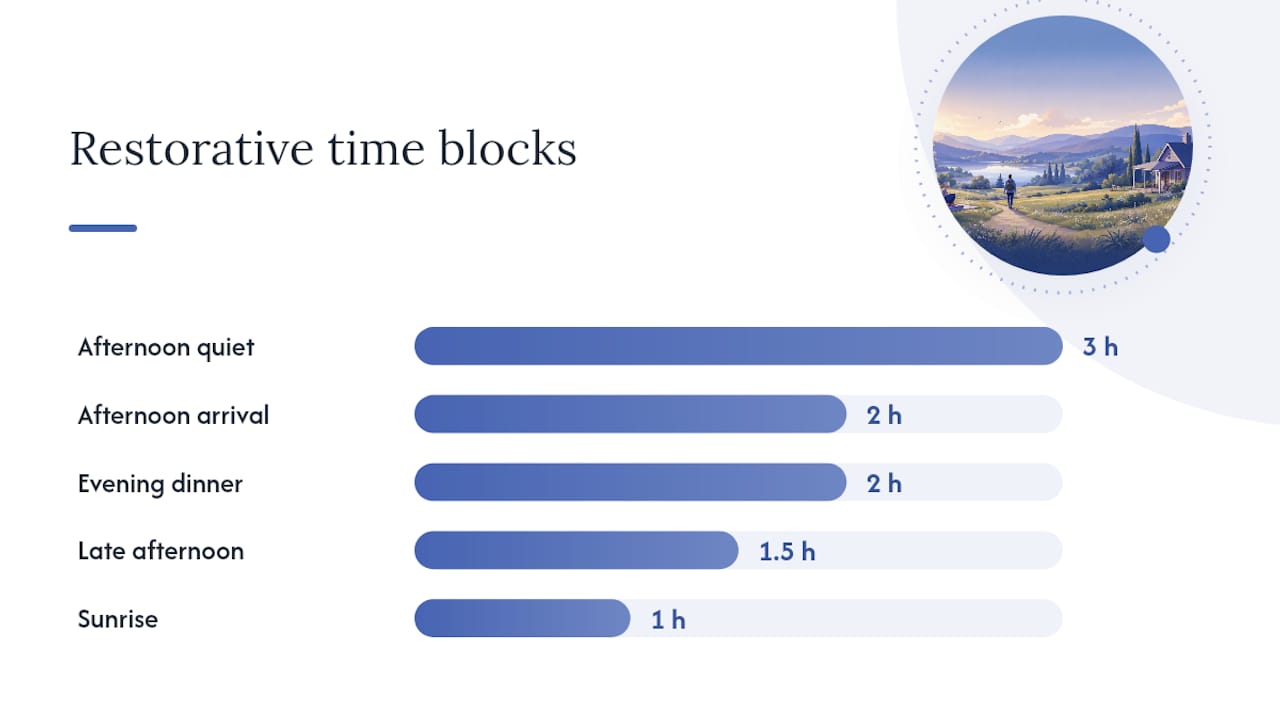
This schedule maps research-backed activities to Luana inn's amenities and the surrounding Big Island landscape.
Day 1
- Afternoon arrival (2:00–4:00 PM): Check in, settle into your room, and take a 20-minute grounding walk on the property. No agenda, no destination.
- Late afternoon (4:00–5:30 PM): Soak in the hot tub or take a quiet swim in the chlorine-free pool. Gaze at the bay as the light shifts.
- Evening (6:00–8:00 PM): Farm-to-table dinner, low in stimulants. Couples: share the meal without screens. Solo travelers: eat slowly and notice the flavors.
- Night (9:00 PM): Sleep-focused room prep. Blackout the room, lower the temperature, and leave devices outside the bedroom.
Day 2
- Sunrise (6:00–7:00 AM): Watch the pastel sunrise over Mauna Loa from your private entrance or lanai.
- Morning (7:30–9:00 AM): Farm-to-table breakfast, then a guided nature walk on the Ka'awaloa trail or along Ke'ei Beach for gentle shoreline exposure.
- Mid-morning (9:30–11:00 AM): Restorative spa treatment or infrared sauna session.
- Afternoon (12:00–3:00 PM): Quiet time. Read, rest, or sit with the birdsong. Couples can share this window in comfortable silence. Solo travelers may join a guided mindfulness session if offered.
- Late afternoon (3:30–5:30 PM): Optional dolphin-watching or a slow walk to Manini Beach for wildlife connection.
- Evening: Repeat the low-stimulant dinner and early sleep routine.
Day 3 (checkout): A final sunrise breakfast, a short reflective walk, and a relaxed departure. Avoid scheduling anything demanding for the afternoon after you leave.
How strong is the evidence, and what researchers still don't know
The research base is genuinely promising, and it is worth being clear-eyed about its limits.
Common study limitations:
- Many field experiments use small samples, making effect sizes harder to generalize
- Heterogeneity across studies is high: different landscapes, durations, populations, and outcome measures make direct comparisons difficult
- Most outcomes are short-term; evidence for sustained clinical benefits beyond a few weeks is thin
- Expectancy effects are hard to rule out in open-label nature studies
What moderates the benefit: dose matters. Longer stays and repeat visits produce stronger and more durable effects. Baseline distress level also matters: guests with higher starting stress tend to show larger gains. Guided programming adds value over unstructured time, particularly for attention and heart rate outcomes. Clinical populations often show the largest improvements, which is also why rural stays should complement, not replace, professional care.
Treat the evidence as a strong signal, not a guarantee. The consistency across cortisol, HRV, mood, and attention measures across different study designs is what makes the case compelling, even when individual effect sizes vary.
What we've learned from building restorative stays at Luana inn
The research on Attention Restoration Theory and Stress Reduction Theory shaped how Luana inn approaches every room placement and package design. Rooms face Kealakekua Bay and the foothills of Mauna Loa deliberately, because water views and tree cover are the two landscape elements most reliably tied to restorative outcomes. The chlorine-free pool, hot tub, and infrared sauna support parasympathetic activation between activities, not as luxury add-ons but as functional recovery tools. Private entrances and bathrooms keep stimulation low from the moment you arrive. Farm-to-table breakfasts use local, low-stimulant ingredients that support overnight cortisol regulation rather than spiking it.
Mountain lodging at this elevation also means cooler nights, which research consistently links to deeper sleep. The property's position on Napo'opo'o Road keeps road noise minimal and birdsong prominent, the exact soundscape combination the evidence favors. If you want to ask about staff wellness credentials, package inclusions, or a custom restorative program, contact the inn directly before booking.
Ready to rest? Here's how to book a restorative stay at Luana inn

Luana inn offers something most wellness travelers spend months searching for: a property where the research-backed features are already built in. Quiet rooms with bay and mountain views, a chlorine-free pool, hot tub, infrared sauna, guided nature walks, and farm-to-table breakfasts come together in a small, private setting on the Big Island. You're not choosing between luxury and restoration. You get both.
Browse available rooms and packages to find the right fit for your stay length and goals. When you book, request a birdsong-facing room with sunrise views and let the team know if you'd like a sleep-focused room setup or a custom wellness package. Check availability and reserve your stay directly through the inn's booking page.
A perspective on what the research actually means for your next stay
Most wellness content treats the science of nature and recovery as a footnote. The real finding is structural: your nervous system is not broken when you feel depleted after months of city life and screen time. It is doing exactly what it was built to do, staying alert in a high-demand environment. The problem is that modern life rarely gives it permission to stop.
What rural retreats do, when they are designed well, is remove that permission barrier. The birdsong, the open water, the absence of traffic noise, the unhurried meal: none of these are luxuries in the decorative sense. They are the specific inputs your parasympathetic nervous system needs to shift gears. The research on cortisol and HRV is not telling you that nature is nice. It is telling you that your body responds to these inputs with measurable, predictable changes, and that two to three days is enough to start the process.
The part most guides miss is this: the quality of the environment matters as much as its rurality. A noisy rural property near a highway does not produce the same outcomes as a quiet one with birdsong and water views. That is why the booking checklist in this article is not optional reading. Choosing the right room, the right soundscape, and the right programming is the difference between a pleasant trip and a stay that actually changes how you feel when you get home.
Sources
- Acute Effects of Exposure to a Traditional Rural Environment on Urban Dwellers: A Crossover Field Study in Terraced Farmland - PMC
- Forest therapy for psychological stress and emotional disorders: a systematic review and meta-analysis | BMC Public Health | Springer Nature Link
- Both restored forest and birdsong promote psychological wellbeing (Environmental Conservation / Cambridge Core)
- A Guide to Nature Immersion: Psychological and Physiological Benefits