Contrast therapy provides reliable short-term recovery benefits, especially faster biochemical recovery after intense exercise, but proof of lasting long-term health gains has not been established. The strongest evidence backs three things: reduced creatine kinase (a marker of muscle damage), less swelling after acute injuries like ankle sprains, and short-term pain relief. If you have cardiovascular risk factors, talk to a clinician before alternating hot and cold extremes.
TL;DR:
- Contrast therapy most effectively reduces muscle damage markers like creatine kinase, with a high ranking among recovery methods based on meta-analyses.
- Its benefits for pain relief, swelling reduction, and mobility improvements are consistently observed in short-term studies, but protocols vary widely.
- The strongest evidence supports applying contrast therapy immediately or shortly after intense exercise, with a temperature gap of around 20 to 25 degrees Celsius for 14 to 20 minutes.
- People with cardiovascular risks, circulatory disorders, or other health conditions should seek medical clearance before attempting contrast therapy.
- It functions as a supportive recovery tool, not a long-term health solution or disease modifier, and should be integrated into a broader routine including active recovery, sleep, and nutrition.
Table of Contents
- What Is Contrast Therapy Benefits and How Do People Practice It?
- How Does Contrast Therapy Work Inside the Body?
- What Does the Research Say About Contrast Therapy for Recovery?
- What Physical and Mental Benefits Can You Actually Expect?
- How Do You Practice Contrast Therapy Safely at Home or a Facility?
- Who Should Avoid Contrast Therapy or Get Medical Clearance First?
- How Do You Fit Contrast Therapy Into a Real Recovery Routine?
- Who's Behind This Guide and Where You Can Experience Guided Recovery
- How Should You Actually Prioritize Contrast Therapy?
- Experience Guided Recovery at Luana Inn
- Sources
- FAQ
What Is Contrast Therapy Benefits and How Do People Practice It?
Contrast therapy means alternating between hot and cold exposure, usually water, in a structured cycle. You'll see it called contrast water therapy, contrast hydrotherapy, hot/cold plunge protocols, or simply contrast baths depending on the setting and who's writing about it. All of these refer to the same underlying idea: shift your tissue temperature up, then down, then up again, rather than picking one extreme and staying there.
That distinction matters more than it sounds. Single-modality heat therapy (a hot tub session, a heating pad) mainly relaxes muscles and boosts local blood flow. Single-modality cold therapy (an ice bath, a cold plunge) constricts blood vessels and numbs pain signals. Contrast therapy tries to get both effects in one session by forcing your circulatory system to respond twice, once to heat, once to cold, in quick succession.
You'll encounter a few common setups depending on where you practice it:
-
Home contrast baths: Two basins or a single tub, filled first with hot water, then swapped or refilled with cold, feet or limbs submerged in cycles.
-
Gym or recovery studio setups: A dedicated cold plunge tank paired with a traditional sauna, used sequentially after training.
-
Infrared sauna plus pool or hot tub: A gentler variation, common at wellness-focused properties, where infrared heat replaces steam heat and a chlorine-free pool or hot tub provides the cold or cool contrast.
-
Contrast showers: The simplest version, alternating hot and cold water at the tap, often used by people without access to a plunge tank or sauna.
None of these setups is inherently superior. What matters more is the temperature gap and how consistently you cycle between the two, which we'll get into further down.
How Does Contrast Therapy Work Inside the Body?
The core mechanism is straightforward: heat dilates blood vessels, cold constricts them, and cycling between the two creates a pumping action that pushes blood and lymph fluid through tissue faster than either temperature alone. Vasodilation from the hot phase floods muscle tissue with oxygenated blood. Vasoconstriction from the cold phase pushes blood and metabolic waste back toward the core. Repeat that cycle several times and you get something closer to a mechanical flush than a passive soak.
There's also a nervous system component. Alternating temperature extremes appears to alter nerve conduction velocity and triggers what researchers call a gate-control effect on pain, essentially competing sensory signals that can dull the perception of soreness. Cold exposure also drives a burst of catecholamines (adrenaline and related compounds), which likely explains why so many people report feeling alert, even mildly euphoric, right after a session.
On the inflammatory side, the picture is more nuanced. Contrast therapy seems to influence markers like creatine kinase, an enzyme that leaks into the bloodstream when muscle fibers are damaged, without fully suppressing the inflammatory response the way constant icing might. That's a meaningful difference from ice-only protocols, some of which may blunt the adaptive signaling your muscles need after training. Whether contrast therapy strikes a better balance is still being studied.
A few mechanisms researchers point to most often:
- Alternating vasodilation and vasoconstriction, creating a circulatory "pumping" effect through muscle and lymphatic tissue.
- Gate-control pain modulation from competing temperature and pressure signals reaching the spinal cord.
- Catecholamine release during cold exposure, contributing to short-term alertness and mood lift.
- Shifts in local metabolic waste clearance, which may explain measurable drops in creatine kinase.
Here's a number worth knowing: a network meta-analysis of 57 studies covering 1,220 participants found contrast water therapy ranked highest among recovery methods for reducing creatine kinase, with a SUCRA score near 79.9%. SUCRA is a statistical ranking tool that estimates how likely a treatment is to be the best option among several compared, and a score that high puts contrast therapy ahead of cold-only or heat-only approaches in that specific analysis. It's one reason contrast therapy keeps showing up in serious recovery discussions rather than fading as a wellness fad.
The inconsistency in other trial outcomes usually traces back to protocol differences rather than the mechanism failing. A study using a 2 degree Celsius temperature gap for 20 minutes is not testing the same intervention as one using a 25 degree gap for six minutes, even though both get labeled "contrast therapy" in the literature.
What Does the Research Say About Contrast Therapy for Recovery?
The evidence for contrast therapy is genuinely strong in one narrow area, biochemical muscle recovery, and considerably weaker everywhere else. That gap between the strongest claim and the average claim is the single most important thing to understand before you build a recovery plan around it.
The 2024 network meta-analysis mentioned above pooled 57 separate studies and 1,220 participants comparing contrast water therapy against cold-water immersion, heat-only treatment, and passive recovery. Contrast water therapy came out on top for reducing creatine kinase levels after exercise-induced muscle damage, with that 79.9% SUCRA ranking. That's a large, well-aggregated dataset by sports medicine standards, and it gives contrast therapy real standing as a biochemical recovery tool.
A separate 2025 scoping review took a broader lens, examining contrast therapy's role across musculoskeletal pain conditions generally, not just post-exercise soreness. Its conclusion: short-term improvements in pain, range of motion, and function show up consistently across the literature, but the review's authors flagged major heterogeneity in study protocols and generally modest trial quality as real limitations on how confidently anyone should generalize those findings.
That heterogeneity problem is worth sitting with for a second. When one trial cycles 30-second bursts and another runs 3-minute phases, when one uses 8°C water and another uses 18°C, you're not really comparing the same intervention twice. Researchers doing meta-analyses have to pool these mismatched protocols together, which weakens the confidence you can place in any single average result. It's a structural problem in the field, not a flaw in any individual study.
Here's how the major evidence sources stack up:
| Source | Study type | Sample size | Key finding |
|---|---|---|---|
| BMC Musculoskeletal Disorders network meta-analysis | Network meta-analysis | 57 studies, 1,220 participants | Contrast water therapy ranked highest for creatine kinase reduction (SUCRA ≈ 79.9%) |
| PMC scoping review | Scoping review | Multiple RCTs and clinical studies | Short-term gains in pain, ROM, and function; high protocol heterogeneity noted |
| 2016 ankle sprain RCT | Randomized controlled trial | 115 participants | Reduced swelling at day 3 versus standard recovery care |
The practical takeaway sits between enthusiasm and skepticism. Short-term biochemical and swelling improvements have decent backing across multiple studies. Soreness relief and functional performance gains, meaning things like next-day strength or jump height, are far more mixed and depend heavily on which protocol you're looking at. If someone tells you contrast therapy "definitely speeds recovery," ask them to specify which outcome they mean, because the answer changes depending on what you measure.
What Physical and Mental Benefits Can You Actually Expect?
The benefit people cite most, faster recovery, is real but narrower than marketing copy suggests. It shows up most clearly in biochemical markers and swelling reduction, less clearly in subjective soreness, and only briefly in mood and alertness.
Faster biochemical recovery. That creatine kinase reduction from the network meta-analysis is the clearest, best-supported physical benefit contrast therapy offers. Lower creatine kinase levels after intense training generally track with less muscle fiber damage, which may translate to feeling ready to train again sooner. It doesn't guarantee better performance in your next session, though; researchers have noted that lab markers like creatine kinase don't always move in lockstep with functional outcomes such as jump height or strength output.
Reduced swelling after acute injury. The 2016 randomized trial of 115 participants with ankle sprains found measurably less swelling at day 3 in the contrast hydrotherapy group compared to standard recovery approaches. That's a concrete, dated data point for anyone dealing with an acute soft-tissue injury, not just post-workout soreness.
Short-term pain relief and mobility gains. The 2025 scoping review found consistent short-term improvements in pain and range of motion across musculoskeletal conditions, including some osteoarthritis research. The word "short-term" is doing real work in that sentence: nobody has shown contrast therapy changes the long-term trajectory of joint disease.
Beyond the physical side, most people notice a mental lift within minutes of finishing a session:
- A temporary mood boost and sense of alertness, likely tied to the catecholamine surge triggered by cold exposure.
- A feeling some describe as mild euphoria immediately after cycling out of the cold phase.
- Subjective reports of feeling "reset" or mentally clearer, though this hasn't been tracked in rigorous long-term mental health trials.
One honest caveat belongs here: reviewers and clinicians agree that contrast therapy's role is supportive symptom management, not disease modification or lasting mental health treatment. If you feel fantastic after a session, that's a genuine physiological response, just not evidence of durable change.
How Do You Practice Contrast Therapy Safely at Home or a Facility?
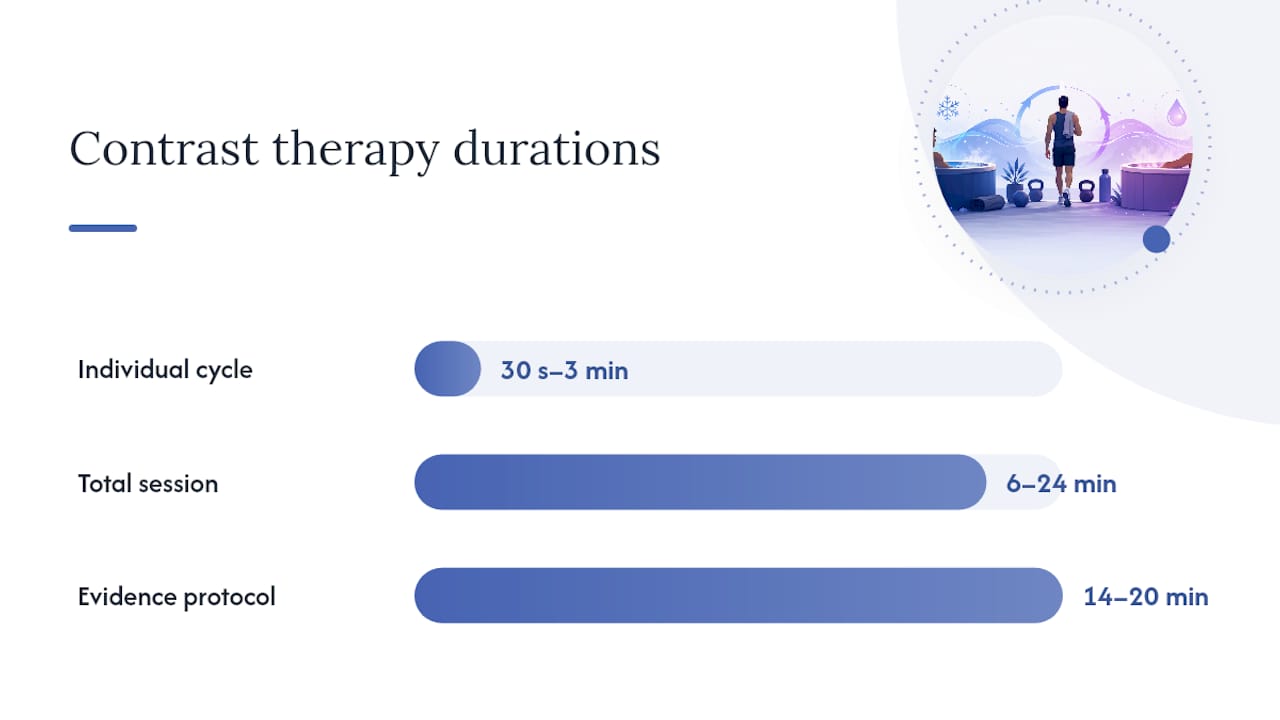
Study protocols vary widely, but most fall within recognizable ranges. Hot phases typically run 36 to 40°C, cold phases run 5 to 20°C (commonly landing between 8 and 15°C in trials), individual cycles last anywhere from 30 seconds to 3 minutes, and total session length spans 6 to 24 minutes.
One protocol worth naming specifically: alternating roughly 1 minute at 38°C with 1 minute at 15°C for a total of 14 minutes showed strong early results in a review of cold, heat, and combined recovery therapies. It's not the only approach that works, but it's a reasonable, evidence-informed starting point if you want a structured number rather than guessing.
Here's a step-by-step approach for trying it yourself:
- Warm up your baseline. Confirm you're not already overheated or chilled from exercise before starting; extreme starting points skew how your body responds.
- Start with the hot phase. Submerge in water around 38°C, or spend time in a sauna, for 1 to 3 minutes.
- Switch immediately to cold. Move to water around 15°C, or a cold plunge, for 1 minute. Use a thermometer rather than guessing; "cold" from the tap varies wildly by season and location.
- Repeat the cycle. Aim for 4 to 6 full cycles, totaling somewhere between 14 and 20 minutes depending on how your body tolerates it.
- End on cold. Most protocols finish on the cold phase to lock in vasoconstriction and reduce residual swelling.
- Rehydrate and rest. Give yourself 10 to 15 minutes before jumping into another demanding activity.
If you're using a sauna and cold plunge combination rather than water immersion, the same cycle logic applies. An infrared sauna session after a workout followed by a cool pool or hot tub dip mimics the same vasodilation and vasoconstriction pattern, just with gentler, more radiant heat instead of steam.
Pro Tip: If you're new to contrast therapy, start with a smaller temperature gap, something like 30°C to 20°C, rather than jumping straight to extreme hot and cold. Your circulatory system adapts over a few sessions, and starting mild helps you gauge your own tolerance before pushing toward the tighter, more intense ranges used in research protocols.
Who Should Avoid Contrast Therapy or Get Medical Clearance First?
Alternating temperature extremes puts real, measurable stress on your cardiovascular system, and that's exactly where the caution belongs. Both heat and cold trigger sympathetic nervous system activation on their own; cycling between them back to back compounds that effect, which is why certain groups need a conversation with a doctor before trying it.
The American Medical Association's guidance on cold plunges and contrast therapy is direct on this point: people with arrhythmia, uncontrolled hypertension, or coronary artery disease face elevated risk from the blood pressure swings that alternating hot and cold can cause. The rapid vasoconstriction from cold exposure, layered on top of an already stressed cardiovascular system, is the specific mechanism of concern.
Beyond cardiac conditions, a few other groups should be cautious or avoid contrast therapy entirely:
-
People with peripheral vascular disease or Raynaud's phenomenon, where cold exposure can trigger painful vasospasm in the extremities.
-
Pregnant individuals, who should check with an OB-GYN before any significant hot or cold exposure protocol.
-
Anyone with open wounds, recent surgery, or post-op restrictions where temperature extremes could interfere with healing.
-
People with poorly controlled diabetes affecting circulation or sensation, since numbness can mask warning signs of tissue damage.
During any session, stop immediately if you notice chest pain, dizziness, lightheadedness, or a feeling like you might faint. Those are not "push through it" signals. If you're unsure whether your health history puts you at elevated risk, a quick conversation with your physician before starting is a far better use of five minutes than finding out the hard way.
How Do You Fit Contrast Therapy Into a Real Recovery Routine?
Timing matters more than most people assume. Using contrast therapy immediately after intense exercise appears to support that early biochemical recovery window, but some evidence suggests delaying it by a few hours may preserve more of the natural inflammatory signaling your muscles use to adapt and get stronger. Neither timing is definitively "correct," so this is a place to experiment and track your own results.
Contrast therapy works best layered into a broader routine rather than treated as the whole plan:
- Pair it with active recovery, like light walking or restorative yoga, rather than replacing movement entirely.
- Protect your sleep and nutrition; no amount of hot and cold cycling compensates for chronic sleep debt or under fueling.
- Treat contrast therapy as one tool among several, not a standalone fix for overtraining or poor recovery habits.
If you notice unusual soreness after cold exposure or a bigger-than-expected blood pressure spike, scale back the temperature gap or shorten your cycles before abandoning the practice altogether.
Pro Tip: Track two or three simple metrics, next-day soreness on a 1 to 10 scale, how many minutes it takes you to fall asleep, and your resting heart rate the next morning, for a couple of weeks with and without contrast therapy. That small experiment tells you far more about whether it's working for your body than any general study can.
Who's Behind This Guide and Where You Can Experience Guided Recovery
This piece was written by Nicole, whose wellness writing draws on evidence-based practice rather than trend chasing, covering topics from sound bath protocols to the kind of quiet, ocean-view stillness that supports recovery just as much as any single technique.
Some wellness-focused properties near Kealakekua Bay offer settings conducive to contrast-style recovery, without positioning any of it as medical treatment:
- Access to an infrared sauna for gentle, radiant heat exposure.
- Use of a chlorine-free pool and hot tub, providing both a cool contrast and soothing soak.
- Availability of spa treatments and wellness packages, including massage services that complement a hot-cold routine.
If you're curious about trying a guided version of this during a stay, staff at similar properties may help you adapt timing and intensity to your own health background. That conversation matters more than following a generic protocol, especially if you have any of the cardiovascular considerations covered above.
How Should You Actually Prioritize Contrast Therapy?
Contrast therapy earns a real spot in a recovery toolbox, but only as an adjunct, not a centerpiece. It can speed up specific biochemical markers and take the edge off acute swelling, and that's a legitimate, evidence-backed reason to use it. What it can't do is substitute for graded rehabilitation, consistent sleep, or actual medical care when something is genuinely wrong.
The individualized dosing point from the scoping review deserves more attention than it usually gets. Clinicians tend to start patients with milder temperature gaps and shorter cycles, then adjust based on how the person actually responds, not based on whatever protocol went viral that month. If you have any cardiovascular risk factors, get clearance first; the downside of skipping that step is disproportionate to the upside of an extra hot-cold cycle.
My honest read: measure your own outcomes, recovery time, soreness, how you sleep, rather than chasing the next headline protocol. The data supports contrast therapy as a useful short-term tool. It doesn't support treating it as a wellness cure-all.
— Nicole
Experience Guided Recovery at Luana Inn
Reading about contrast therapy protocols is one thing. Actually feeling the shift from radiant heat to a cool, quiet pool overlooking Kealakekua Bay is another. Luana inn gives you both, on one eco-friendly property, without needing to build a home setup or hunt for a gym with the right equipment.
Kick back in the infrared sauna, then ease into the chlorine-free pool or hot tub for that natural contrast most people only read about. Pair your stay with a massage or spa treatment starting at $160 per hour, or build a longer recovery-focused stay around one of the wellness packages, which include options like in-room or poolside massage. This is a complementary recovery experience, not a substitute for medical care, so if you have a cardiovascular condition or any concerns raised above, check with your doctor before booking a wellness-heavy itinerary.
Ready to see what a few days of guided rest and gentle contrast exposure feels like against a sunset over the bay? Browse the spa and treatment options and reserve your stay at Luana inn.
Sources
The evidence in this guide rests on four core sources. The network meta-analysis of 57 studies supports the creatine kinase and biochemical recovery claims. The 2025 scoping review backs the short-term pain, mobility, and heterogeneity findings. The 2016 ankle sprain trial grounds the swelling-reduction example. The American Medical Association's commentary anchors every safety and contraindication point in this piece. Together, they represent the clearest available floor of evidence on what contrast therapy can and can't do.
- The effects of hydrotherapy and cryotherapy on recovery from acute post-exercise induced muscle damage—a network meta-analysis | BMC Musculoskeletal Disorders
- Mechanisms and Efficacy of Contrast Therapy for Musculoskeletal Painful Disease: A Scoping Review
- Contrast hydrotherapy reducing swelling after ankle sprain (2016 RCT)
- 4 things to know about cold plunges and contrast therapy | American Medical Association
FAQ
What Does Contrast Therapy Do for Your Body?
It alternates vasodilation and vasoconstriction to boost circulation, most reliably lowering creatine kinase levels and reducing swelling after acute injury, with short-term pain relief in some musculoskeletal conditions.
When Is the Best Time to Do Contrast Therapy?
Right after intense exercise appears to support the early biochemical recovery window measured by creatine kinase, though some evidence suggests waiting a few hours may preserve more natural inflammatory adaptation.
Why Do I Feel So Good After Contrast Therapy?
The cold phase triggers a burst of catecholamines like adrenaline, which produces the alertness and mild euphoria many people notice right after finishing a session; this effect is short-lived and hasn't been linked to lasting mental health gains.
Is Contrast Therapy Worth It?
For short-term goals like faster biochemical recovery, reduced swelling, and temporary pain relief, the evidence says yes; for long-term health claims, the research isn't there yet, so treat it as a supportive tool rather than a cure.
Can I Try Contrast Therapy at Luana Inn?
Luana Inn offers an infrared sauna, a chlorine-free pool and hot tub, and spa services that let guests experience a guided, hot-cold recovery routine as part of a wellness package, always adapted to individual health needs.