The most common greenwashing travel mistakes are easy to fall for: single-issue gestures dressed up as full sustainability programs, vague buzzwords with no numbers behind them, self-styled badges that no independent body recognizes, offset-first carbon claims that skip onsite reductions, wildlife "sanctuaries" with no welfare standards, and influencer-led eco messaging built on aesthetics rather than operations. Knowing what to look for before you book makes all the difference.
Here's a quick scan of the mistakes covered in this guide:
- Trusting a towel-reuse card as proof of a hotel's sustainability
- Accepting "eco," "green," or "responsible" labels with no measurable data
- Assuming a badge on a website is independently verified
- Believing "carbon neutral" claims that rely entirely on purchased offsets
- Booking wildlife encounters marketed as sanctuaries without checking welfare standards
- Taking token gestures (straw bans, bamboo straws) as the whole story
- Following influencer or sponsored "eco" content that focuses on wood décor and plant imagery
- Confusing LEED construction certification with strong daily operational sustainability
Key Takeaways
Greenwashing in travel is most reliably caught by asking for operational metrics and verifying certifications in public registries, not by reading marketing copy.
| Point | Details |
|---|---|
| Verify certifications publicly | Search the property's name in a GSTC-recognized registry; an audit date confirms the claim is real. |
| Ask for baseline metrics | Request kWh per guest-night and water use figures with year-over-year comparisons, not just current commitments. |
| Distrust single-issue gestures | Towel cards and straw bans are visible but represent minor efforts; energy, water, and supply-chain data reveal the real picture. |
| Demand reductions before offsets | A credible carbon claim reduces direct emissions first and offsets only the unavoidable remainder with named registry details. |
| Confirm wildlife welfare standards | Ethical wildlife operators publish group-size limits, no-contact policies, and conservation funding; ask if it's not posted. |
Table of Contents
- What does greenwashing mean in travel, and why does it matter?
- Concrete greenwashing examples in tourism
- Why single-issue gestures create a "sustainability halo"
- How to verify sustainability claims before you book
- Quick red flags to spot at a glance
- What to prioritize instead of falling for greenwashing
- Why this matters to me as a traveler and host
- Sources
What does greenwashing mean in travel, and why does it matter?
Greenwashing, in tourism, means marketing claims about environmental or social responsibility that aren't backed by measurable operational change. A hotel can call itself "eco-friendly" on its booking page while running energy-intensive HVAC systems around the clock, sourcing food from distant industrial suppliers, and sending nearly all waste to landfill. The gap between the claim and the reality is greenwashing.
That gap has real consequences. When you spend money at a property that greenwashes, you're not rewarding genuine sustainability work. You may also be funding practices that harm local ecosystems, displace community income, or contribute to wildlife stress. And if you're trying to reduce your travel footprint, misdirected spending means your climate goals don't land where you intended.
Trusted standards exist to close that gap. Bodies like the Global Sustainable Tourism Council (GSTC), EarthCheck, and Green Key publish criteria and maintain public registries of certified properties. LEED is useful for construction-phase sustainability but doesn't automatically reflect strong daily operations. When a property links to one of these registries and you can find its name there, you're on solid ground. When it can't, you're looking at a marketing claim.
A few practical consequences worth keeping in mind:
- Misdirected spending rewards greenwashing operators and undercuts genuinely sustainable ones
- Misleading carbon claims make it harder to track your actual travel footprint
- Wildlife-washing can fund operations that harm the animals they claim to protect
- Vague "local benefit" claims often mask supply chains that bypass local communities entirely
Concrete greenwashing examples in tourism
Hotels and the towel-reuse trap
The towel-reuse card is the most recognizable example of a single-issue gesture. It's visible, it feels participatory, and it costs the hotel almost nothing to implement. WIRED warns that programs like towel reuse are useful but small compared with energy, water, and supply-chain impacts. A property running diesel generators, importing all its food, and sending kitchen waste to landfill is not a sustainable operation because guests hang their towels.
Certifications you can't verify
Self-styled badges are everywhere on booking platforms. A property might display a green leaf logo it designed itself, or pay a nominal fee to appear on a list that conducts no audits. Responsible Tourism catalogs these as "false labels" and "no proof" greenwashing. The test is simple: click the badge. If it doesn't link to a public registry where you can search the property's name and see an audit date, treat it as a marketing mark, not a certification.
Carbon-neutral claims built on offsets alone
"Carbon neutral" is one of the most misused phrases in travel marketing. A credible carbon claim reduces direct emissions first and uses offsets only for the small unavoidable remainder, citing high-integrity registries and project details. Many voluntary carbon credits used in travel bookings have been found to be low-integrity, with projects that don't deliver the reductions promised. If a property leads with "we offset all our emissions" and says nothing about onsite reductions, that's a red flag.
Wildlife encounters and sanctuary washing
Paid wildlife encounters marketed as "sanctuaries" or "ethical experiences" are a frequent greenwashing vector. Genuinely ethical operations limit group size, avoid direct animal contact, and disclose conservation funding and welfare protocols. World Animal Protection's guidance makes clear that operations allowing riding, bathing with, or close handling of wild animals are almost never operating to genuine welfare standards, regardless of how they market themselves.

All-inclusive resorts and the "local benefit" claim
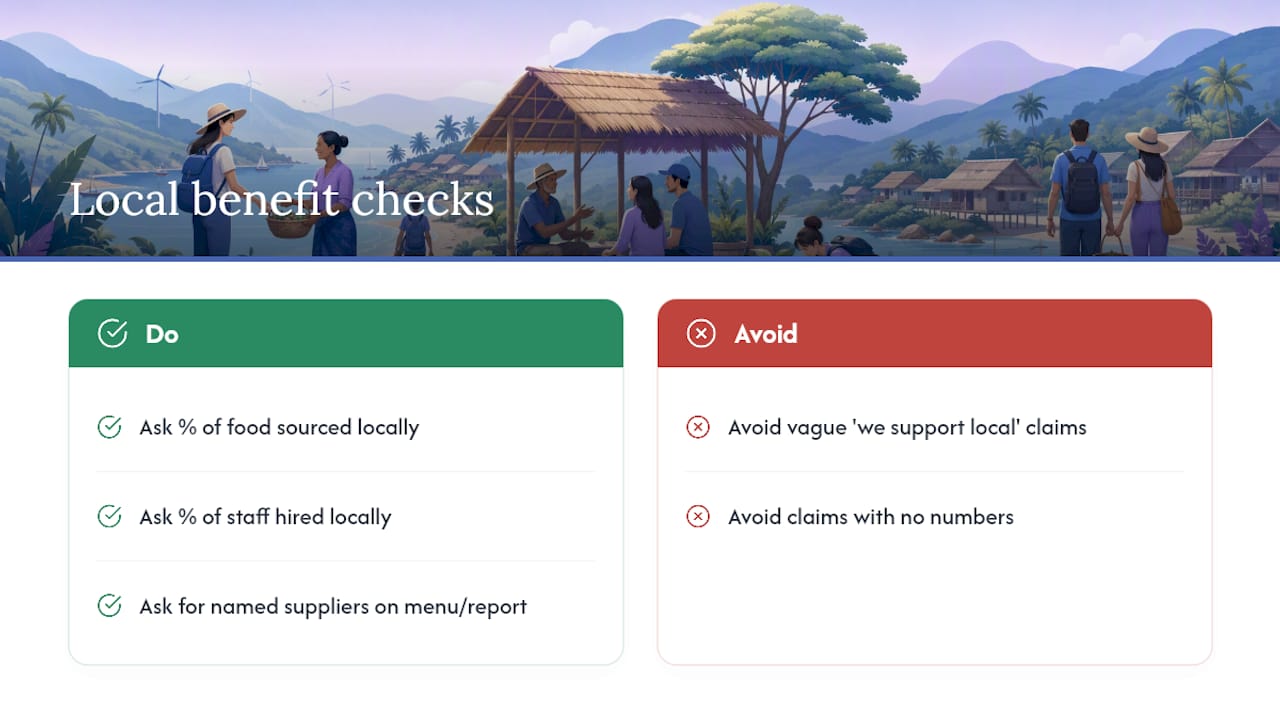
"We support local communities" is a phrase that can mean almost anything. Without numbers, it means nothing. Ask what percentage of food is sourced locally, what percentage of staff are hired from the surrounding community, and whether any named local suppliers appear on the menu or in a published report. Resorts that genuinely contribute to local economies can answer those questions specifically.
Aesthetics over operations
Wood paneling, potted plants, bamboo furniture, and earthy color palettes are not sustainability indicators. Research confirms that visible aesthetics are poor proxies for real operational change. The same applies to influencer posts and sponsored content that focus on how a property looks rather than how it runs. If the sustainability story lives entirely in the photography, keep looking.
Pro Tip: Before booking, open the property's website and search for the words "kWh," "liters," or "waste diversion." If those words don't appear anywhere, the sustainability story is almost certainly surface-level.
Why single-issue gestures create a "sustainability halo"
The sustainability halo is a well-documented effect: one visible, feel-good action creates the impression of broader commitment, even when the underlying operations haven't changed. Impact Travel Alliance identifies single-issue gestures as a major greenwashing pitfall and recommends prioritizing holistic practices like onsite renewable energy and water recycling over token programs.
The mechanism is straightforward. A straw ban is easy to see, easy to photograph, and easy to communicate. Switching to solar power, installing greywater recycling, or auditing a supply chain is expensive, complex, and hard to photograph. So operators who haven't done the hard work lean on the visible gesture. Travelers who don't know to look deeper reward them for it.
A 2026 Frontiers in Sustainability article documents a widening gap between sustainability marketing and actual operational practice, recommending transparency through measurable audits as the true benchmark of commitment. That finding applies directly to travel: the gap between what properties say and what they do is growing, not shrinking.
Pro Tip: Ask for baseline metrics, not just current claims. "What is your energy consumption per guest-night in kWh, and how has that changed over the past two years?" is a question a genuinely sustainable property can answer. A greenwashing one cannot.
How to verify sustainability claims before you book
You don't need hours to check whether a property's sustainability claims hold up. Two minutes and a few targeted questions will tell you most of what you need to know.
Two-minute website checks
- Search the property's name on the GSTC-recognized certifier's public registry (Green Key, EarthCheck, Rainforest Alliance). If it's listed with an audit date, that's a real signal.
- Look for a published sustainability report with a date. Undated reports are often recycled from years past.
- Check whether energy, water, and waste figures appear with baselines. "We reduced water use by 18% from our 2022 baseline" is meaningful. "We are committed to reducing water use" is not.
- Confirm that LEED or similar construction certifications are accompanied by operational data. LEED covers building materials and construction, not necessarily day-to-day energy or water performance.
- Look for named local suppliers, farms, or community partners. Generic "locally sourced" language without names is a soft claim.
Questions to email or ask before booking
Send a short email with a clear subject line. Something like: "Quick sustainability questions before I book" works well and signals you're a serious traveler.
- What percentage of your energy comes from verified renewable sources, and who verifies it?
- What is your water consumption per guest-night, and what reduction methods are you using?
- What percentage of your staff are hired from the local community?
- Can you name the local farms or suppliers you work with?
- What is your waste diversion rate, and where does your food waste go?
- If you offer carbon offsets, which registry and project are they from?
SustainableTravel's guidance reinforces that named certifiers, published metrics with baselines, and skepticism toward image-driven claims are the three most reliable filters a traveler can apply.
Pro Tip: If a property replies with "we care deeply about the environment" and no numbers, that's your answer. A genuinely transparent operator will be glad you asked and will have the data ready.
Certifications worth trusting
- GSTC-recognized schemes (Green Key, EarthCheck, Rainforest Alliance Verified): these require independent audits and appear in searchable public registries
- Certified B Corp status: requires third-party assessment of social and environmental performance
- ISO 14001: an environmental management system standard with external audit requirements
Self-awarded badges, "eco-certified by [property name]," and awards from lists that charge for inclusion are not in this category.
Quick red flags to spot at a glance
Scan for these when you're browsing listings, social posts, or a property's homepage:
- Vague adjectives with no numbers: "eco," "green," "responsible," "sustainable" used as standalone descriptors with no data attached
- Unverifiable badges: logos that don't link to an independent certifier or a searchable public registry
- Offset-first messaging: "We're carbon neutral" with no mention of what was reduced onsite before offsets were purchased
- Influencer-heavy content: sustainability stories told entirely through aesthetics, staged photography, or sponsored posts
- Token actions as the headline: a straw ban, bamboo cups, or a recycling bin in the room presented as the primary sustainability achievement
- No dated reports: sustainability pages with no publication date or metrics that haven't been updated in years
- Wildlife contact without welfare disclosure: encounters that allow riding, bathing with, or close handling of wild animals, with no published welfare standards or conservation funding details
What to prioritize instead of falling for greenwashing
Avoiding eco-friendly travel errors isn't just about saying no to bad actors. It's about knowing what good looks like and choosing it deliberately.
- Prioritize transparency with numbers. Properties that publish energy, water, and waste data with baselines and audit dates are doing the work. That's the clearest signal available.
- Look for supply-chain specifics. Named farms, named suppliers, and a stated percentage of local hiring are concrete. Generic "local sourcing" language is not.
- Favor onsite reductions over offset-first claims. An operator that has cut its energy use by switching to solar and then offsets only what remains is operating with integrity. One that offsets everything without reducing anything is not.
- Choose locally owned or locally integrated accommodations. A small, locally owned property on a clean grid often has a lower footprint than a remote eco-resort accessible only by long-haul flight and private transfer.
- Check wildlife welfare standards explicitly. Ethical operators publish group-size limits, no-contact policies, and conservation funding details. If that information isn't on the website, ask for it.
Pro Tip: A mid-range hotel in a city with a clean electricity grid can have a lower operational footprint than an expensive remote eco-lodge that requires a connecting flight and runs diesel generators. Distance and aesthetics are not sustainability metrics.
Learning to recognize eco-lodging claims that hold up under scrutiny takes practice, but the checklist above covers the most important ground. And if you want to understand what sustainable accommodation actually looks like in operational terms, the indicators are consistent: verified energy sourcing, documented water management, traceable supply chains, and community benefit with numbers attached.
Why this matters to me as a traveler and host
Watching travelers get misled by surface-level sustainability claims is genuinely frustrating, especially when so many people are making real efforts to travel more thoughtfully. The green travel misconceptions that circulate most widely, such as the idea that a bamboo straw or a towel card signals a sustainable operation, are exactly the ones that let operators off the hook for the changes that actually matter.
At Luana inn, we believe that transparency isn't optional. The property sits on the Big Island of Hawaii, where the natural environment is both the draw and the responsibility. What we've found, both as hosts and as travelers ourselves, is that the properties worth trusting are the ones that answer hard questions without hesitation and publish the numbers to back their claims.
If you're planning a stay and want to see what transparent practice looks like in a real property, Luana inn's eco-friendly lodging resources walk through the certifications and operational indicators we consider meaningful.
The single most useful thing you can do before your next trip is send that email with specific questions. The reply, or the silence, will tell you everything.
Sources
These resources are worth bookmarking when you're evaluating sustainability claims on a property's website or booking page:
- Frontiers in Sustainability article on sustainability marketing vs operational practice
- How to spot greenwashing when you travel | WIRED
- How to avoid greenwashing
- How to Spot and Avoid Greenwashing in Tourism
Use certifier registries and offset project registries directly when evaluating claims. A property that can't be found in a public registry after claiming certification is telling you something important.
Ready to experience a stay where the sustainability story goes deeper than the décor? Luana inn offers eco-friendly bed and breakfast accommodations on the Big Island of Hawaii, with transparent practices and a genuine connection to the land. Explore our wellness packages and see what thoughtful hosting looks like in practice.