
Green certification lodging is independently audited accommodation that meets documented standards for energy, water, waste, pollution prevention, and social responsibility. Recognized schemes include GSTC-accredited certification bodies, Green Seal, and Green Key. For you as a traveler, it means the property's "eco-friendly" claims have been checked by someone other than the owner.
Before you book, run this quick checklist:
- Confirm the certifying body is GSTC-accredited or a recognized program (Green Seal, Green Key, Audubon International).
- Ask for the on-site audit date and how often the property is re-audited.
- Look for a certification badge on the booking platform or property website that links to the certifier's directory.
Table of Contents
- What does green certification lodging actually assess?
- Which certification badges should U.S. travelers recognize?
- How does certification improve your stay?
- How can you verify a property's green certification?
- What does a certified stay look like at a Hawaiian B&B?
- How do you spot greenwashing in lodging?
- Does green certification affect price or booking decisions?
- Key Takeaways
- Why certification is only part of the story
- A peaceful, eco-conscious stay on the Big Island
What does green certification lodging actually assess?
Certification programs don't just ask properties to pinky-promise they care about the planet. They require documented, measurable evidence across several areas:
- Energy: metered consumption data, efficient lighting, HVAC maintenance logs
- Water: low-flow fixture records, irrigation tracking, hot-water system efficiency
- Waste: recycling rates, single-use plastic reduction, composting programs
- Purchasing: environmentally preferable products, local sourcing documentation
- Indoor air quality: cleaning product ingredient lists, ventilation maintenance
- Training and guest communication: staff education records, guest-facing signage
- Community and biodiversity: local hiring practices, native landscaping plans
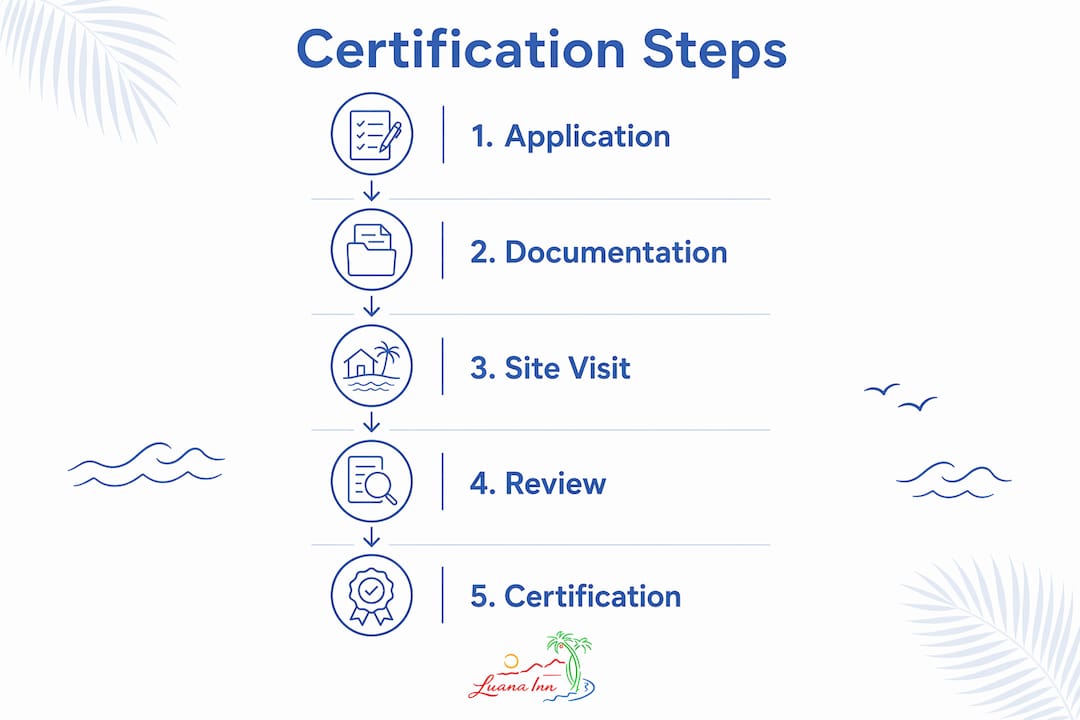
The typical certification lifecycle follows a clear path. A property submits an application and documentation package, then an independent auditor conducts a desk review. An on-site audit follows, where the auditor physically inspects systems, checks logs, and interviews staff. The auditor issues a draft report, the property responds to any gaps, and the certification body issues the certificate. GSTC-accredited certificates are typically valid for three years, with surveillance audits or annual reporting in between.
Audubon International's Green Hospitality Program uses a standardized checklist covering Energy Efficiency, Resource Conservation, Pollution Prevention, and Environmental Management, followed by a site visit that produces an eco-rating and performance report. That structure works well for smaller properties like B&Bs that may not have a dedicated sustainability team.
Which certification badges should U.S. travelers recognize?
| Program | Who Audits | Scope | Best For |
|---|---|---|---|
| GSTC-Accredited CBs | Third-party, GSTC-overseen | Global benchmark: social, environmental, economic | Highest assurance; any size property |
| Green Seal | Independent auditor | Energy, water, waste, air quality, purchasing | U.S. hotels and B&Bs; Google Travel badge eligible |
| Green Key | National jury + on-site audit | annual re-application | Small to mid-size properties; 90+ countries |
| Audubon International | Site visit + eco-rating | Energy, water, pollution, environmental management | Smaller lodging; regional programs |
GSTC sets the global benchmark. It doesn't certify properties directly. Instead, it accredits Certification Bodies that then audit and certify hotels and B&Bs. A GSTC-accredited certificate carries the highest assurance because the certifier itself has been independently evaluated.
Green Seal is a U.S.-based nonprofit whose hotel standard covers waste minimization, energy conservation, water management, pollution prevention, and environmentally preferable purchasing. Certified properties have reported CO2 reductions up to 55% (roughly 400 tons annually) and more than $600,000 in savings from reduced electricity, water, and paper use. Green Seal certification also makes a property eligible for sustainability badges on Google Travel.
Green Key operates in more than 90 countries with over 9,000 certified establishments. Its criteria align with the UN Sustainable Development Goals, and properties must re-apply annually with documented improvements. On-site audits and a jury review are part of the award process, making it a solid choice for small B&Bs that want a continuous-improvement framework.
Audubon International's Green Hospitality Program suits smaller properties well. The self-evaluation survey, site visit, and eco-rating process are approachable for a family-run B&B without a large operations team.
How does certification improve your stay?
The benefits aren't abstract. Certified properties deliver real, guest-facing improvements you can feel during your stay.
- Quieter rooms: Preventative HVAC maintenance, required by programs like Green Seal, keeps systems running efficiently and quietly. No rattling vents at 2 AM.
- Cleaner air: Certified properties use low-VOC or fragrance-free cleaning products and maintain ventilation systems, which matters especially if you're sensitive to chemical smells.
- Reliable hot water: Efficient hot-water systems documented during audits tend to be better maintained, meaning consistent pressure and temperature.
- Less plastic waste: Many certified properties have eliminated single-use toiletries and replaced them with refillable dispensers or locally made alternatives.
- Locally sourced food: Breakfast at a certified B&B often features regional ingredients, which supports local farmers and tastes noticeably fresher.
Green Seal-certified hotels have reported CO2 reductions up to 55% and more than $600,000 in combined savings from electricity, water, and paper reduction.
Certification also tends to surface hidden operational improvements. Properties that pursue third-party audited certification often discover maintenance issues they didn't know existed, and fixing those issues directly benefits guests through quieter, more comfortable rooms. For a Hawaiian B&B, where the whole point is to relax and soak up the natural beauty around you, that kind of operational care makes a real difference.
How can you verify a property's green certification?
Don't take a "we're eco-friendly" header at face value. Here's how to check:
- Name the certifier. Ask which program certified the property. "We're green" is not an answer. "We're Green Seal certified, certificate number GS-XXXX, renewed in 2024" is.
- Request the audit date. A real certification has an issue date and an expiry or renewal date. If the property can't provide one, the badge may be self-declared.
- Check the certifier's directory. GSTC, Green Seal, Green Key, and Audubon International all publish lists of currently certified properties on their websites. Verify the property appears there.
- Look for booking-platform badges. Google Travel displays eco-certified badges for eligible properties. Click the badge to confirm it links to the certifier, not just a property description.
- Ask for evidence. A confident property will share photos of metering equipment, maintenance logs, or a sustainability summary. Hesitation is a red flag.
Red flags to watch for:
- Vague language like "we care about the environment" with no certifier named
- No audit date or certificate number
- A badge that looks homemade or links nowhere
- Claims focused on a single initiative ("we recycle") with no broader program
Pro Tip: Ask specifically: "Which certification body issued your certificate, and when does it expire?" Certifiers publish current certified-property lists online, so you can cross-check the answer in about 30 seconds.
What does a certified stay look like at a Hawaiian B&B?
Hawaii's island setting shapes how certified practices show up in practice. A few things you're likely to notice at a certified B&B on the Big Island:
- Water-smart plumbing: Low-flow showerheads and faucets that still feel comfortable, not punishing. Certified properties balance conservation with guest comfort.
- Native landscaping: Gardens planted with native Hawaiian species need far less irrigation than imported ornamentals, which also means quieter, more natural surroundings for you.
- Fragrance-free housekeeping: Staff trained to use unscented, low-chemical cleaning products, so your room smells like fresh air rather than industrial cleaner.
- Linen reuse options: Clear, friendly signage giving you the choice to skip daily linen changes, framed as a guest preference rather than a guilt trip.
- Locally sourced breakfast: Eggs from a nearby farm, tropical fruit from the property's own trees, or Kona coffee from a local roaster.
Before booking, you might ask: "Do you use fragrance-free cleaning products?" and "How often is your HVAC system serviced?" A property that answers confidently and specifically is one that has thought carefully about your comfort, not just its marketing. You can also explore what eco-friendly lodging benefits look like in practice before you arrive.

How do you spot greenwashing in lodging?
Not every "green" label means the same thing. The gap between a self-declared badge and a third-party audited certification is significant.
- Self-declaration vs. third-party audit: Any property can print a green leaf on its website. Only a certified property has had an independent auditor check its systems, records, and practices in person.
- Vague single-issue claims: "We recycle" or "we use LED bulbs" describes one action, not a program. Genuine certification covers energy, water, waste, air quality, purchasing, and community impact together.
- No measurable outcomes: Certified properties can point to specific numbers: consumption data, audit scores, CO2 reductions. Marketing-only claims stay abstract.
- Missing renewal information: GSTC accreditation and programs like Green Key require continuous improvement and periodic re-audits. A certificate with no renewal date is a warning sign.
Prioritize properties certified by GSTC-accredited bodies or long-standing NGO programs with documented on-site audits. Those programs are designed as continuous-improvement pathways, not one-time badges, so you're choosing a property that keeps working to earn its status.
Does green certification affect price or booking decisions?
Certification doesn't automatically mean a higher room rate. For many small B&Bs, the operational savings from certification (lower energy and water bills) offset the cost of pursuing it, keeping prices competitive. Some certified properties do charge a modest premium, and it's worth asking what you get for it.
- What to weigh: quieter HVAC, better air quality, stable hot water, locally sourced food. If those matter to your stay, the value is real regardless of a small price difference.
- Booking platforms: Google Travel eco-badges and OTA sustainability filters make certified properties easier to find. Use those filters as a starting point, then verify the badge as described above.
- Corporate and group travelers: Certification can unlock green-meetings business for properties, which sometimes means certified B&Bs are better resourced and more attentive to guest experience overall.
The honest answer is that certification signals operational discipline. A property that has gone through a rigorous third-party audit tends to run tighter, quieter, and more consistently than one that hasn't. For a relaxing Hawaiian getaway, that's worth factoring into your decision alongside the nightly rate.
Key Takeaways
Green certification lodging means independently audited accommodation with documented, measurable improvements in energy, water, waste, and air quality — verified by a named certifying body, not just claimed in marketing copy.
| Point | Details |
|---|---|
| Highest-trust badges | Prefer GSTC-accredited certification bodies, Green Seal, or Green Key — all require on-site audits and published renewal dates. |
| Verification step | Ask for the certifier name and certificate expiry date, then confirm the property appears in the certifier's online directory. |
| Guest comfort link | Certified measures like HVAC maintenance, low-VOC cleaning, and low-flow plumbing directly improve quiet, air quality, and water reliability. |
| Greenwashing check | A vague "eco-friendly" claim with no certifier name, no audit date, and no measurable outcomes is a red flag, not a credential. |
| Luana inn | Ask Luana inn directly about its sustainability practices and request any available documentation before booking your Big Island stay. |
Why certification is only part of the story
Green certification gives you a verified baseline, and that matters. But the most peaceful, comfortable stays I've seen described at Hawaiian B&Bs come from something harder to audit: genuine care for the guest experience woven into every daily decision.
At Luana Inn, overlooking Kealakekua Bay with Mauna Loa rising behind it, the setting itself does a lot of the work. The native landscaping keeps things quiet and private. The morning light over the mountain is the kind of thing you don't forget. What makes that experience hold together is attentiveness: staff who know when to be present and when to give you space, a breakfast that reflects the island rather than a generic hotel buffet, and systems that work without intruding on your rest.
My honest view is that travelers sometimes over-index on certification labels and under-ask about the specific practices that will actually affect their stay. A GSTC-accredited certificate is a strong signal, but so is a host who can tell you exactly which cleaning products they use and why. Ask both questions. The answer to the second one often tells you more.
Certification is a floor, not a ceiling. The best certified properties treat it as a starting point and keep improving. That's the continuous-improvement model Green Key and Green Seal are built around, and it's the right way to think about it when you're choosing where to spend a week on the Big Island.
A peaceful, eco-conscious stay on the Big Island
If you're looking for a B&B that takes both comfort and environmental care seriously, Luana Inn is worth a close look. Perched in the foothills of Mauna Loa and overlooking Kealakekua Bay, the property offers the kind of quiet, unhurried stay that certified sustainable practices are designed to support: well-maintained systems, thoughtful housekeeping, and a setting that lets the island do what it does best.
When you reach out, ask about specific sustainability measures that matter to you, whether that's cleaning products, water systems, or breakfast sourcing. The team is happy to walk you through what's in place. Check availability and explore the rooms to find the right fit for your Big Island getaway, or visit Luana Inn to start planning your stay.