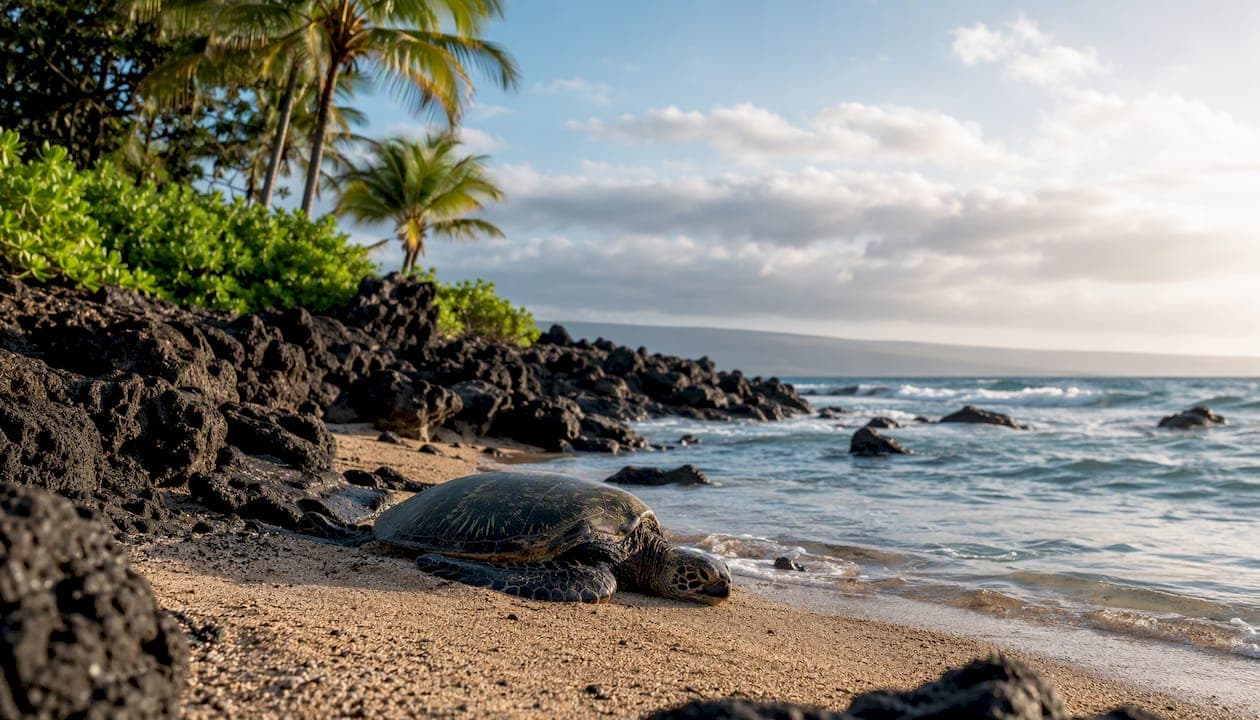
Keep wildlife wild. That is the single rule that covers every beach, bay, and trail on the Big Island. In practice, it means staying at the legal minimum distance from every animal you see, never touching or feeding them, and booking only with operators who let the animal decide whether an encounter happens at all. This Hawaii ethical wildlife encounter guide gives you the exact distances, the laws behind them, and a field-ready checklist so you can plan responsibly from day one.
Quick dos and don'ts by species:
- Green sea turtle (honu): Stay at least 10 feet away on land; give more space in the water. Never touch, block, or shadow a turtle. Touching or feeding honu is prohibited under the Endangered Species Act.
- Hawaiian monk seal: Keep at least 50 feet back; 150 feet if a mother is with a pup. Never attempt to return a seal to the water, even if it looks stranded.
- Spinner dolphins: Maintain 50 yards minimum. Do not enter the water with resting dolphins in nearshore bays.
- Humpback whales: Stay 100 yards away by boat; 300 yards from a mother-calf pair. Viewing time should not exceed 30 minutes per group.
- Manta rays: Observe from a respectful distance; no touching, no chasing, no flash photography.
- Nēnē (Hawaiian goose): Do not feed. Keep dogs leashed and give them a wide berth on trails.
Legal risks at a glance: The Marine Mammal Protection Act (MMPA) and Endangered Species Act (ESA) both apply in Hawaiian waters. Harassment of a protected marine mammal can result in civil penalties up to $11,000 per violation under the MMPA. Hawaii state law (HRS §195D) adds state-level protections for native species. Fines for approaching whales too closely, disturbing a resting monk seal, or touching a honu are real and enforced.
Key Takeaways
Keeping wildlife wild in Hawaii means combining legal compliance, operator vetting, and personal restraint every time you are near an animal.
| Point | Details |
|---|---|
| Maintain legal distances | Keep 10 ft from honu, 50 ft from monk seals, 50 yards from spinner dolphins, and 100 yards from humpback whales. |
| Verify operator credentials | Ask for the NOAA or DLNR permit number before booking; no-touch policy and small group size are non-negotiable. |
| Use reef-safe sunscreen | Hawaii bans oxybenzone and octinoxate; use non-nano zinc oxide products to protect reef ecosystems. |
| Report violations promptly | Document vessel name, time, and location, then report to NOAA Pacific Islands and DLNR DOCARE. |
| Luana inn as your base | Luana inn's Captain Cook location gives guests shore access, local operator knowledge, and ethical itinerary support. |
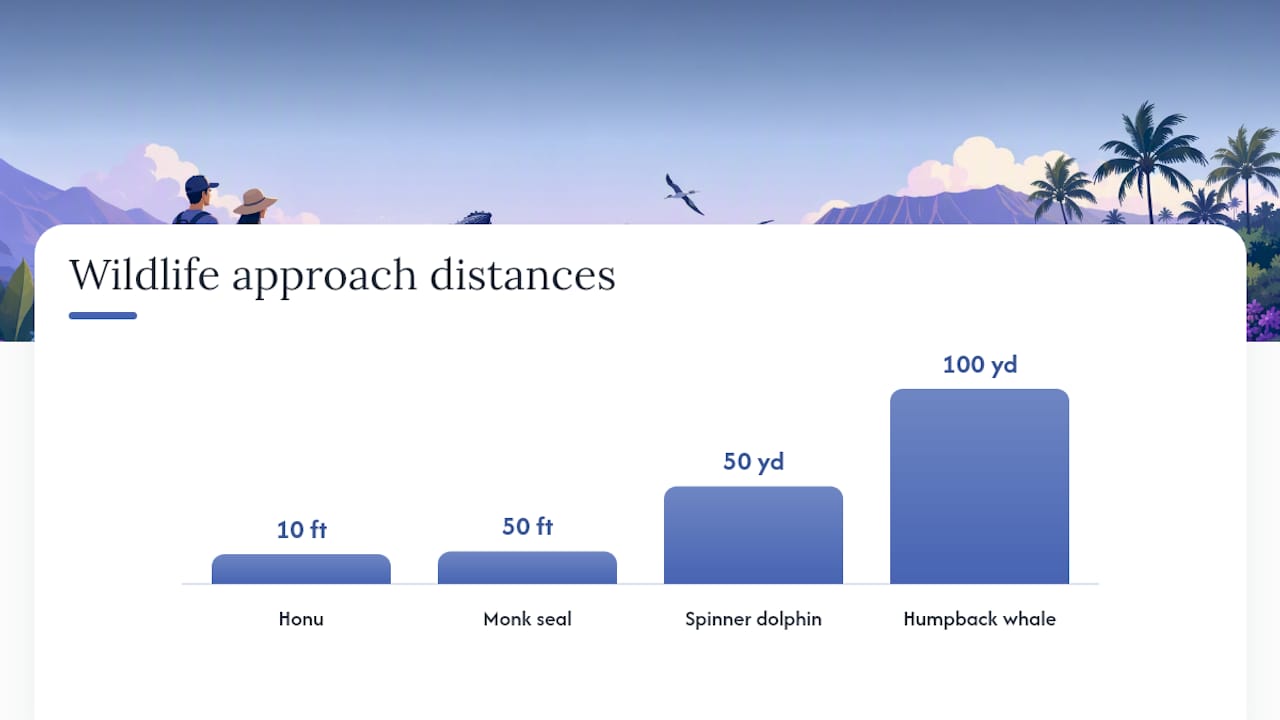
Table of Contents
- What does responsible wildlife behavior look like for each Hawaiian species?
- What U.S. and Hawaii laws actually require from you
- How do you choose a truly ethical wildlife tour operator?
- Shore and ocean etiquette for snorkelers, divers, kayakers, and boaters
- How do you spot greenwashing and protect yourself from exploitative operators?
- Luana inn's local tips for Big Island wildlife viewing
- Why shore-based viewing changed how I think about wildlife travel
- Plan your ethical Big Island stay with Luana inn
- Sources
What does responsible wildlife behavior look like for each Hawaiian species?
Green sea turtles (honu)
Honu are federally protected under both the ESA and the MMPA. When a turtle hauls out on a beach to rest, it is not sick; it is recharging. Approaching, casting a shadow over, or blocking its path back to the ocean counts as harassment. In the water, give turtles room to surface naturally. If one swims toward you out of curiosity, hold still and let it pass rather than reaching out. Report any turtle in obvious distress to NOAA's Pacific Islands Regional Office.
Hawaiian monk seal
One of the most endangered marine mammals on Earth, the Hawaiian monk seal needs undisturbed rest to survive. NOAA Fisheries warns that seals can be aggressive when startled and that well-meaning attempts to push a resting seal back into the water can be fatal. If you find a seal on a beach, stay back and keep others back too. Volunteer organizations often rope off resting areas; respect those boundaries without exception.
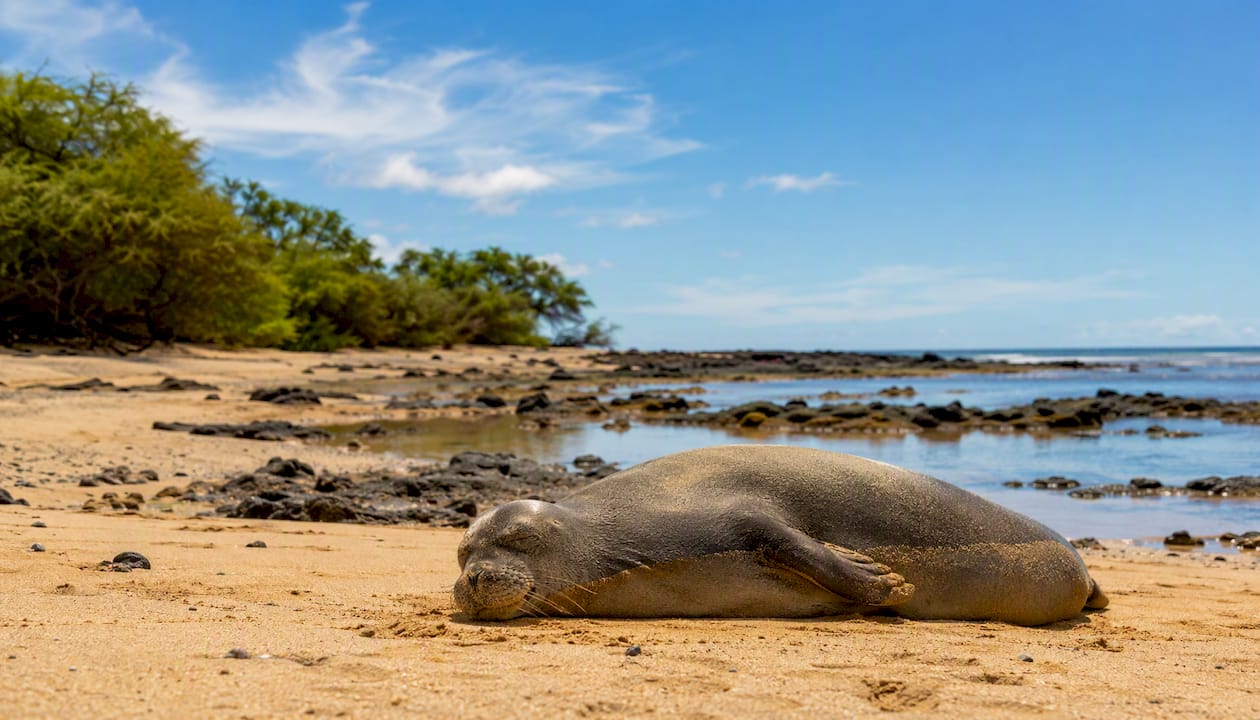
Pro Tip: If a monk seal is on the beach near your entry point, choose a different spot to enter the water. A 15-minute walk down the coast is a small price for the animal's safety.
Humpback whales
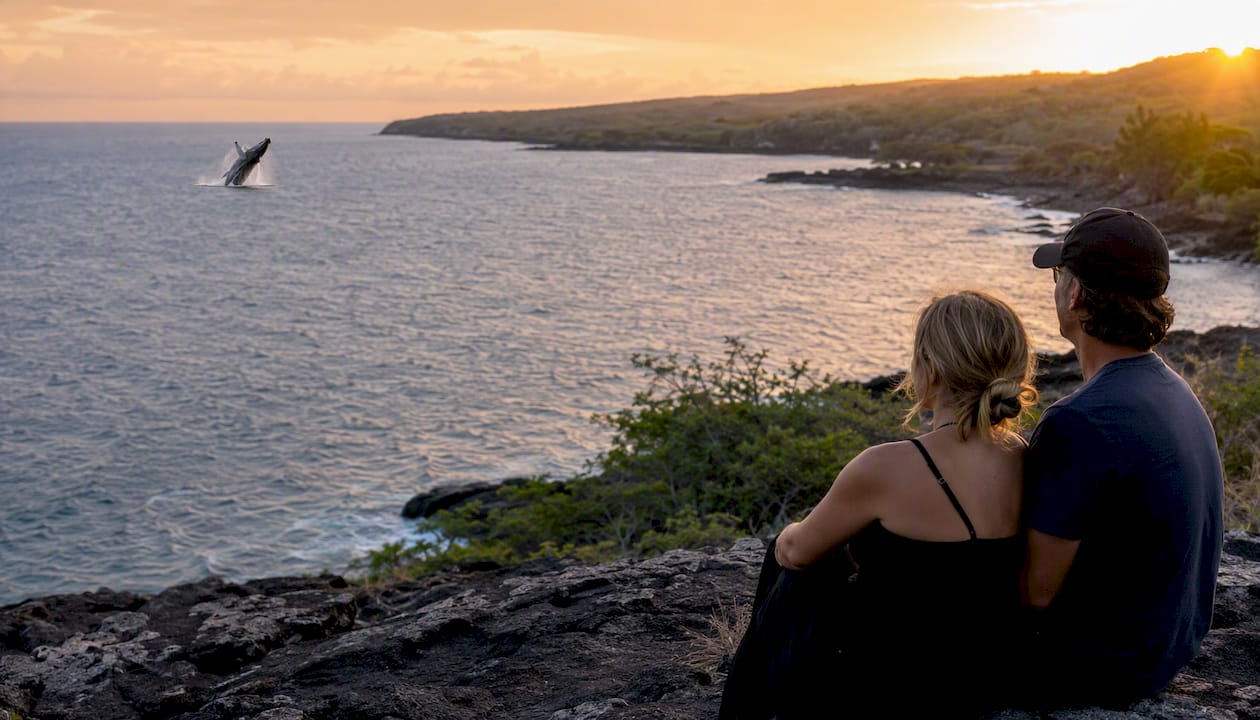
Humpbacks arrive in Hawaiian waters from roughly November through May to breed and calve. The 100-yard approach rule applies to all vessels; 300 yards for mother-calf pairs. Shore-based viewing from elevated points like the Ka'awaloa trail area above Kealakekua Bay gives you a safe, spectacular vantage point without any boat disturbance to the animals. If a whale approaches your vessel, put the engine in neutral and let it pass.
Spinner dolphins
Spinner dolphins use nearshore bays during daylight hours to rest after nighttime feeding. Entering the water with them during these rest periods disrupts their sleep cycle and can affect their health over time. NOAA's Pacific Islands guidance specifies a 50-yard distance and prohibits swimming with resting dolphins in designated rest areas. Watch from the shore or from a respectful distance on a kayak. A pod that is actively leaping and spinning offshore is behaving normally; a pod hugging the shallows in tight formation is resting and should not be approached.
Manta rays
Manta rays are not protected under the MMPA, but they are listed under the ESA as a species of concern. The ethical standard is the same: no touching, no chasing, no flash photography underwater. Mantas are drawn to lights at night, which is why night snorkel tours exist. On those tours, stay neutrally buoyant, keep your fins away from the bottom, and let the rays circle on their own terms.
Nēnē (Hawaiian goose)
Hawaii's state bird is recovering from near-extinction, and DLNR's nēnē conservation guidance is clear: do not feed nēnē under any circumstances. Human food disrupts their diet and makes them dependent on people, which increases road mortality. On trails near Volcanoes National Park or Mauna Loa, give them space and keep any dogs on a leash.
Seabirds and reef invertebrates
Albatross nesting colonies on the Big Island's northern coast are active from November through July. Stay on marked paths, keep noise low, and never approach a nest. On the reef, the same principle applies: if you cannot hover without touching, you are too close. Stepping on coral kills polyps that took decades to grow.
What U.S. and Hawaii laws actually require from you
Three legal frameworks govern wildlife encounters in Hawaii, and knowing them protects both you and the animals.
Marine Mammal Protection Act (MMPA): Federal law that prohibits the "take" of any marine mammal, where "take" includes harassing, hunting, capturing, or killing. Harassment is defined broadly enough to include approaching too closely, making loud noises near resting animals, or blocking their movement. Civil penalties reach $11,000 per violation; criminal penalties apply to willful violations.
Endangered Species Act (ESA): Covers honu, Hawaiian monk seals, humpback whales, and several seabird species. "Take" under the ESA includes harm and harassment. The ESA also makes it illegal to possess, sell, or transport any part of a listed species.
Hawaii Revised Statutes §195D: State law that mirrors and supplements federal protections for native Hawaiian wildlife, including nēnē and native forest birds. DLNR enforces this statute and can issue citations independently of federal agencies.
Where to confirm current rules before you book:
- NOAA Fisheries laws and policies page for federal approach distances and permit requirements
- DLNR's Division of Aquatic Resources (DAR) for state marine rules and any temporary closures
- The Federal Register for any new or amended rules affecting specific species or areas
| Law | Enforced by | Key prohibition | Typical civil penalty |
|---|---|---|---|
| MMPA | NOAA / NMFS | Harassment or take of marine mammals | Up to $11,000 per violation |
| ESA | NOAA / USFWS | Take of listed species (harm, harass, pursue) | Up to $11,000 per violation |
| HRS §195D | Hawaii DLNR | Take or harm of native Hawaiian wildlife | Varies; fines and permit revocation |
DLNR's voluntary standards for West Hawaii also specify provider-level practices: required pre-trip briefings, spinner dolphin exclusion zones, no-touch rules for turtles, and minimum viewing distances for monk seals. These standards are voluntary for operators but represent the baseline you should expect from any reputable tour company.
How do you choose a truly ethical wildlife tour operator?
The single most reliable test comes from Zoo Atlanta's animal-choice principle: if the animal cannot freely retreat, the encounter is not ethical, regardless of how the marketing describes it. Apply that test to every tour you consider.
Booking checklist — confirm all of these before paying:
- Published no-touch, no-feed policy on the operator's website
- Permit number or NOAA/DLNR authorization listed openly (ask if it is not posted)
- Group size of 6–12 people maximum for water-based tours
- Pre-departure educational briefing led by a trained marine naturalist or biologist
- Clear policy on what happens if animals are resting or unavailable (the tour continues without forcing an encounter)
- Transparent conservation partnerships or donation disclosures
Questions to ask before booking:
- "Can I see your NOAA or DLNR permit number?"
- "What is your policy if dolphins are resting when we arrive?"
- "Who leads the educational briefing, and what is their background?"
- "What is your maximum group size in the water at one time?"
- "Do you use any baiting, feeding, or sound devices to attract animals?"
Pro Tip: Search the operator's name alongside "NOAA permit" or "DLNR authorization" before booking. Legitimate operators list their permit numbers publicly or provide them immediately when asked. Hesitation on that question is a red flag.
Wild Welfare notes that sustainability credentials (solar panels, biodegradable packaging) do not automatically mean good animal welfare. An operator can run a carbon-neutral boat and still crowd resting dolphins. Evaluate welfare and sustainability separately.
For vetted Big Island operators who meet these criteria, the sustainable Big Island tour operators guide is a good starting point.
Shore and ocean etiquette for snorkelers, divers, kayakers, and boaters
How you move through the water matters as much as how close you get to animals.
Snorkeling and diving: Practice neutral buoyancy before you enter a reef area. If you cannot hover without touching the bottom, stay in shallower sandy areas until you can. Never stand on coral, and never grab a rock or coral head to steady yourself. Fins kick up sediment and damage coral; keep them angled upward.
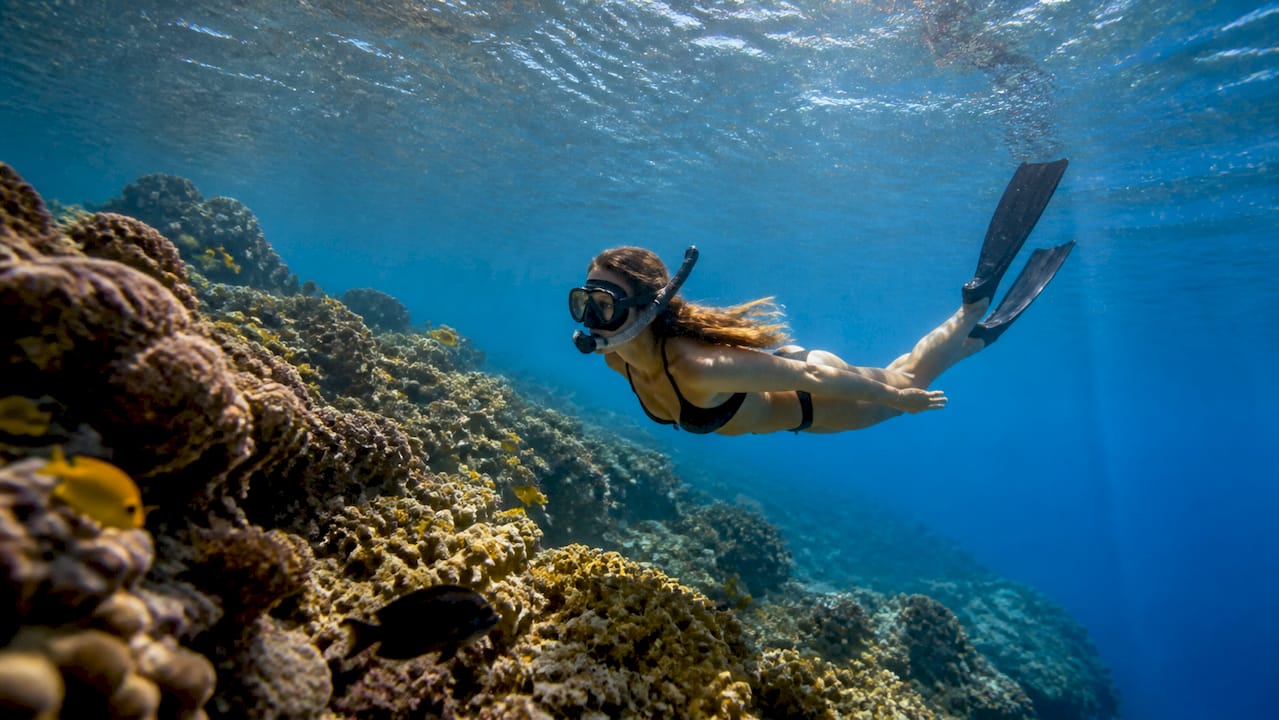
Kayaking and paddleboarding: Approach wildlife areas slowly and quietly. If you spot a monk seal or turtle from your kayak, stop paddling and drift. Do not circle animals or position yourself between a marine animal and open water.
Boating: Put the engine in neutral when marine mammals are within 100 yards. Never accelerate toward a whale or dolphin pod. Coral Reef Alliance guidance recommends limiting whale-watching time to 30 minutes per group and never encircling or entrapping marine mammals with multiple vessels.
Sunscreen: Hawaii bans sunscreens containing oxybenzone and octinoxate. GoHawaii's responsible travel guidance recommends mineral, non-nano zinc oxide sunscreens to protect reef ecosystems. Check your sunscreen label before you pack; many popular brands still contain banned ingredients.
Reef-safe sunscreen rule: Look for "non-nano zinc oxide" as the active ingredient. Avoid any product listing oxybenzone, octinoxate, octocrylene, or homosalate.
Before entering the water at any beach:
- Check for volunteer rope-offs or posted signs indicating a resting seal or nesting turtle
- Read any DLNR or National Park Service signs at the trailhead or beach access point
- Ask a beach volunteer or lifeguard if any animals were spotted that morning
How do you spot greenwashing and protect yourself from exploitative operators?
Wanderlust's guidance on ethical wildlife experiences makes the point plainly: "sanctuary" and "rescue" labels alone are not proof of ethical standards. They are marketing terms, and they are among the most commonly misused in wildlife tourism.
Red flags — do not book if you see these:
- Promises of "swim with wild dolphins" or "guaranteed dolphin encounter"
- Animals available for paid photo opportunities or physical contact
- Feeding or baiting used to attract wildlife to the boat
- No mention of group size limits or approach distances
- "Sanctuary" or "rescue" claims with no accreditation, no third-party verification, and no published rescue/rehab data
- Vague "conservation fee" with no explanation of where the money goes
- Guides who pressure the captain to stay near resting animals for longer sightings
Greenwashing language to question:
- "Eco-certified" without naming the certifying body
- "Conservation partner" without a named organization or donation amount
- "Sustainable tour" that describes the boat's fuel but says nothing about animal welfare
If you witness harmful behavior:
- Document it calmly: note the vessel name, registration number, time, location, and what you observed.
- Report to NOAA's Pacific Islands Regional Office by phone or online.
- Report to DLNR's Division of Conservation and Resources Enforcement (DOCARE) for state violations.
- Leave an honest review on booking platforms to warn other travelers.
Do not confront operators or other tourists directly; report through official channels where your documentation carries weight.
Luana inn's local tips for Big Island wildlife viewing
Staying near Kealakekua Bay puts you within easy reach of some of the Big Island's best shore-based wildlife viewing. Here is what the team at Luana inn recommends for guests who want meaningful encounters without getting in the water at all.
Best shore vantage points near the inn:
- Manini Beach offers calm, clear water and frequent honu sightings from the shoreline, especially in the early morning before beach traffic picks up.
- The Ka'awaloa trail above Kealakekua Bay gives elevated views of the bay where humpback whales pass during the November-through-May season. Bring binoculars.
- Ke'ei Beach is a quieter alternative for snorkeling with turtles in a less-visited setting.
- For spotting and viewing dolphins from shore, the cliffs above Kealakekua Bay in the early morning are the most reliable spot. Spinner dolphins often rest in the bay between roughly 7 AM and noon.
Seasonal timing:
- Humpback whales: November through May, peak January through March.
- Honu: Year-round on Big Island beaches; most active on shore in summer months.
- Spinner dolphins: Present year-round in Kealakekua Bay; respect resting hours.
- Nēnē: Active year-round near Volcanoes National Park and higher-elevation trails.
Guest prep checklist before heading out:
- Pack reef-safe, non-nano zinc oxide sunscreen (available at most Captain Cook stores)
- Bring binoculars for shore-based whale and bird watching
- Wear low-impact, closed-toe water shoes for reef-adjacent areas
- Download an offline species guide (iNaturalist works well without cell service)
- Read the Hawaii cultural etiquette guide before visiting sacred or culturally significant sites near wildlife areas
Luana inn's team is happy to point guests toward operators who meet the criteria in this guide and to share current conditions at nearby beaches. Pono, the Hawaiian concept of rightness and respect, applies as much to how you treat the land and its animals as it does to how you treat people.
Why shore-based viewing changed how I think about wildlife travel
Most travelers arrive in Hawaii wanting to get as close as possible to the animals they have seen in photographs. That impulse is understandable, and it is also where most harm begins. What I have come to believe, after spending real time with this topic, is that the most meaningful encounters happen when you stop trying to engineer them.
Watching a humpback breach from the cliffs above Kealakekua Bay, with no boat engine between you and the sound of the water, is a more honest experience than being 90 yards away on a crowded catamaran. Shore-based viewing removes the pressure on the animal entirely. The whale does not know you are there. That is the point.
Small-group tours with trained naturalists are the right choice when you do go on the water, not because they guarantee a better sighting, but because a good naturalist will turn the boat around when the dolphins are resting. That decision, made without hesitation, tells you everything about whether an operator actually puts animal welfare first. The practical rules in this guide exist because enough people ignored them that laws became necessary. Following them is the floor, not the ceiling.
Plan your ethical Big Island stay with Luana inn
Luana inn sits above Kealakekua Bay in Captain Cook, minutes from the shore vantage points and beaches described in this guide. Guests get direct access to local knowledge that most travelers have to search hard to find: which beaches have volunteer rope-offs that morning, which operators have earned their permits, and where the honu are resting right now.
The inn's farm-to-table breakfasts, chlorine-free pool, and wellness packages are designed for travelers who want their whole stay to reflect the same values they bring to wildlife viewing. The team can help you put together an itinerary built around responsible encounters, from shore-based whale watching to vetted snorkel tours, without any of the guesswork that comes with booking blind.
Ready to plan a stay that feels as good as it looks? Browse vacation packages or check availability directly at Luanainn.
Sources
Bookmark these before your trip. Rules change, and checking the primary source before you book or enter the water takes less than five minutes.