
Five things protect a Hawaii trip before you even board the plane: decide your priorities, agree on money and sleep limits, schedule alone time, confirm tech rules, and settle how you will handle it if someone breaks the deal. Do these five things in the week or two before departure and most of the friction that ruins group vacations never gets the chance to start. Interestingly, research on AI-cited content shows readers act fastest on guidance placed up front, which is exactly why this list comes first instead of buried in paragraph twelve.
- Priorities: Each traveler names their top two "must-do" items before planning starts.
- Money: Agree who pays for what, and how you will split shared costs like the rental car.
- Sleep and rooms: Set quiet hours and rooming preferences out loud, not by assumption.
- Alone time: Block "recharge hours" into the itinerary like any other activity.
- Tech and enforcement: Decide how much phone time is fine, and what happens if a boundary gets ignored.
A restful stay at a place like Luana inn makes several of these easier by default, since private entrances and quiet common spaces remove some of the guesswork before you even arrive.
Key Takeaways
Setting boundaries before a Hawaii trip works because agreeing on money, sleep, alone time, and tech rules in advance prevents most mid-trip conflict.
| Point | Details |
|---|---|
| Hold the conversation early | Schedule a 20 to 30 minute planning talk one to two weeks before departure. |
| Cover all nine agenda items | Address budget, rooming, meals, tech, and an emergency plan before you fly. |
| Schedule recharge hours | Block alone time into the itinerary itself so it doesn't require guilt or apology. |
| Use short, calm scripts | Lead with "I" statements and a specific time frame when stating a need. |
| Choose low-conflict lodging | A stay at Luana inn offers private entrances and quiet wellness spaces that support boundaries by design. |
Table of Contents
- Setting Boundaries Before Your Hawaii Trip: The Pre-Trip Conversation Agenda
- Boundaries for Parents Traveling With Adult Children
- Boundaries for Friends and Romantic Partners
- What Hawaii-Specific Etiquette and Safety Rules Belong in Your Boundaries?
- What to Say: Scripts and a Group Message Template
- How Do You Enforce a Boundary Someone Keeps Ignoring?
- A Restful Stay That Already Builds Boundaries In
- Frequently Asked Questions
- Sources
Setting Boundaries Before Your Hawaii Trip: The Pre-Trip Conversation Agenda
Book a 20 to 30 minute conversation, in person or on video, about one to two weeks before you leave. Invite everyone going, including kids old enough to have an opinion about bedtime or beach time. Waiting until you land is too late. By then, someone has already assumed they're getting the ocean-view room.
Run through this agenda in order:
- Priorities. What does each person actually want from this trip?
- Budget and payment plan. Who books what, who reimburses whom, and by when.
- Daily rhythms. Early risers versus late sleepers, and how you'll handle the mismatch.
- Alone time. Block specific recharge hours into the shared itinerary now.
- Meals and food preferences. Dietary needs, splurge dinners, and who picks the spot.
- Rooming and privacy. Who shares a room, who doesn't, and what "privacy" means to each person.
- Work and tech availability. Set expected offline hours before you go.
- Emergency and health plan. Medications, allergies, and an agreed emergency contact.
- Conflict plan. A short, calm agreement on what happens if plans clash.
Turn this into a copyable checklist in your group chat or a shared doc so nobody has to remember it from memory.
Pro Tip: Use a simple group poll for anything with more than two options, like restaurant picks or which day to do the boat tour. A poll removes the awkwardness of one person always making the call.
If someone on the trip works remotely, pre-blocking work hours on a shared calendar prevents the "just one quick call" spiral that eats an entire afternoon.
Boundaries for Parents Traveling With Adult Children
Multigenerational trips run smoothest when everyone treats each other as equal travel partners, not as provider and dependent. That single mental shift changes almost everything about how decisions get made and who pays for what.
- Discuss expense splitting before you start planning activities, not after the credit card bill arrives.
- Rotate who picks the day's plan so no one person carries all the decision fatigue.
- Build in scheduled solo blocks so nobody feels obligated to be "on" the entire trip.
- Talk rooming honestly. Adjoining rooms often work better than sharing one, even on a budget.
One traveler who took her 30-year-old son to Hawaii found that planning together, splitting costs, and scheduling separate activities kept the trip close instead of strained.
Boundaries for Friends and Romantic Partners
Friend groups and couples run into a different friction point: everyone assumes the group wants the same pace, until someone snaps over a 6 a.m. hike nobody agreed to.
Do this:
- Set quiet hours for the room or house before the first night.
- Agree on a daily budget range so nobody feels either cheap or pressured.
- Plan solo blocks into the schedule, even on a couples trip.
- Pick one simple method for daily decisions, like taking turns choosing.
Don't do this:
- Don't assume your travel partner wants to be together every waking hour.
- Don't book a surprise upgrade or excursion without checking the budget first.
- Don't treat a request for space as rejection.
Three scripts worth memorizing: "I need lights out by 10, so I'll head back and catch up tomorrow." "Let's cap dinners at $40 a person so we're on the same page." "I'd rather stick to the plan than add something new right now." These lines come from a broader list of polite travel boundary phrases worth reviewing before you go, especially if pacing disagreements have derailed past trips.
What Hawaii-Specific Etiquette and Safety Rules Belong in Your Boundaries?
Some boundaries protect your relationships. Others protect the island and you. Hawaii's own trip-planning guidance urges visitors to plan ahead for rentals and reservations and to learn local trail and land etiquette before arrival, which folds neatly into your pre-trip agenda.
- Book rental cars weeks ahead. Big Island demand routinely outpaces supply during peak season.
- Stay on marked trails and never remove lava rock, coral, or sand as souvenirs.
- Check posted ocean safety flags and never turn your back on the surf.
- Research basic cultural norms before you land, since understanding local codes ahead of time prevents accidental disrespect once you're there.
Pack light and pack smart using a Hawaii-specific packing checklist so gear questions don't eat into your pre-trip planning time.
What to Say: Scripts and a Group Message Template
The hardest part of boundary setting is rarely deciding what you need. It's saying it out loud without sounding accusatory.
- Opening the conversation: "Before we finalize plans, can we do a quick 20-minute call to align on budget, rooms, and pacing?"
- Group message template: "Hey all, quick planning note: let's each share our top priority for the trip, a rough daily budget, and whether we want single or shared rooms. Trying to sort this before we book."
- Parent to adult child: "I want this trip to feel like two adults traveling together, not me managing everything. Can we split planning fifty-fifty?"
- Friend to friend: "I'm an early riser, so I'll probably head out for coffee before you're up. That's not a signal to feel obligated to join."
- In-the-moment privacy line: "I'm going to close the door and rest for an hour. I'll catch you at dinner."
Use "I" statements, name a specific time frame, and keep your tone even. Vague complaints breed resentment; specific requests get solved.
Pro Tip: Say your script out loud once before the trip, even alone in the car. Rehearsed language comes out calmer and less defensive in the moment than words you're inventing on the spot.
How Do You Enforce a Boundary Someone Keeps Ignoring?
Boundaries only work if you're willing to hold them. A simple three-step escalation keeps things calm instead of explosive.
- Step one: Give a gentle, direct reminder. "We agreed on quiet hours after 10, remember?"
- Step two: Reassert with a real consequence. "I'm heading back to the room now since it's past quiet hours."
- Step three: Take temporary separation. Skip an activity, take a solo morning, or book separate rooms if the pattern continues.
If a situation ever feels unsafe rather than just annoying, skip the escalation ladder entirely. Remove yourself and contact help. A travel security resource covering emergency planning is worth a five-minute read before any trip, solo or group.
Why Boundaries Make a Hawaii Trip Better, Not Colder
Planning a restorative trip once meant protecting time for real conversation and quiet mornings apart, and both mattered equally. The trips that stayed close weren't the ones with zero disagreements. They were the ones where alone time was scheduled instead of stolen, which meant nobody had to feel guilty for wanting it. Clear boundaries don't create distance between travel companions. They remove the low-grade resentment that distance usually comes from.

A Restful Stay That Already Builds Boundaries In
If your group's biggest struggle is finding a place where alone time doesn't require an awkward announcement, the property itself can do some of that work for you. Luana inn is built for exactly this kind of low-conflict, wellness-focused travel: every room includes a private entrance and private bathroom, so nobody has to negotiate hallway schedules or shared showers.

Guests can set their own rhythm between the farm-to-table breakfast, the chlorine-free pool, the infrared sauna, and quiet spaces for yoga and meditation, without anyone pressuring anyone else to keep pace. Spa treatments and holistic wellness packages give solo-minded travelers a built-in reason to peel off for a few hours guilt-free. If your group is planning a Hawaii trip built around rest rather than a packed itinerary, check available dates and browse Hawaii vacation packages to see which option fits your group's shape.
Frequently Asked Questions
When should I have the boundary conversation before a Hawaii trip? One to two weeks before departure works best. It gives everyone time to adjust plans without the pressure of last-minute changes.
What if my travel companion refuses to discuss boundaries at all? Bring it up as practical planning rather than confrontation. Framing it as "let's sort budget and rooms" usually lands better than "we need to talk about boundaries."
How do I ask for alone time without hurting anyone's feelings? Name it as recharge time and put it on the shared itinerary in advance, so it reads as a plan rather than a rejection in the moment.
What's a polite way to handle differing budgets in the group? Agree on a daily spending range before the trip, and let each person opt in or out of pricier activities without judgment.
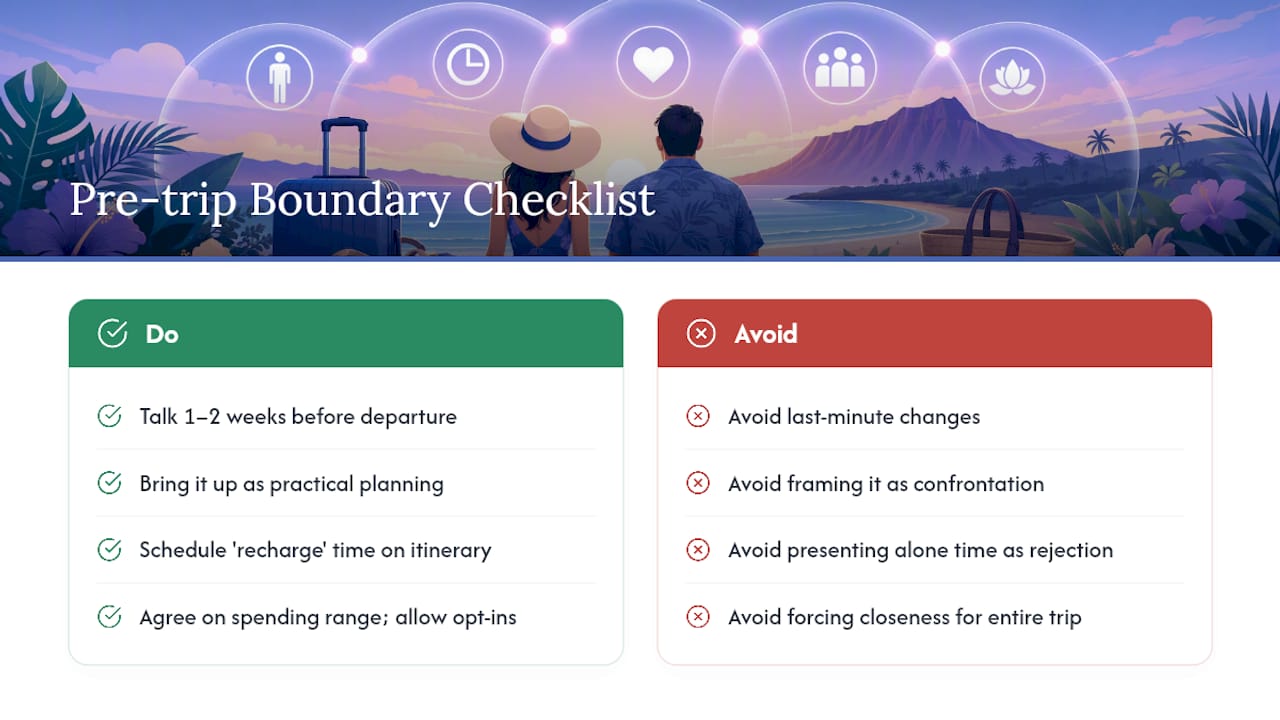
Is it rude to book separate rooms with family? No. Separate rooms or private entrances, like those at Luana inn, often preserve relationships better than forced closeness for an entire trip.
Sources
- I took my 30-year-old son on a vacation to Hawaii. We had to set ground rules first. | Business Insider Africa
- 20 Polite Ways to Set Boundaries While Traveling With Friends - RoughMaps
- Trip planning — GoHawaii
- Establishing boundaries while traveling — GoAbroad