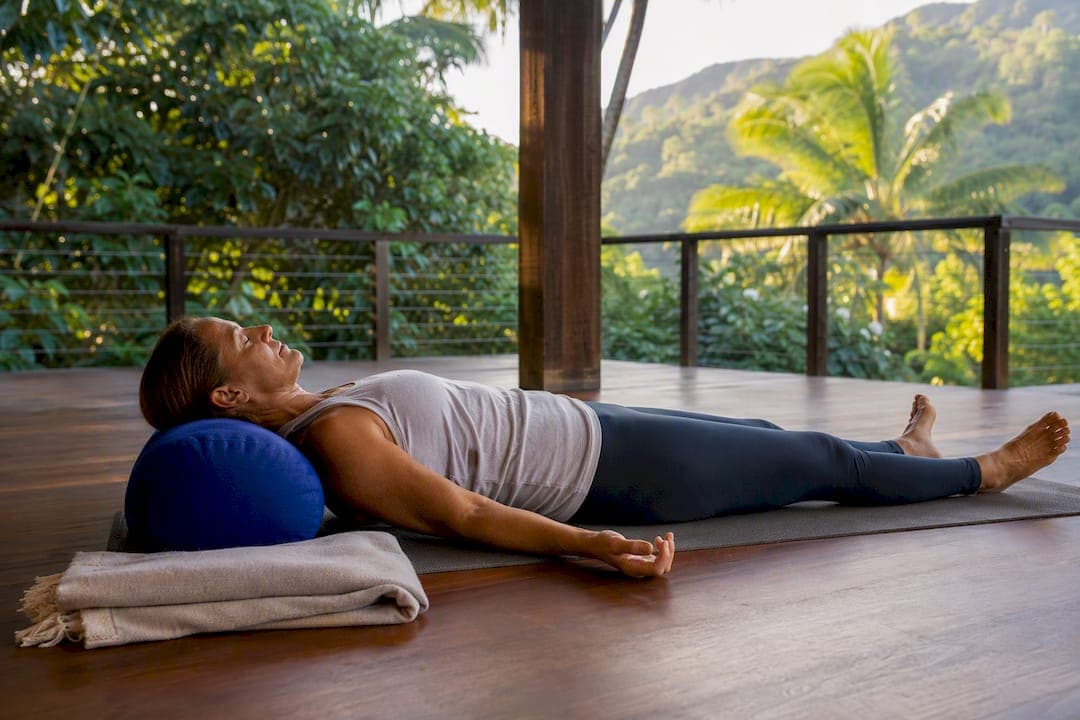
Yoga Nidra helps most people who try it, easing stress, calming anxiety, and improving sleep within weeks of regular practice. A 2025 systematic review and meta-analysis of 73 studies found moderate-to-large effects on all three, though the researchers flagged uneven study quality. Start with short daily sessions, pay attention to how your body responds, and treat it as one piece of a bigger rest routine, not a cure-all.
TL;DR:
- Practice Yoga Nidra regularly for at least two to four weeks to observe measurable improvements in sleep, stress, and mood, with even short daily sessions showing benefits.
- While effective in reducing anxiety and stress, the quality of studies varies, and large effects may be inflated due to methodological differences.
- Most people tolerate Yoga Nidra well, but those with active mental health concerns or pregnancy should practice under supervision or modify positions.
- Objective sleep studies indicate a 3.62% increase in sleep efficiency and roughly 20 minutes less wakefulness after sleep onset with consistent practice.
- Guided sessions and retreat environments can enhance adherence, especially for those who find it difficult to unwind at home or need additional support.
Table of Contents
- What Is Yoga Nidra, and How Is It Different From Meditation or Sleep?
- The Real Benefits of Yoga Nidra, Broken Down by Domain
- Why Yoga Nidra Works: The Nervous System and Brain Science Behind It
- What the Best Studies Actually Show, and Where They Fall Short
- How to Practice Yoga Nidra Tonight: A Simple Step-by-Step Routine
- Who Should Be Careful, and When to Talk to a Clinician
- Where Guided Practice and a Retreat Setting Add Something Extra
- An Editorial Take: Try It Before You Judge It
- Bring Your Practice to a Setting Built for It
- Sources
- FAQ
What Is Yoga Nidra, and How Is It Different From Meditation or Sleep?
Yoga Nidra is a guided practice done lying down, sometimes called "conscious sleep" because you stay aware while your body rests deeply. The Cleveland Clinic describes its defining features as a fully supported supine posture and a structured rotation of consciousness through the body, both of which set it apart from seated meditation.
Ordinary sleep switches off awareness. Seated meditation asks you to stay upright and alert. Yoga Nidra sits between the two: you follow a teacher's voice through body awareness, breath cues, a personal intention called a sankalpa, and visualization, usually across 20 to 40 minutes, though shorter versions work too.
The Real Benefits of Yoga Nidra, Broken Down by Domain
The benefits split into a few clear categories, and the evidence behind each one varies in strength.
Stress and mood. The 2025 meta-analysis found a large effect on stress and depression symptoms compared to active control groups, meaning people who practiced consistently reported feeling noticeably calmer than those doing other relaxation activities.
Anxiety relief. The same review reported a strong result for anxiety, a large effect that lines up with what yoga therapists describe clinically: guided rotation of attention interrupts the looping thoughts that keep anxiety active.
Sleep quality. A 2023 PLOS One trial found four weeks of practice improved sleep efficiency by 3.62% and cut wake-after-sleep-onset by roughly 20 minutes, both measured with objective sleep tracking, not just self-report.
Cognitive gains. That same trial found medium-to-large improvements in some memory and learning tasks among novice practitioners, a finding researchers link to the deep-rest state the practice produces.
Physiological markers. Clinical reviews report drops in blood pressure and cortisol, along with gains in heart-rate variability, in smaller trials. These are consistent signals across several studies, even if sample sizes remain modest.
- Lower perceived stress and reactivity to daily hassles
- Reduced anxiety symptoms and better emotion regulation
- Better sleep efficiency and less time spent awake at night
- Improved accuracy on certain memory and learning tasks
- Lower blood pressure, cortisol, and improved heart-rate variability
Why Yoga Nidra Works: The Nervous System and Brain Science Behind It
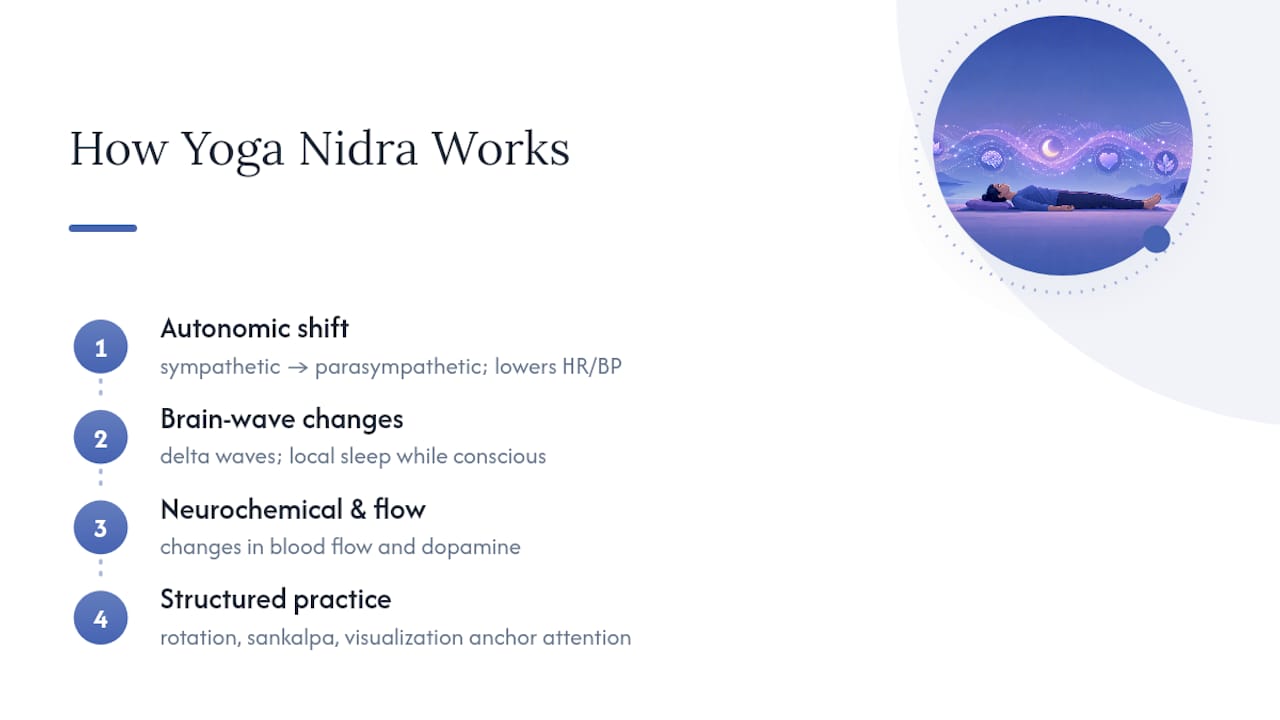
The mechanism starts with your autonomic nervous system. Lying still with guided attention shifts you out of sympathetic "fight or flight" mode and into parasympathetic rest, the same shift that lowers heart rate and blood pressure during deep relaxation.
Brain-wave research adds another layer. EEG studies during Yoga Nidra show delta-wave and "local sleep" patterns, brain activity that resembles deep sleep even while you remain conscious, which may explain the sleep and memory improvements seen in the PLOS One study.
Some clinical reviews also point to changes in cerebral blood flow and dopamine activity tied to relaxed, non-judgmental attention, a pathway that may support the emotional regulation benefits reported above. The structured elements matter here. Rotation of consciousness gives your mind something specific to track, the sankalpa anchors intention, and visualization keeps you engaged just enough to avoid drifting into unconscious sleep.
What the Best Studies Actually Show, and Where They Fall Short
The strongest evidence comes from the 2025 meta-analysis covering 73 studies and 5,201 participants, which reported large effects for anxiety and stress and a moderate effect for depression. The researchers were candid about a catch: low methodological quality and heterogeneity across studies likely inflate those numbers, so treat the effect sizes as an upper bound rather than a guarantee.
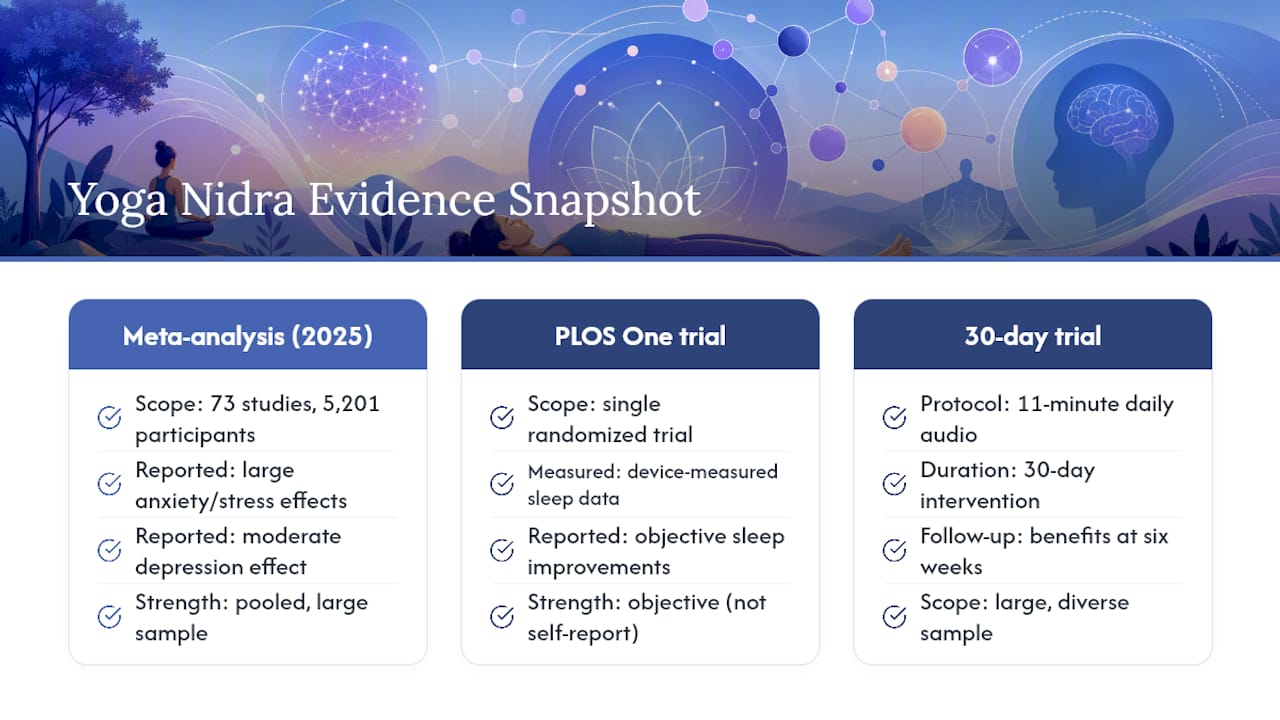
The PLOS One trial offers something the meta-analysis can't: objective, device-measured sleep data instead of self-report alone. That is a meaningfully stronger form of evidence, even from a single study.
A 30-day trial using an 11-minute daily audio session in a large, diverse sample found benefits held up at six-week follow-up, good news for anyone assuming they need an hour-long session to see results. A broader narrative review still calls for larger, more consistent trials before treating any of these numbers as settled science.
How to Practice Yoga Nidra Tonight: A Simple Step-by-Step Routine
You don't need an hour or a teacher in the room. A short 5 to 12 minute bedtime version works well for building the habit, while a traditional 20 to 40 minute session suits weekend practice or when you have more time to unwind.
- Dim the lights and set up your space, pillow under the knees, blanket nearby, phone silenced.
- Lie flat on your back in a fully supported position, arms loose at your sides.
- Set a short sankalpa, a one-sentence personal intention you'll return to later.
- Follow a guided rotation of awareness through each part of the body.
- Notice your natural breath without trying to change it.
- Let a brief visualization or image arise, then let it go.
- Return slowly, wiggle your fingers and toes, and open your eyes.
Try this three to seven times a week for two to four weeks before judging results, and keep a quick note of your sleep and stress levels so you can actually see the trend instead of guessing at it.
Pro Tip: If you finish a session still wide awake, resist the urge to restart a long recording. A short repetitive cue, or a few quiet minutes with your eyes closed, keeps you from re-triggering alertness right when you wanted to wind down.
Who Should Be Careful, and When to Talk to a Clinician
Most people tolerate Yoga Nidra well, but mild reactions happen. If a long session feels too intense, shorten it or repeat a familiar, simple cue instead of pushing through discomfort.
If you're managing active PTSD or a severe mental health condition, practice with a clinician's guidance rather than solo, since deep relaxation can occasionally surface strong emotions that are easier to process with support nearby. During pregnancy, swap the flat supine position for a semi-reclined or side-lying position to stay comfortable. And if insomnia persists past a few weeks of consistent practice, or your symptoms get worse rather than better, that's a signal to talk to a doctor rather than keep waiting for the practice to work.
Where Guided Practice and a Retreat Setting Add Something Extra
Guided sessions and a dedicated retreat environment often help practice stick, especially for people who struggle to unwind at home. Luana Inn's wellness-focused setting near Kealakekua Bay gives guests the quiet, distraction-free space that structured relaxation practices tend to need most.
An Editorial Take: Try It Before You Judge It
The research is genuinely encouraging, but it's not a promise. Try short sessions for two to four weeks and watch for realistic shifts, less nighttime tossing, a calmer baseline, small mood gains, rather than overnight transformation.
Pair it with decent sleep hygiene, because Yoga Nidra works better as an addition than a replacement. The evidence is real. The hype around it, less so.
— Nicole
Bring Your Practice to a Setting Built for It
Trying Yoga Nidra at home is a fine place to start, but a quiet room and a phone app can only take you so far when daily noise keeps creeping back in. An eco-friendly property in Captain Cook, Hawaii, with a chlorine-free pool, infrared sauna, and amenities built specifically for yoga and meditation, offers a setting that removes the friction between wanting to relax and actually doing it.

If you want bodywork alongside your practice, the on-site spa offers services like Massage and Craniosacral Therapy that pair naturally with a restorative stay. Guests planning a longer reset can look at the wellness packages, which include options like the 10-Day Wellness Detox for anyone wanting a deeper, guided break. Check availability and browse current offerings directly on the Luana Inn site to plan your stay.
Sources
The claims in this article draw on peer-reviewed and clinical sources, not casual wellness blogs. Start with the 2025 systematic review and meta-analysis for effect-size data, the PLOS One sleep and cognition trial for objective measures, and the Cleveland Clinic overview for a clinician's framing of the practice itself. Read effect sizes as estimates, not guarantees, given the quality caveats researchers themselves raised.
This article is general information, not a substitute for advice from a qualified doctor. Consult a qualified healthcare professional about your own circumstances before acting on anything here.
- Effects of Yoga Nidra on Stress, Anxiety, and Depression: A Systematic Review and Meta‐Analysis
- Improved sleep, cognitive processing and enhanced learning and memory task accuracy with Yoga nidra practice in novices | PLOS One
- Effectiveness of a short Yoga Nidra meditation on stress, sleep and well-being in a large and diverse sample
FAQ
Does Yoga Nidra Actually Reduce Stress?
Yes. A 2025 meta-analysis of 73 studies found a large stress-reduction effect (Hedge's g = -0.80) compared to active control activities, though the authors noted study quality varied widely.
How Is Yoga Nidra Different From Regular Meditation?
Yoga Nidra is done lying down with guided rotation of attention through the body, while seated meditation usually involves sitting upright with self-directed focus. The supported supine posture is central to how Yoga Nidra produces its relaxation response.
Can Yoga Nidra Help With Insomnia?
Research suggests it can. A four-week trial found increased sleep efficiency and reduced nighttime wakefulness, measured with objective sleep tracking rather than self-report alone.
How Long Should a Yoga Nidra Session Last?
Sessions range from 5 to 40 minutes, with shorter bedtime versions working well for daily habit-building and longer sessions suited to weekend practice. Even an 11-minute daily practice showed measurable benefits sustained at six weeks.
Is Yoga Nidra Safe for Everyone?
Most people tolerate it well, but those with active PTSD or severe mental health conditions should practice under clinician guidance, and pregnant practitioners should use a semi-reclined or side-lying position instead of flat supine. Persistent insomnia or worsening symptoms after several weeks of practice warrants a conversation with a doctor.
Does Luana Inn Offer Guided Yoga Nidra Sessions?
Luana inn provides a wellness-focused property with amenities for yoga and meditation, along with spa services and multi-day wellness packages that support restorative practice. Current offerings and pricing are listed directly on the Luana inn site.